Custom Mailer Box Inside Printing: Is It Worth the Extra Cost for E-Commerce Brands?
TL;DR
A plain cardboard interior does nothing for your brand. Printed interiors turn the moment a customer opens their box into something worth sharing. It costs a bit more per unit, and it’s not for everyone. If you ship in bulk, sell B2B, or run on razor thin margins, save the money and spend it somewhere else.
Table of Contents
- What Is Inside Printing on a Custom Mailer Box?
- Custom Mailer Boxes: The Bigger Picture
- The Real Problem: A Box That Opens and Says Nothing
- What Interior Printing Actually Costs
- Exterior Only vs Interior Print: A Quick Comparison
- Does Interior Printing Really Increase Unboxing Shares?
- When Custom Mailer Box Inside Print Is Worth It, and When It Is Not
- Inside Print vs Other Unboxing Upgrades
- How to Order a Mailer Box With Interior Print
- FAQs
- Get Your Free Quote
Custom mailer box inside print means putting your logo, colors, or a message on the inside walls of your box instead of just the outside. Most e-commerce brands that lean on unboxing content should do it. It costs more, usually fifteen to twenty five percent more per unit, but it’s the difference customers actually notice and film.
What Is Inside Printing on a Custom Mailer Box?
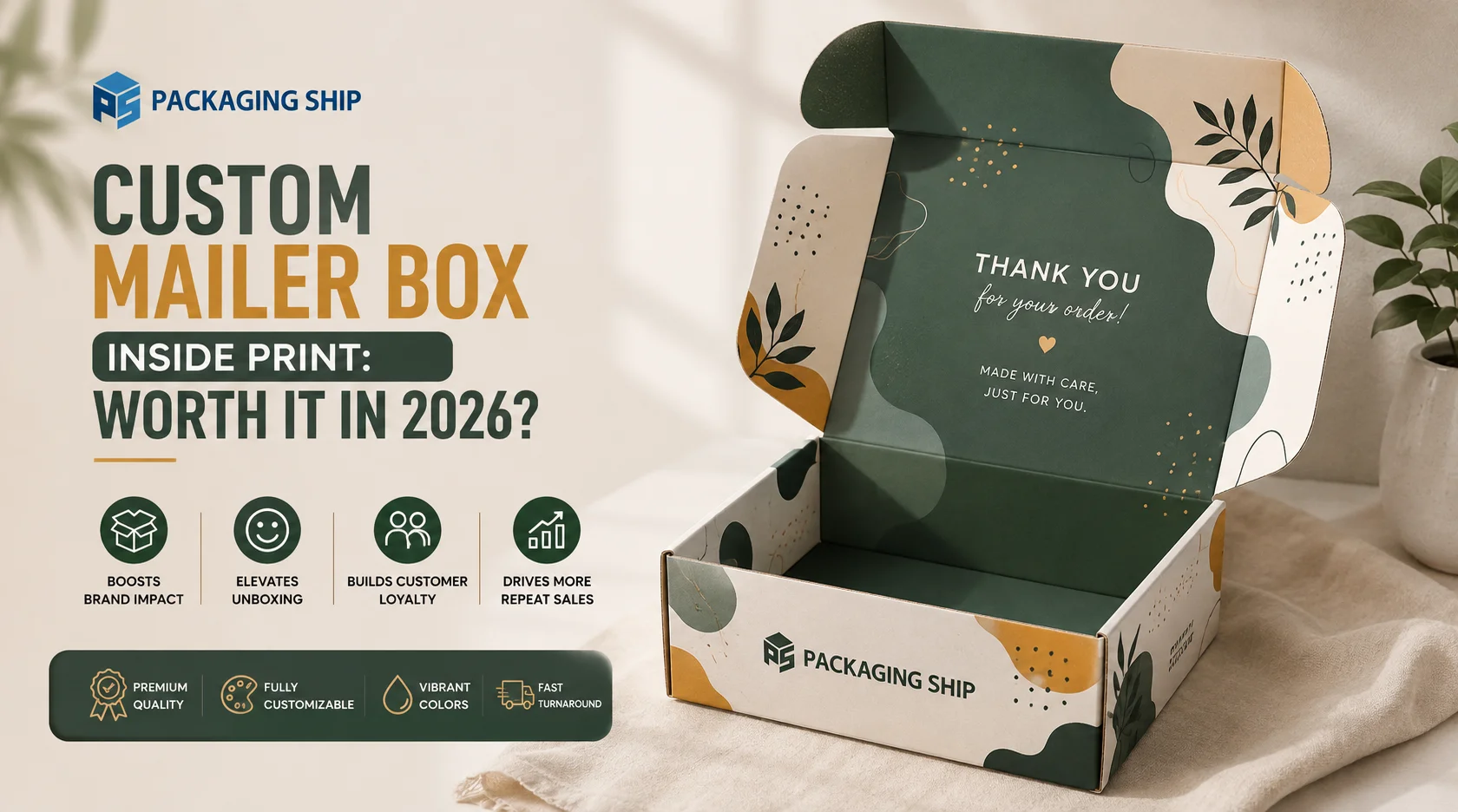
Inside printing is pretty much what it sounds like, but it’s easy to underestimate what it actually changes. Instead of leaving the inner walls of your mailer box plain brown or white, you print them. That could be a repeated logo pattern, a solid color that pops when the lid lifts, a short thank you note, or a QR code pointing to a review page. Some brands even keep the outside totally plain and let the inside do all the talking.
I’ve watched this shift happen firsthand on our production floor over the last couple of years. It used to be that brands poured their whole design budget into the outer panel and forgot the inside existed. That’s changing. More of our clients now ask us to hold back on the exterior a bit and put real effort into what happens the second the box opens. At Packaging Ship, we build both versions every single week, and honestly, the interior-focused ones tend to get more excited reactions from clients when they see the proof.
Custom Mailer Boxes: The Bigger Picture
Before we go deeper into interior print, it’s worth stepping back for a second. What are custom mailer boxes even for? They’re lightweight, sturdy shipping boxes made from cardboard or corrugated stock, cut and sized around a specific product instead of some generic one size fits all carton. DTC brands lean on them constantly, subscription kits, cosmetics, apparel, you name it, because a mailer box does two jobs at once. It protects what’s inside, and it markets your brand the entire time it’s sitting on someone’s porch. A box sized right also means less wasted space and fewer damaged items in transit, which matters more than people give it credit for.
The Real Problem: A Box That Opens and Says Nothing
Picture this. A customer’s package shows up. They’re excited, maybe they’re already filming for a TikTok or getting ready to snap a photo. They pop the flap open and… plain gray cardboard. That’s it. Whatever polished, put together brand image they had in their head from your Instagram feed just evaporated in about half a second.
This isn’t only about losing a cute photo. It kills the emotional buildup that got the customer to that point in the first place. They were excited to open something, and the box handed them nothing back right when it mattered most.
There’s another problem hiding underneath that one, and it’s quieter but just as costly. A lot of founders treat interior print like it’s a luxury they can’t justify, so they skip it without ever actually looking at what it would cost. That’s a budget call made on a gut feeling, not on real numbers. And even brands that do add interior print often can’t point to what it’s actually doing for them, so the whole decision starts to feel like guesswork instead of strategy.
What Interior Printing Actually Costs
Across the packaging industry, interior printing usually adds somewhere between fifteen and twenty five percent to the per unit cost compared to exterior only. In dollar terms that’s often fifteen to forty cents extra per box, give or take, depending on your print method, box size, and how complex the design is.
At Packaging Ship, we run interior print jobs on both digital and offset presses. Digital works best for smaller batches, roughly fifty to five hundred units, and it’s a solid choice if you’re testing a design before going bigger. Offset kicks in above five hundred units, since the plate setup starts paying for itself through tighter color matching and a lower cost per piece at volume. Both methods handle interior print fine, full color CMYK, up to eight colors, 300 DPI resolution. And since there’s no minimum order on mailer boxes, you don’t need to bet big on a first run just to see how interior print looks and feels.
Exterior Only vs Interior Print: A Quick Comparison
| Factor | Exterior Only Print | Interior Print (Inside or Inside and Outside) |
| Typical cost impact | Baseline price | Adds roughly 15 to 25 percent per unit, or about $0.15 to $0.40 per box |
| Best use case | Bulk shipping, B2B orders, warehouse restocks | Subscription boxes, gifting brands, social first DTC brands |
| Unboxing impact | Low, customer sees plain interior on opening | High, interior becomes the reveal moment |
| Print method available | Digital or offset | Digital or offset, both support interior print |
| Turnaround impact | Standard 7 to 10 business days | Same 7 to 10 business days in most cases, extra pass adds minimal time |
| Porch security | Branding visible from outside | Can stay plain outside while printing inside, lowering theft risk |
Does Interior Printing Really Increase Unboxing Shares?
The numbers on mailer box demand tell part of this story on their own. A 2026 report from Fortune Business Insights put the U.S. mailer packaging market at 7.81 billion dollars in 2026, and pointed straight to online retail and direct to consumer growth as the reason why. That same report also called out customizable printing as one of the reasons brands pick mailers over plain shipping cartons to begin with. So it’s not just that more mailer boxes are being ordered. Brands are choosing them specifically because the box itself can be a marketing surface.
But a printable surface only matters if people actually look at it and share it. Back in 2015, Dotcom Distribution surveyed 524 online shoppers, and Packaging Digest covered the results. Thirty nine percent said they’d shared a photo or video of a new product after unboxing it. That number jumped to sixty percent once the packaging looked gift-like instead of like a plain brown box. And thirty five percent of shoppers said they’d watched an unboxing video before buying something, with fifty five percent of that group saying the video is what actually got them to purchase.
Line those two things up and the picture gets pretty clear. Mailer boxes are booming because they give brands somewhere to print. And once that surface exists, customers are far more likely to film it, screenshot it, or post it if it looks like someone actually designed it on purpose. That’s exactly where interior print earns its keep. It’s the exact moment a customer decides if a brand feels premium or feels like an afterthought. Blank cardboard reads as the second option. A printed interior reads as the first, and that’s the part that ends up on someone’s feed.
When Custom Mailer Box Inside Print Is Worth It, and When It Is Not
If you’re running a subscription box, a gifting brand, a beauty or skincare line, or basically any social first DTC business where customers post their orders, this is worth doing. Word of mouth and TikTok reveals are doing real marketing work for you, and the interior of the box is part of that pitch whether you’ve planned for it or not.
It’s a different story for high volume, low margin shipments where nobody’s treating the box as a brand moment, or for B2B orders headed straight into a warehouse, or bulk restocks where no individual customer ever opens a single unit. A plain shipping box does the job just fine there, and that saved budget is probably better spent on faster shipping or the product itself.
There’s also a smart in between option a lot of brands overlook. You can print only the inside and leave the outside completely plain. On the porch or in transit, the box looks like nothing special, which can actually help against theft. Then the customer opens it at home and gets the full color surprise anyway.
Inside Print vs Other Unboxing Upgrades
Interior mailer box design isn’t the only lever for improving an unboxing moment, but dollar for dollar it’s usually the strongest one. Tissue paper is a cheap way to add a gift-like feel. Stickers are cheap and easy to bolt on later. Insert cards work well for a thank you note or a discount code. None of that, though, matches the impact of a fully printed interior filling the whole frame the second the box opens. And unlike a loose insert, a printed interior can’t fall out, get left behind in the packaging, or get missed on camera.
If you’re building out a full custom mailer boxes strategy from the ground up, interior print is usually the one upgrade that pays back the most per dollar spent, mostly because it’s built into the structure itself instead of being one more thing that could get lost.
How to Order a Mailer Box With Interior Print
You don’t need a finished design or a graphic designer sitting on staff to get this started. At Packaging Ship, orders start at fifty units, no minimum required, so you can try interior print out before committing to anything bigger. Send us your logo, your brand colors, and whatever direction you’re going for, and our design team turns around a full proof in twenty four to forty eight hours. Standard production is seven to ten business days once you approve that proof, and rush options exist if you’re racing a launch date. If you want to read more about that guide so click here
If part of your packaging lineup uses flexible pouches instead of rigid boxes for certain products, mylar bags handle that separately, since interior printing is specific to box structures and doesn’t apply to sealed bags.
Frequently Asked Questions
| Question | Direct Answer |
| How much does interior mailer box printing cost per unit? | Usually fifteen to twenty five percent more than exterior only printing, or roughly fifteen to forty cents per unit depending on box size and how complex the design is. |
| Is custom mailer box inside print available with no minimum order? | Yes. Packaging Ship starts orders at fifty units, so you can test an interior print design before scaling up. |
| Mailer box vs shipping box, which one supports interior print? | Mailer boxes are the better fit since they double as the unboxing moment. A closer look at mailer boxes vs. shipping boxes shows shipping boxes make more sense for bulk transit where nobody’s opening individual units. |
| Does interior printing slow down production? | A little, the extra pass adds some time, but standard turnaround still lands around seven to ten business days. |
| Is interior printing worth it for every e-commerce brand? | Not really. It pays off for brands whose customers open and share their orders. For bulk or B2B shipments where nobody sees the interior, it’s not doing much. |
Get Your Free Quote and See Real Pricing on Interior Print Mailer Boxes
If unboxing moments matter to your brand, this is one of the easier upgrades to actually test instead of debate. Skip the guesswork and get a free quote to see exactly what interior printing adds for your specific size and quantity.
Request Your Free Mailer Box Quote →
Conclusion
Custom mailer boxes inside print won’t make sense for every brand out there, and that’s fine. But if you’re an e-commerce business that lives and dies by the unboxing moment, it tends to earn back its extra cost through better recall, more shares, and stronger repeat purchases. The mailer packaging market is growing because brands have started treating the box as a marketing space instead of just a shipping container, and the interior is simply the next part of that space getting real attention. Try it on a small first order, see how people react, and go from there.