
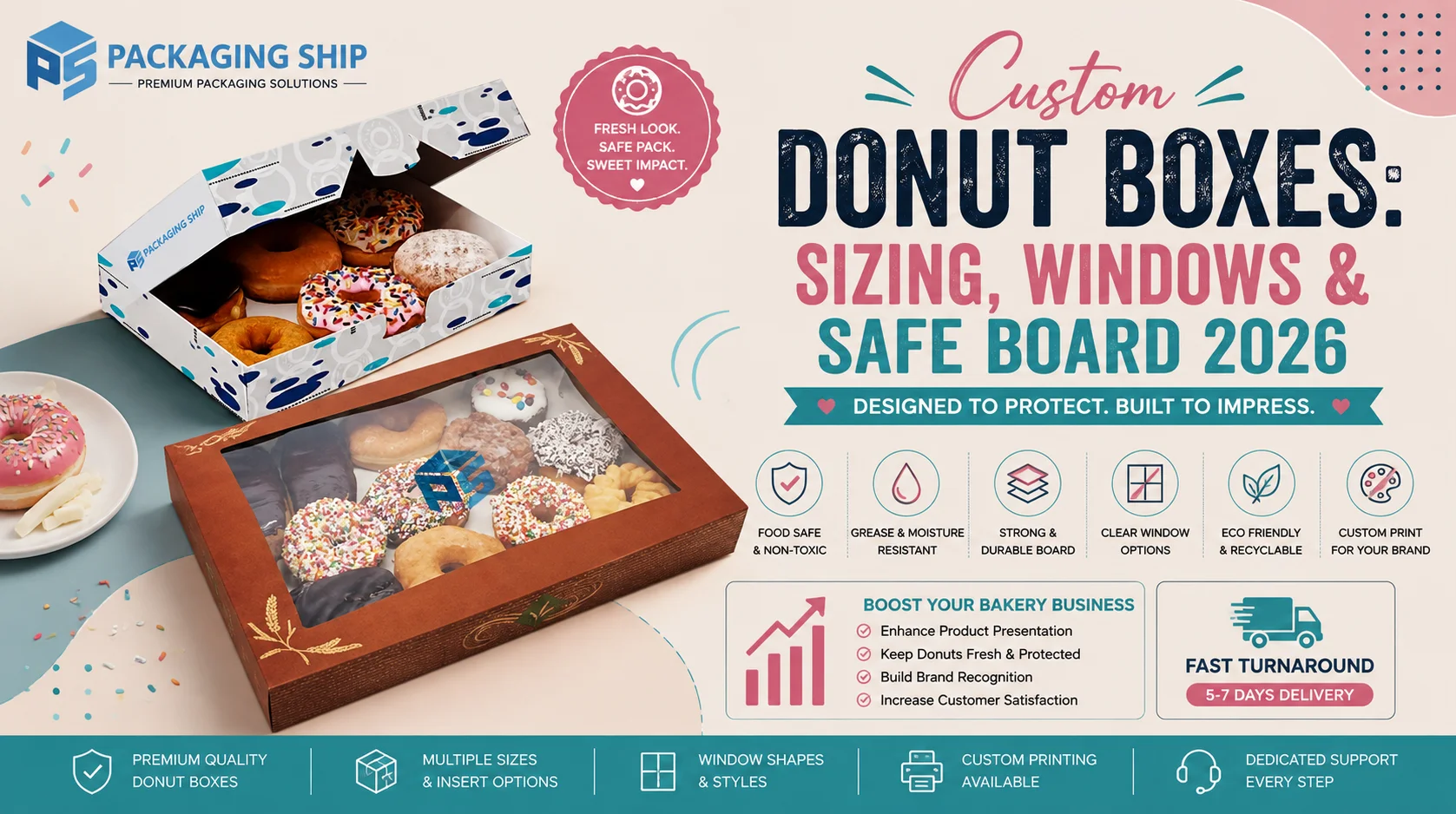
Custom donut boxes only work well when three things line up: the box size matches your donut count, the window style fits how you sell, and the board is food safe and grease resistant. A dozen boxes that run too shallow crushes filled donuts. A window placed too low fogs up from glaze steam. A generic kraft box with no coating lets grease bleed through in under an hour. This guide walks through donut box sizing, glazed donut packaging needs, dozen donut box dimensions, and what food safe actually means on paper, so you can order the right box the first time.
Sizing custom donut boxes correctly starts with knowing how many donuts you actually need to fit. Most donut shops need three box sizes. A six count box runs about 9 by 6 inches. A dozen boxes runs about 14 by 9 inches. A larger 18 count or two dozen box adds width and length but keeps a similar depth. The depth matters most. Glazed rings need less headroom than filled donuts, and getting depth wrong is the most common sizing mistake shop owners make.
Picture this. A customer walks past your shop and past the shop two doors down. Both sell a solid glazed donut. One hands the box over in plain white cardboard with a grease stain already forming on the bottom corner. The other hands over a kraft box with a clean logo, a window showing the donuts inside, and a lid that closes flat without bowing. The customer does not consciously rate the box. But their brain files it away. Next week, when they are deciding where to stop, that memory nudges the decision.
This is not a theory. A study by the Paper and Packaging Board, conducted with Ipsos, found that most consumers say a product’s packaging design shapes how they feel about the purchase, and that the materials used in that packaging carry real weight in the buying decision too. For a donut shop competing on the same street as three other bakeries, packaging is one of the few variables you fully control:
Generic packaging is not the only thing hurting repeat business. Four problems show up again and again when shop owners talk about their boxes:
Custom donut boxes solve all four of these at once, if you order them with the right specs.
Donut box sizing is not guesswork. It follows the size of the donut itself. A standard raised glazed donut finishes at roughly 3.5 inches across. Add a small gap between donuts so the glaze does not stick two pieces together, plus a little wall clearance on each side, and you land on the industry standard footprint.
Here is a simple breakdown shop owners can use as a starting point before requesting a custom quote.
| Box Type | Typical Count | Approx. External Size | Best For |
| Single serve | 1 donut | 5 x 5 x 2.5 in | Grab and go, coffee shop counters |
| Half dozen | 6 donuts | 9 x 6 x 3 in | Small orders, catering add ons |
| Dozen donut box | 12 donuts | 14 x 9 x 3.5 in | Standard retail and delivery |
| Party size | 18 to 24 donuts | 18 x 13 x 3.5 in | Office catering, events |
Depth deserves its own line item, because it is the number most shops get wrong. A cake donut sits low and needs less than 2.5 inches of clearance. A filled bismarck or a cronut can stand over 2 inches tall on its own, and if the lid sits too close, it presses the filling flat against the box and smears the seam. If your shop sells a mix of glazed rings, filled donuts, and specialty flavors, order your dozen donut boxes with enough headroom for your tallest product, not your average one.
A window turns a box into a display case. Customers see the glaze, the sprinkles, or the chocolate drizzle before they even ask what flavors are available. This matters most at a retail counter or in a bakery case, where the visual sells the impulse buy.
A window is not free of tradeoffs:
For catering and office orders, some shops skip the window entirely and instead print an interior layout on the inside of the lid. This solves a different problem: delivery customers who think an item is missing simply because they do not recognize a flavor without seeing it labeled.
Food safe does not just mean the box looks clean. It means the material and any coating applied to it are cleared for direct contact with food under FDA rules. This matters more for donut boxes than most bakery packaging, because donuts combine two things that stress a box at once: oil from frying and moisture from glaze.
Two materials dominate the donut packaging market:
Either material needs a grease resistant barrier if it is going to hold up against a warm glazed donut for more than a few minutes, and the industry has actually shifted recently on this point. The FDA determined that a group of grease proofing coatings built with PFAS chemicals were phased out of the US food packaging supply, with manufacturers agreeing to stop selling them and a final compliance deadline landing in mid 2025.
That means any donut box supplier still offering an old style PFAS grease barrier is behind current regulation. When you request a quote, ask directly whether the grease resistant coating is PFAS free. It is a fair question, and a supplier that cannot answer it clearly is worth a second look before you commit to a large order.
Glazed donut packaging has to manage two enemies at once, and most generic boxes only solve for one:
Order a box with both, and a glazed donut holds its texture and appearance for hours instead of minutes. This is the kind of detail a generic, off the shelf box almost never accounts for, because it is built to a lowest common denominator spec rather than to donuts specifically.
This is usually the deciding factor for a small or mid sized donut shop. Large packaging manufacturers often set minimum orders at 1,000 to 5,000 units, which forces a shop to commit to a design and a size before they know if it actually performs well in daily use. That is a real financial risk for a business running on thin bakery margins.
Custom donut boxes wholesale pricing at Packaging Ship is built around a few core promises:
If donuts are not the only thing coming out of your kitchen, it is worth pricing out matching packaging for your other products at the same time:
| Question | Direct Answer |
| What size box do I need for a dozen donuts? | A standard dozen donut box runs about 14 by 9 inches with a depth of 3 to 3.5 inches, sized for a 4 by 3 grid of standard glazed rings. |
| Do donut boxes need a window? | Windows help at retail counters where visual display drives impulse sales, but they matter less for delivery only orders where the box is opened once. |
| Are custom donut boxes food safe? | Yes, when the board and any coating are cleared under FDA food contact rules, which includes using PFAS free grease resistant barriers. |
| How much do custom donut boxes cost? | Pricing starts around 50 cents per unit and depends on size, board weight, coating, and quantity, with no die or plate charges added. |
| Can I order without a minimum order quantity? | Yes, Packaging Ship accepts custom donut box orders starting at 50 units, well below the 1,000 to 5,000 unit minimums common at large manufacturers. |
| What is the best material for glazed donut packaging? | SBS board with a grease resistant, PFAS free coating handles glaze and oil best, while kraft board suits shops prioritizing a natural, eco friendly look. |
If your current box is plain, unbranded, or already showing grease stains before it reaches the customer’s hands, it is costing you more than you think in repeat business. Packaging Ship builds custom donut boxes sized to your product, with food safe board, grease resistant coating, and window options that fit how you actually sell. No minimum order. No die charges. Free US shipping. Production in 7 to 10 business days.
A donut box does more work than most shop owners give it credit for. It protects the product, it represents the brand, and it shapes whether a customer remembers your shop or the one down the street. Getting the size right prevents crushed filling. Getting the window placement right prevents fogging. Getting the board and coating right keeps grease where it belongs and keeps you compliant with current FDA guidance. Custom donut boxes are not a cosmetic upgrade. They are a practical decision that pays back every time a customer opens one and decides to come back for more.