
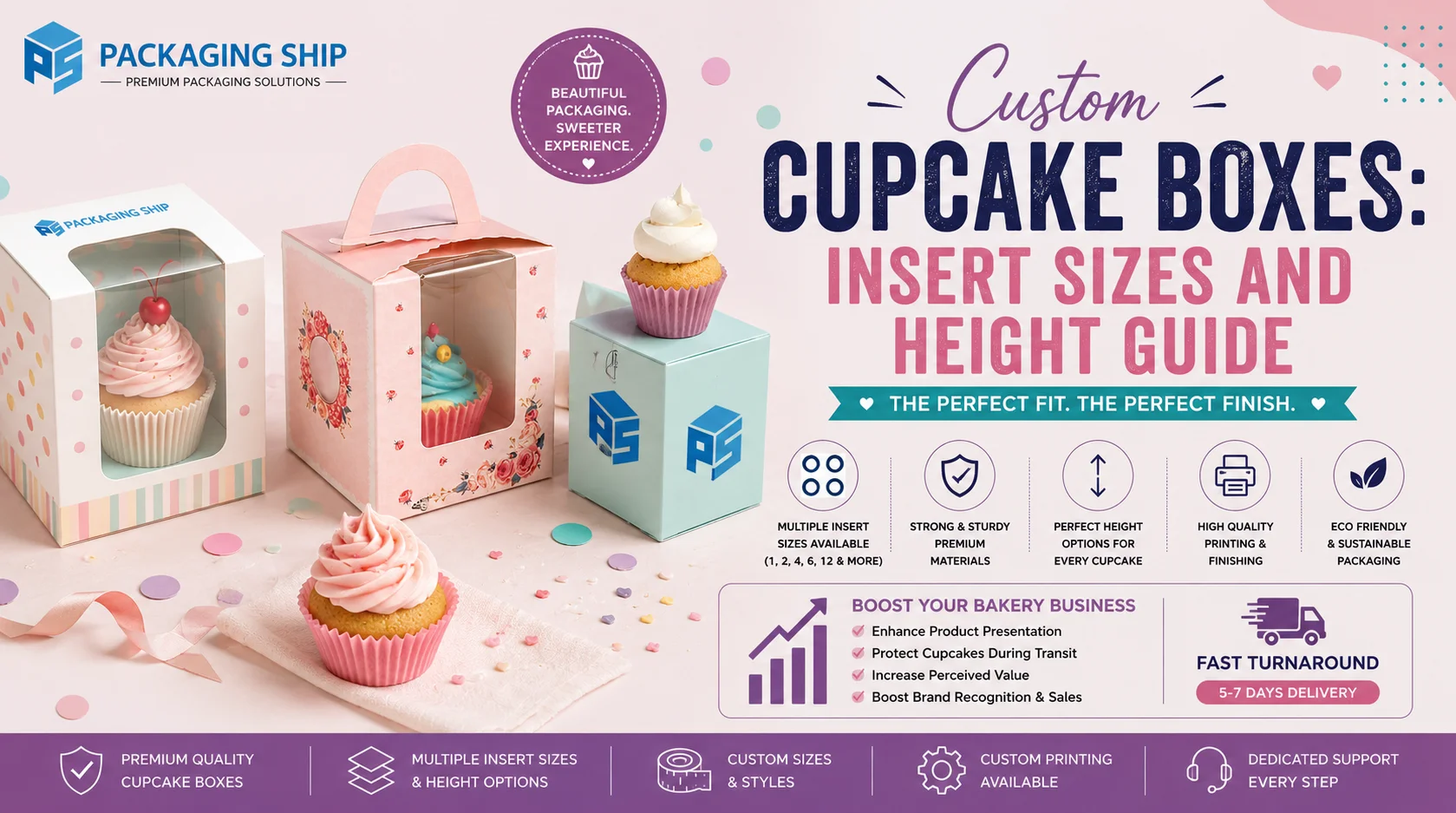
TL;DR: Custom cupcake boxes fail buyers for one reason more than any other, the box height is measured wrong. A box built for a flat iced cupcake will crush a buttercream swirl. This guide breaks down real insert cavity sizes, height clearance numbers for 4, 6, and 12 count boxes, and the ordering mistakes that cost bakeries the most money. You will also find a spec table, an FAQ section, and a direct path to a free quote with no die charge.
Custom cupcake boxes are printed, sized packaging built to hold a set number of cupcakes, usually 1, 4, 6, or 12, using a die cut insert that locks each cupcake in its own cavity. A good box protects frosting and decoration during transport. A poorly sized box crushes both. The size, insert layout, and interior height all have to match the cupcake, not just the count.
At Packaging Ship, that matching process starts with the spec, not the artwork, which is the part most first time buyers skip.
Picture this. A bakery lands its first wholesale account, maybe a local coffee shop or a corporate catering order. They search for custom cupcake boxes, order the first option that shows up, and pack their best batch that night. The delivery arrives, the box gets opened, and half the swirls are smeared flat against the lid.
This happens constantly, and it is rarely a bad box. It is usually a box height that was measured against the box itself, not against the tallest point of a decorated cupcake, topper included. That single gap between box height and cupcake height at its tallest point is where most first orders go wrong, and it sets the tone for everything else in this guide.
Packaging is not a small detail here either. A 2018 study from the Paper and Packaging Board conducted with Ipsos found that 72 percent of consumers say packaging design influences their purchasing decisions. A crushed swirl inside a well printed box still reads as a packaging failure to the customer, even when the recipe was flawless.
A cupcake insert box is not just a box with a lid. It is a box built around a die cut insert tray that gives each cupcake its own cavity, so it cannot slide, tilt, or bump into the cupcake next to it. Without an insert, cupcakes shift every time the box moves, and frosting transfers between cupcakes or smears against the box wall.
Standard insert layouts run in cavity counts of 1, 2, 4, 6, 9, 12, and 24, and each cavity is sized to a specific liner diameter. A standard bakery liner measures close to 2 inches across the bottom and finishes around 2.5 inches across the top once baked. The insert cavity needs to sit close to that footprint, with a small margin of slack so the cupcake sits snug without being wedged in.
Here is the part most first time buyers miss. A 12 count insert built for a mini cupcake is a completely different physical product than a 12 count insert built for a standard or jumbo cupcake, even though both get sold under the same 12 count label. Always confirm liner size before you lock in an insert.
This is the section that actually saves you a reshipment. Cupcake box height spec depends entirely on decoration, not on the cupcake itself.
Use this as a starting reference. Confirm exact tolerances with your supplier before locking artwork, since liner size and topper height shift the numbers slightly.
| Count | Typical Box Size | Interior Height Needed | Best For |
| 1 count | 4 x 4 x 4 in | 3.5 to 4 in | Gift, sample, single item pickup |
| 4 count | 8 x 8 x 4 in | 4 to 4.5 in | Small retail box, family pack |
| 6 count | 10 x 7 x 4 in | 4 to 4.5 in | Most requested retail size in the US |
| 12 count | 14 x 10 x 4 in | 4.5 to 5 in | Wholesale, event, and catering orders |
This table covers the core 4, 6, 12 cupcake packaging range that most bakeries reorder month after month. Once you have your numbers confirmed, you can get a free quote with those exact dimensions instead of guessing on a standard size. Above 24 cupcakes, most bakeries split the order into two boxes instead of building one large tray, since a loaded tray past two dozen tends to flex in the middle and crack frosting on the cupcakes near the center.
Some suppliers offer a loose pack option, meaning a plain box with no insert tray. It costs less to produce, but it only makes sense for short local deliveries where the box barely moves, like a table display at a bake sale.
For anything that travels further than a few blocks, a cupcake insert box is worth the extra cost. Precise fit inserts, built to match one liner size exactly, cut down on returns and remakes caused by shifted or crushed frosting far more than a universal insert does. A universal insert fits a wider range of products, which helps a bakery running multiple cupcake sizes, but it protects each individual cupcake less. If your bakery runs one standard liner across most of its menu, the precise fit insert almost always pays for itself in fewer damaged deliveries.
Order patterns tend to fall into three groups, and knowing which one you fall into makes it easier to pick the right spec from the start.
Farmers market and retail case orders usually run 4 or 6 count, ordered frequently in smaller batches, often with a window die cut so the frosting is visible on the shelf.
Event and catering bulk orders lean toward the 12 and 24 count range, and these need a sturdier board weight since the box gets stacked and transported in bulk rather than handled one at a time. For larger celebration orders, some bakeries move away from individual cupcake boxes entirely and toward custom cake boxes instead, especially when a single tiered cake is easier to transport safely than forty individually boxed cupcakes. If your order mixes both formats, it is worth reading through choosing the right cake box before you finalize either spec.
Subscription and direct to consumer cupcake brands lean heavily on branded window boxes, since the unboxing moment is part of the product experience for a customer who ordered online rather than walked into a storefront.
Custom cupcake boxes built with the right insert and height spec for each of these three order types cut down on the two most common complaints bakeries deal with, damaged product on arrival and inconsistent presentation across orders.
Die charges and plate charges are one of the most overlooked costs in packaging, typically running between 150 and 800 dollars per design, on top of the unit price. For a bakery running a seasonal or limited run box, a design that will not get reordered next quarter, that upfront fee can wipe out the margin on an entire order.
Ordering custom cupcake boxes wholesale no die charge USA options removes that fee entirely, which matters most for smaller wholesale runs and first time bulk orders where you are still testing demand before committing to a repeat design. This pricing structure applies across the full range of bakery boxes, not just cupcake formats, which helps if your kitchen also ships cakes, cookies, or pastries under one supplier relationship. Combined with a low minimum order, this is what makes custom packaging realistic for a bakery placing its first 300 or 500 unit order, not just for large operations placing orders in the tens of thousands.
For any box touching food directly, material choice is not optional. The FDA’s Packaging and Food Contact Substances program sets the framework suppliers use to confirm a material is safe for direct food contact, and it is worth asking your supplier which certifications apply to your specific board and coating before you place a food contact order.
1- Mistake: Ordering by count alone. A 12 count label does not tell you cavity size.
2- Mistake: Trusting box height without decoration height.
3- Mistake: Using a tuck lid for shipped orders.
4- Mistake: Stacking past 24 counts in one tray.
5- Mistake: Treating every dessert format the same.
A box that works for cupcakes will not necessarily work for cookies, since cookies need a shallower profile and often a wider window to show a full batch. If cookies are part of your lineup ,custom cookie boxes with a window cover that spec separately rather than forcing one box style across your whole menu.
6- Mistake: Paying die charges on a one time seasonal design.
Each of these mistakes is fixable before production, not after delivery, which is the entire point of getting the spec right the first time.
If cupcakes are not the only thing leaving your kitchen, the same insert and clearance logic applies to macarons, arguably with even less room for error, since a macaron shell cracks under pressure a cupcake would shrug off. Most first time macaron box orders go wrong for the same root reason as cupcake orders, the box was sized for the product’s footprint, not its fragility. If you want to read more, click here.
| Question | Direct Answer |
| How tall should a custom cupcake box be? | 3.5 inches for flat iced cupcakes, 4.5 inches or more for a piped buttercream swirl, and 5 inches if the topper includes a macaron or fondant piece. |
| What size insert do I need for 12 cupcakes? | A standard 12 count insert fits a 14 x 10 inch box footprint, with cavity diameter matched to your liner size, usually between 2 and 2.5 inches. |
| Is there a minimum order for custom cupcake boxes? | Not with every supplier. Some, including Packaging Ship, accept orders starting from 50 units with no die charge added. |
| What is the difference between a cupcake insert and a plain box? | An insert is a die cut tray inside the box that gives each cupcake its own cavity, preventing movement. A plain box has no internal structure. |
| Are custom cupcake boxes food safe? | Yes, when made from food contact materials that meet FDA requirements, which is a standard requirement for any packaging touching food directly. |
You already know your cavity count and your tallest topper. The only thing left is turning that into a box that actually fits, without paying a die charge for a design you might only run once.
Getting custom cupcake boxes right comes down to two numbers most buyers skip past, cavity size and interior height measured against the tallest point of a decorated cupcake. Get those two right, and everything else, presentation, brand image, repeat orders, falls into place on its own. Packaging Ship builds cupcake boxes and bakery packaging around real specs, not guesswork, with orders starting from 50 units and no die charge added to your quote.