
TL;DR:
A custom macaron box only works if three things match your product: an insert cavity sized to your shell diameter, a paperboard weight in the 250–400 GSM range, and a count (6, 12, or 24) that matches how you actually sell.
Custom macaron boxes need three things to work: a cavity insert sized to your shell diameter, a paperboard weight between 250 and 400 GSM, and a count, 6, 12, or 24, that matches how you actually sell. Get any one of those wrong and you find out three days before a market, not before.
You know that feeling. You open the shipping box, and under the tissue paper, half your macarons have cracked lids or shells that slid loose and chipped against the wall. Nothing about the flavor changed. But the photo they were going to post now shows crumbs instead of a clean shell, and that’s the version of your product that travels.
This happens for one of two reasons almost every time. Either the box shipped with no insert at all, so the macarons had room to rattle around during transit, or the insert was ordered by guess instead of by measurement, so the cavity was slightly too loose for the shell. We put this guide together at Packaging Ship after walking enough bakery owners through a first order to know exactly where it tends to go sideways.
New bakery owners tend to order packaging the way they’d order a t-shirt: pick a size, pick a color, done. Macaron packaging doesn’t work like that, because the product itself is fragile in a way most baked goods aren’t. A macaron shell has almost no structural give. If the box construction doesn’t account for that, the box becomes the reason for the break, not the shipping carrier.
The first order tends to go wrong in one of a few predictable spots: an insert cavity that doesn’t match shell size, a paperboard weight chosen by price instead of by what the box needs to support, uncertainty about minimum order quantities that stalls a decision for weeks, or artwork that looks different on screen than it does printed.
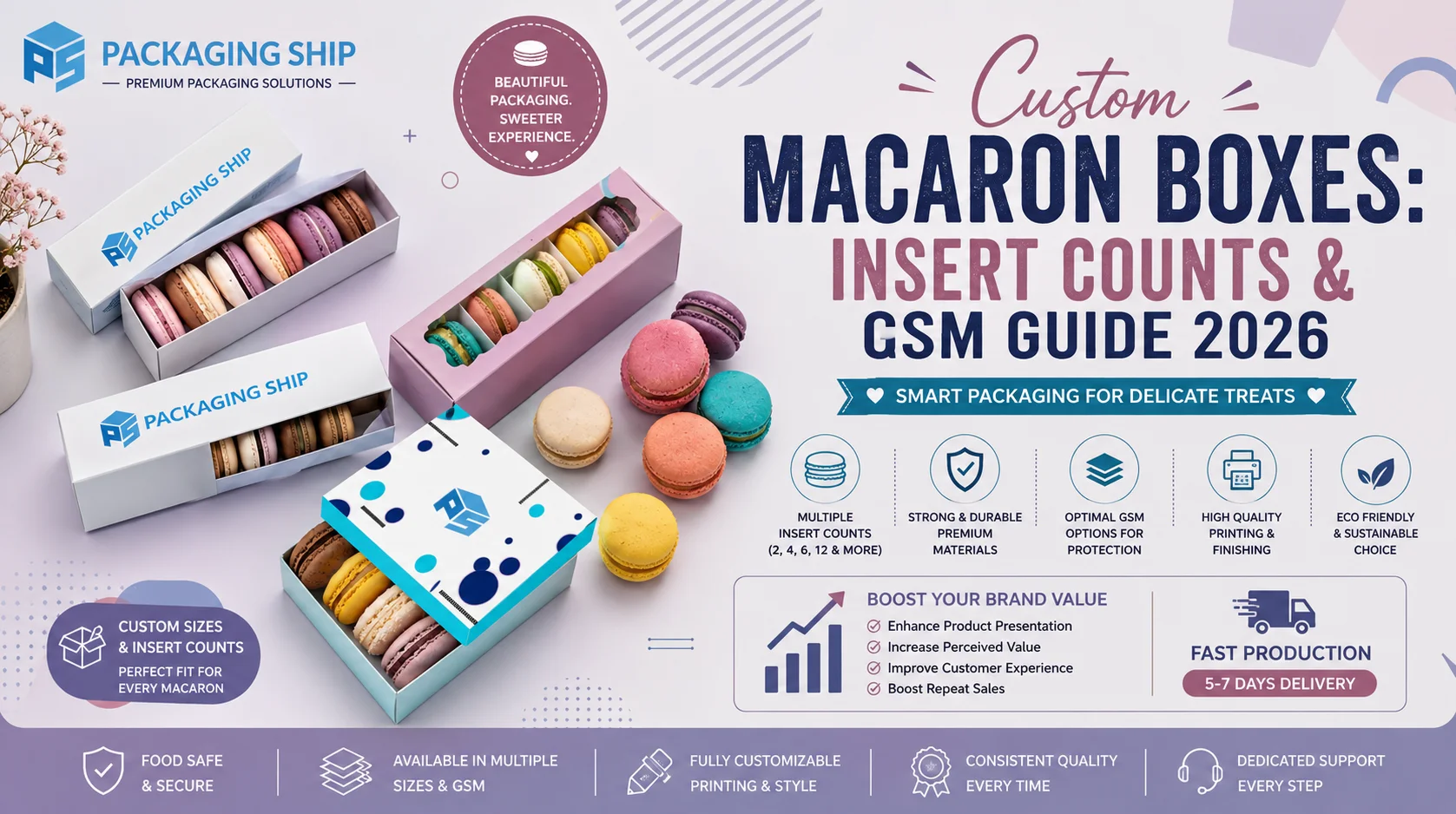
An insert is the die-cut or molded tray that sits inside the box and holds each macaron in its own cavity. Insert count is simply how many cavities that tray has, and it should match how many macarons you’re packing per box, not how many you can technically fit. That’s the idea behind our custom macaron boxes with insert options: match the cavity to the shell, not the shell to whatever cavity happens to be in stock. A box with insert cavities that are even slightly oversized lets the shell move, and movement during transit causes cracking far more often than rough handling does.
Most bakeries standardize around three counts, and each one serves a different part of the business.
A 6 count box works well for single gift orders, sample boxes, and impulse buys at a farmers market table. A 12 count box is the workhorse size for most retail and online orders, since it holds a dozen without becoming too tall or too heavy to ship easily. A 24 count box suits corporate gifting, wholesale accounts, and holiday assortments where the buyer wants variety across flavors in one package.
| Count | Typical Use | Insert Style |
| 6 | Gifts, samples, market stalls | Single row cavity tray |
| 12 | Standard retail and online orders | Single or double row tray |
| 24 | Wholesale, corporate gifts, holiday sets | Double row or two stacked trays |
Ordering a count you don’t actually sell wastes a first packaging budget fast. If your average online order is eight macarons, a 6 count box forces an awkward second box, and a 12 count box ships half empty unless you fill the gap with tissue, which adds cost and still leaves room for shells to shift.
GSM stands for grams per square meter, and it measures how heavy, and by extension how rigid, a sheet of paperboard is. Higher GSM means a thicker, stiffer board. For food packaging, GSM is one of the clearest numbers you can ask a supplier for, because unlike vague terms like “sturdy” or “premium,” it’s a fixed measurement you can compare across quotes.
There’s no single published industry standard GSM specific to macarons, and any supplier who tells you there’s one exact number for every macaron box is oversimplifying. What holds up across confectionery packaging generally is a working range: 250 to 400 GSM for rigid or folding carton stock, depending on box style and count. A 6 count gift box can often use board on the lighter end of that range. A 24 count box, especially one stacked in a retail cooler or shipped with other items, performs better closer to the 350 to 400 GSM range, where the walls resist crushing under load.
Heavier isn’t automatically better. A 450 GSM board on a small 6 count box adds cost and shipping weight without adding meaningful protection, since the insert tray does most of the protective work, not the outer wall thickness. If macarons are one of several items you package, GSM needs to shift by product, so it’s worth browsing our full food packaging range to see how weight recommendations change across your catalog before you lock in one spec for everything.
Before you request a quote, measure your own shells. Standard macaron shells run between 1.5 and 2 inches in diameter, but recipes vary, and “standard” is doing a lot of work in that sentence. Measure five or six finished shells with a ruler, not a guess, and use the average.
Once you know your shell diameter, insert cavity size should sit close to that number, with just enough tolerance, usually around 0.5mm, to seat the shell without forcing it or letting it float. This is the single detail most first-time buyers skip when ordering custom macaron boxes, and it’s the difference between a snug fit that survives a shipment and a loose one that doesn’t.
If your shells fall right on the line between two standard box dimensions, it’s worth requesting a custom die rather than forcing a standard size to fit. A custom die costs more upfront, but it removes the guesswork that leads to reordering.
A window macaron box shows the product through a clear panel, which helps at retail and on a farmers market table. A kraft macaron box gives a natural, rustic look that photographs well and costs less than printed white stock. A rigid macaron packaging option, built on thicker board, holds its shape without folding lines and suits holiday gift sets or corporate orders.
The same style tradeoffs carry over to other bakery formats. If you also stock custom cookie boxes or other flat baked goods, kraft and window options apply there too, though cavity depth and insert shape shift with the product. None of these styles replace the insert, though. A window looks nice on a box that arrives with cracked shells inside it.
Before you approve a proof, confirm these five things in writing with your supplier.
First, your exact shell diameter, measured, not estimated. Second, the insert count and cavity tolerance that matches it. Third, a GSM in the 250 to 400 range that fits your box count and shipping distance. Fourth, whether the box and any coating meet FDA food contact substance guidance. Fifth, your supplier’s turnaround time relative to your market date or launch.
Ask for a physical sample before a full run, since a screen proof can’t show how a cavity seats a shell. Once you have these five answers in hand, you’re ready to get a free quote instead of guessing your way through a first production run.
Macarons aren’t the only delicate bakery item that lives or dies by its packaging spec. If you also sell cookies, shortbread, or other flat baked goods, the same principles apply: cavity fit, board weight, and visibility, with one key difference, window placement. A poorly placed window can crack under stacking pressure the same way an undersized insert cracks a macaron shell. We’ve broken down cavity-safe window sizing, film types, and placement in our guide to cookie boxes with windows. If you want to read more, click here.
If you’re ready to stop guessing on cavity size, GSM, and count, send us your shell measurements and order volume. Packaging Ship builds macaron packaging in food grade kraft and cardstock, with Pantone matched printing, no minimum order requirement, and a 6 to 7 business day production window before shipping.
Get Your Free Quote and Sample →
| FAQ | Direct Answer |
| How many macarons fit in a 6 inch box? | A 6 inch macaron box typically holds 6 to 9 standard size shells, 1.5 to 1.75 inches in diameter, in a single row insert. Larger shells or double row layouts change that count, so confirm against your own measurement first. |
| What GSM is best for macaron boxes? | Most bakeries land between 250 and 400 GSM depending on box count and how the box will be shipped or stacked. |
| Custom macaron boxes have no minimum order, is that real? | Yes, several suppliers, including Packaging Ship, now offer custom macaron boxes with no minimum order quantity, which lets a new bakery test a design at a small volume before committing to a bulk run. |
| Macaron box insert vs no insert, does it matter? | It matters more than almost any other spec. An insert holds each shell in its own cavity so it can’t shift during transit. |
| How do I stop macarons from cracking during shipping? | Match the insert cavity to your shell diameter, use board in the 300 to 400 GSM range for shipped orders, and avoid overfilling or underfilling the box. |
| What’s the best material for macaron packaging? | Food grade cardstock or kraft card in the 250 to 400 GSM range covers most bakeries. |
A first order of custom macaron boxes goes wrong for predictable reasons, not bad luck. Measure your shells before you order. Match insert count to how you actually sell, in sixes, twelves, or twenty-fours. Choose a GSM inside the 250 to 400 range based on count and shipping distance, not on what sounds premium. According to a national study conducted by Ipsos on behalf of the Paper and Packaging Board, seven in ten Americans say packaging design influences their purchase decisions, and a similar share say material choice does too. Get the measurements right, ask your supplier direct questions before you approve a proof, and the packaging will do its job quietly.