
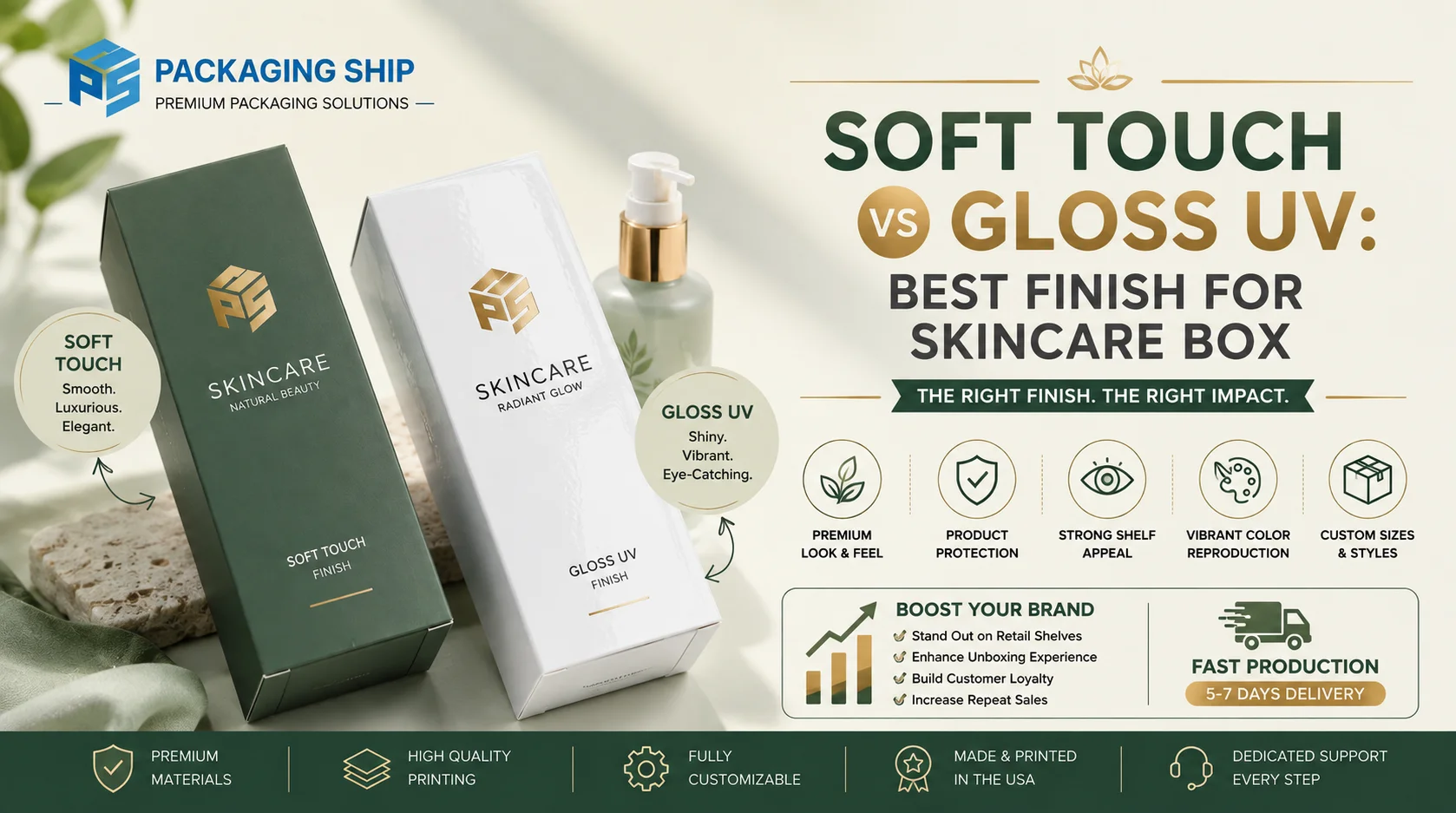
TL;DR: Soft touch feels expensive in your hand but doesn’t always photograph well under a camera flash, and it picks up fingerprints faster than gloss does. Gloss is cheaper, tougher under studio lighting, but can come off a little plain next to a soft touch competitor on the same shelf. Premium serums and clean beauty lines usually lean soft touch. Color cosmetics on a tighter budget usually lean gloss. Either way, check your GSM before you lock in a finish, and ask for a physical sample first. Photos on a screen lie more often than people expect.
We hear some version of this almost every week. A founder approves a mockup, the box shows up two weeks later, and it doesn’t match what they had in their head. Nine times out of ten, it isn’t a printing mistake. It’s the finish. The soft touch vs gloss cosmetic box question is usually sitting right underneath the confusion, unanswered, because nobody explained the difference before the order got placed. Soft touch can feel genuinely luxurious in your hand, but under a ring light it sometimes looks a little dull. Gloss does the opposite. It photographs sharp but wears its fingerprints by the second week on a shelf. Neither finish is the “correct” one. They just do different jobs, and this guide is here to help you pick the right one.
Soft touch is a laminate film, usually a matte base with a bit of texture built in, so the surface feels almost like suede under your fingers. Gloss UV is a completely different animal. It’s a liquid coating cured under ultraviolet light in seconds, leaving behind a hard, shiny shell. One is meant to be touched. The other is meant to be seen from across a store aisle. That’s the whole distinction in a nutshell, and almost everything else in this article builds off it.
People decide what they think of your product long before they open it. Weight, print sharpness, and how the box feels when they pick it up, all of that gets processed in a second or two. According to research from Ipsos conducted for the Paper and Packaging Board, most American shoppers admit that packaging design shapes their buying decisions, and the materials a product ships matter almost as much as how it looks. That lines up with what we see at the quoting stage constantly, which is exactly why the soft touch lamination box question comes up on nearly every skincare call we take.
Picture two products sitting next to each other on a shelf. One box feels a little slick. The other has this warm texture that makes you want to hold it a beat longer. Most people grab the second one without thinking twice about why, and that reaction is the entire point of choosing a finish.
Skincare buyers are already primed to notice texture, since that’s how they judge the product itself once it’s on their skin. A box that echoes that feeling backs up whatever the formula promises. A box that feels cheap when the product claims to be gentle creates a small disconnect, and customers notice it fast.
Soft touch lamination uses a BOPP film bonded onto the printed board. Instead of bouncing light back the way gloss does, it absorbs it, which mutes colors slightly but adds that tactile layer people notice the second they pick up the box. It’s a big reason serum brands, moisturizer lines, and clinical skincare companies gravitate toward it. No copy needed to sell the “premium” feeling. The box does that on its own. This isn’t a niche trend either. Future Market Insights projects steady growth for the global soft touch lamination film market over the next decade, with cosmetics and skincare brands a big part of what’s driving that demand.
Nobody likes hearing the downsides after they’ve committed to a finish, so let’s cover them now. Fingerprints show up faster on soft touch than gloss, especially in darker colors like black or deep navy, and light scuffing along the edges happens too. Soft touch also costs more per unit, not a massive jump, but enough to notice on a big order, mostly because the film and bonding add a step to production. If your product gets handled a lot before reaching the customer, that’s worth thinking through early. In our own experience quoting skincare startups, the soft touch vs gloss cosmetic box decision usually comes down less to what looks best on screen and more to how the box gets handled in the real world.
Gloss UV goes on as a liquid and cures almost instantly under UV light, leaving a hard, reflective shell on top of the print. Colors pop under it, which is why lip gloss, eyeshadow palettes, and anything bright and seasonal tends to use it. It’s tougher against moisture and light scratches than soft touch too, and it costs less, a real factor for a brand still figuring out if a product is going to sell.
The catch is perception. Sit a gloss box next to a soft touch one and gloss can suddenly look a little ordinary, even mass produced. It picks up fingerprints too, just differently than soft touch does. Under bright store lighting, gloss can glare enough to wash out small text or fine details. Plenty of founders comparing matte vs glossy packaging for their first production run go with gloss anyway, simply because it’s the safer, cheaper bet while they’re still testing whether the product sells at all.
Here’s the part almost nobody explains properly, and it’s probably the real reason you searched for a matte vs glossy packaging comparison in the first place. Soft touch is built for touch, not cameras. It absorbs light instead of throwing it back, so a flash or harsh studio lighting can flatten it, making the box look grey or lifeless in a photo, even though the same box feels premium in someone’s hand.
The fix isn’t complicated once you know the cause. Shoot with soft, diffused light instead of a direct flash. Add a small reflective touch, a spot UV cosmetic logo, a foil stamp, or a satin finish box label, so there’s something for the camera to catch a highlight on. That one contrast point usually fixes the whole problem without touching the finish itself.
| Finish | Feel | Best For | Shows Fingerprints | Relative Cost |
| Soft touch | Velvety, suede like | Serums, clean beauty, gifting | Yes, more visible | Higher |
| Gloss UV | Slick, reflective | Lip gloss, color cosmetics, bold packaging | Yes, differently | Lower |
| Matte | Flat, non reflective | Minimalist brands, editorial look | Least visible | Similar to gloss |
| Spot UV | Glossy accent on matte or soft touch base | Logos, brand names, highlights | Only on the coated area | Add on cost |
The finish is only half the story. What’s underneath it, the actual cardboard, decides whether that finish holds up. GSM stands for grams per square meter, a measure of how heavy and stiff your board stock is. Go too light, under 300 GSM, and soft touch lamination can start to feel thin, sometimes even dimpling if a bottle shifts inside during shipping. Bump it up to the 350 to 400 GSM range and soft touch gets its full weight back, while gloss UV holds its shape without warping under humidity or rough handling in transit. If a supplier quotes a finish without mentioning GSM, ask. Skipping that conversation is one of the most common reasons a soft touch vs gloss cosmetic box order shows up feeling flimsier than the sample everyone approved.
Base this on your product and budget, not just what looks nicest in the design file. Selling a premium serum or night cream priced above forty dollars? Soft touch usually pays for itself through perceived value alone. Selling color cosmetics like lip gloss or eyeshadow, built around bold photography? Gloss UV makes the artwork pop and keeps costs down during early production.
Shipping direct to consumer with a lot of unboxing content planned? Soft touch paired with a spot UV accent performs well in person and on video. Selling through retail under fluorescent lighting all day? Gloss holds its shine better across a long shelf life. A cosmetic box with soft touch finish wholesale USA order tends to make sense for brands with some traction already, ones that can protect margin on a premium finish. Newer brands testing the waters often start with gloss to keep launch costs down. There’s no universally right pick, only a mismatched one, and the easiest way to avoid that is a physical sample of both before signing off on a full run.
Packaging Ship builds both finishes in house for skincare and beauty brands, including custom cosmetic boxes,lip gloss boxes, andhair extension boxes, so you’re not stuck guessing before you’ve actually tested what fits your product.
| Question | Answer |
| Does soft touch lamination scratch easily? | It holds up fine under normal handling, but fingerprints and light scuffs show up more visibly than on gloss, especially in darker colors. |
| Is gloss or matte better for skincare packaging? | Gloss works well for bold color cosmetics on a tighter budget. Matte or soft touch fits clinical, premium, or minimalist brands better. |
| Can you combine soft touch with spot UV? | Yes, and it’s common. A soft touch base with a glossy spot UV logo creates a nice contrast that many premium skincare brands use. |
| What is the price difference between soft touch and gloss? | Soft touch usually runs a bit more per unit because of the extra film and bonding step, though the gap shifts with box size and quantity. |
| Does soft touch lamination yellow over time? | It generally resists yellowing better than some coated matte finishes, a solid pick for packaging that needs to hold up on shelf for a while. |
You don’t have to guess your way through this. Tell us what you’re selling, your budget, and your timeline, and we’ll point you toward the coating that fits your brand and your production numbers. Get Your Free Quote and get real pricing back within hours, not days.
There’s no single winner in the soft touch vs gloss cosmetic box debate, just a better fit depending on who you’re selling to. Soft touch earns its price tag on premium, high touch skincare where the unboxing moment carries almost as much weight as the formula itself. Gloss earns its place on bold, color driven cosmetics where visibility and budget matter more than a velvet texture ever will. Know your price point, think about how your customer will experience the box in their hands, and pick the finish that backs up that story instead of working against it. As of July 2026, this is still the most common finish question we get from skincare brands placing their first wholesale order, and getting it right the first time beats paying for a reprint you didn’t budget for.