
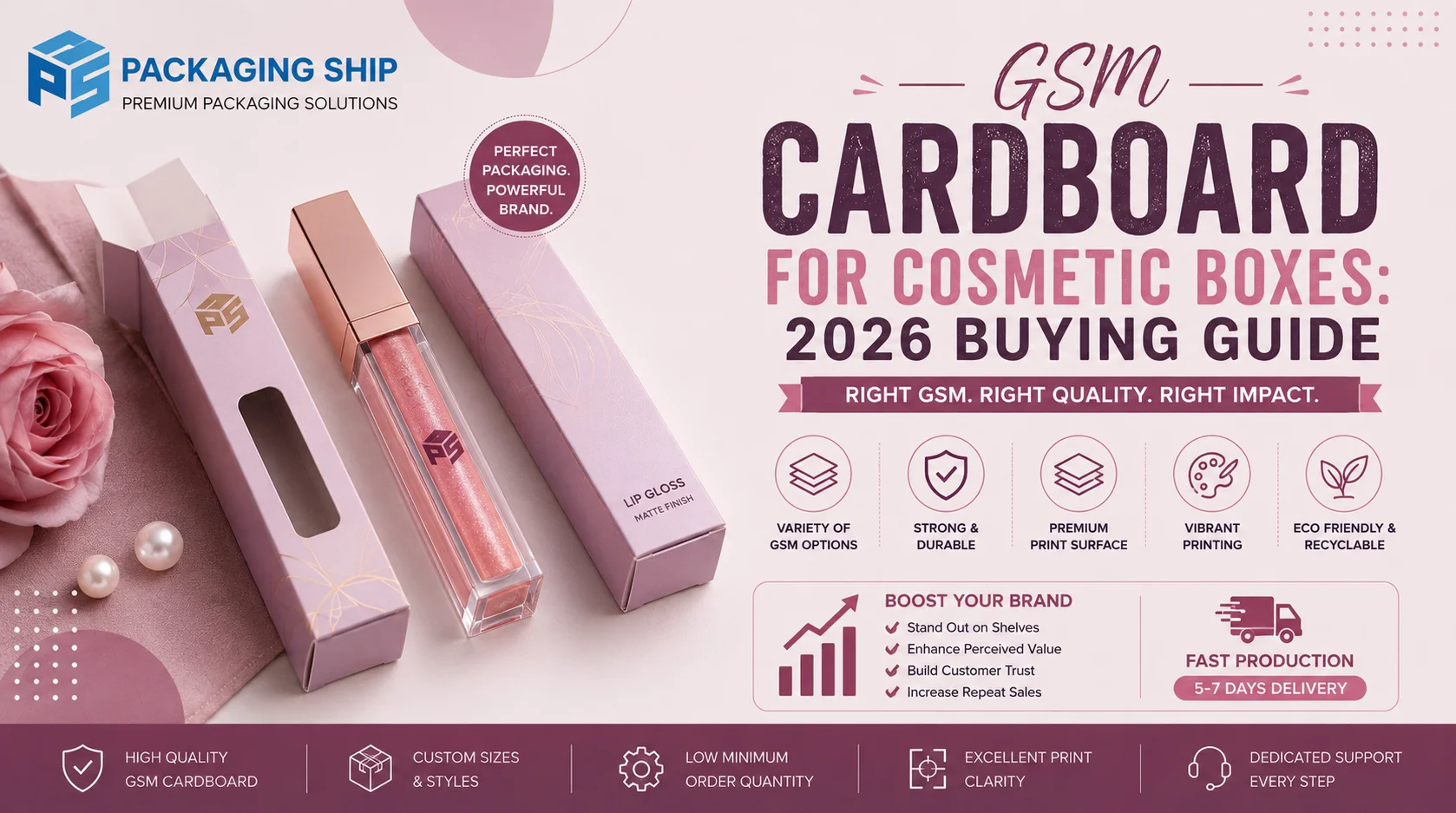
TL;DR
Cosmetic packaging tends to sit between 300 and 400 GSM, or 14pt to 18pt if you’re used to US terms. Light products need less, heavy glass and jars need more, and rigid boxes are a different category entirely, often starting near 1000 GSM. If your last order arrived feeling thin or bent too easily, there’s a good chance you ordered under the range your product actually called for. This guide walks through that decision by product type, so the next order is right the first time.
Most cosmetic brands land somewhere between 300 and 400 GSM, which works out to roughly 14pt to 18pt. Lip balm and other light products can get away with 250 to 300 GSM. Glass perfume bottles need more, usually 350 GSM and up. The right number depends on what the product weighs, how it sits on a shelf, and how far it has to travel before it gets there.
A box shows up. It feels cheap the second you pick it up. Corners already bent in the mailer, lid won’t sit flat, and now you’re wondering if the vendor cut corners somewhere. Most of the time they didn’t. Nobody asked what weight to specify, so the order defaulted to whatever was cheapest.
This trips up more first time buyers than you’d think. Paperboard weight gets measured two ways: GSM, which is grams per square meter, or points, the thickness measurement US suppliers tend to use. Skip that number entirely and you’ve handed over control of how the box feels, prints, and survives shipping. Once the scale behind GSM cardboard cosmetic boxes actually makes sense, the guesswork disappears, and that’s really what this guide is for. Packaging Ship, a custom packaging manufacturer working with brands across the country, built this guide around the questions buyers actually ask before they order.
GSM is a weight measurement, plain and simple. Weigh a square meter of board, and whatever that number comes out to in grams is your GSM. Higher number, heavier and denser sheet. PT works differently. It measures thickness, not weight, and one point is one thousandth of an inch.
Here’s where things get messy. US suppliers usually quote in points. Paper mills overseas quote in GSM. Put those two together and you get brands comparing quotes that aren’t actually speaking the same language. Whether you’re looking at folding cartons or heavier cardboard boxes, this mismatch is where most quote confusion starts.
Roughly speaking, 300 GSM lines up with 14pt, and 400 GSM lines up with 18pt. These aren’t perfect conversions since density shifts by mill and coating, but they’re close enough to build a spec around. If a supplier only gives you one unit, just ask for the other. Takes ten seconds, and it clears up almost every bit of confusion before it costs you an order.
This is the comparison that actually matters for most cosmetic brands. 14pt, sitting close to 300 GSM, handles lightweight items and secondary packaging well, anything that isn’t carrying much weight on its own. It folds clean, prints sharp, and keeps shipping costs reasonable.
18pt runs closer to 350 to 400 GSM, and it’s the better call once your product has real heft, you’re working with magnetic closures, or the box needs to survive a retail shelf without softening at the corners over time. Foil stamping and embossing also hold up noticeably better on the heavier stock, which matters if finishing is part of how your brand shows up.
Not sure which side your product falls on? Order samples of both before committing to a full run. That small delay costs you almost nothing next to what a bad 5,000 unit order costs once it’s already printed.
Cardboard weight for beauty boxes isn’t one size fits all, and treating every SKU the same is usually where the ordering mistakes start. The table below is a fast reference before you get into the details on each category.
| Product Type | Recommended GSM | PT Equivalent | Why |
| Lip balm, small beauty items | 250 to 300 GSM | 12pt to 14pt | Light product, box just needs to hold its fold |
| Perfume, glass bottles | 350 GSM and up | 16pt to 18pt+ | Glass is unforgiving if it shifts in transit |
| Skincare jars, cream tubs, pumps | 350 to 400 GSM | 16pt to 18pt | Needs to support weight and a premium feel |
| Eyelash packaging | Lighter to mid GSM | 14pt to 16pt | Priority is shelf presence, not load bearing |
Custom lip balm boxes and other small items do fine at 250 to 300 GSM. Light product, so the box isn’t fighting gravity. It just needs to print cleanly and hold its fold.
Perfume and glass bottles need more backup. Glass shifts during shipping and doesn’t forgive much when it does, so 350 GSM and up is the safer range here, especially paired with custom perfume boxes that include inserts to keep the bottle from moving around in transit.
Skincare jars and heavier items, cream tubs, pumps, that sort of thing, generally sit in that same 350 to 400 GSM window too, sometimes stepping up into rigid stock when a brand wants that heavier unboxing feel.
Eyelash packaging has different weight needs than perfume or skincare boxes. The product is light, but the packaging still has to hold shape on a retail shelf and support a display window or magnetic closure. Most eyelash brands land in the lighter to mid GSM range rather than heavy rigid board, since the priority is shelf presence and print detail, not load bearing strength. If you want a full breakdown of weight, structure, and finishing options specific to lash packaging, click here to read more.
If you’re working across several product types at once, browsing custom cosmetic boxes by type is the quickest way to find which weight range fits before you ever request a quote.
This one really comes down to how premium the product needs to feel against what you’re willing to pay per unit. Standard cardboard, even at 18pt, is still a folding carton. It ships flat, assembles during production, and stays affordable at almost any order size.
Rigid boxes are a different build entirely. Thick paperboard core, often close to 1000 GSM or more, wrapped in a printed outer layer. They don’t fold flat. They hold their shape permanently, and a customer feels that the second they pick one up. The tradeoff shows up in cost and minimum order size, both of which climb higher than standard cardboard.
For most DTC and small beauty brands, staying in the 14pt to 18pt range hits the right balance between durability and price. Rigid tends to make more sense for gift sets, limited runs, or higher price point lines where the unboxing moment is genuinely part of what someone’s paying for.
Once the GSM range is locked in, the next question is who actually prints it. Custom printed USA orders generally move faster than anything coming from overseas, since there’s no ocean freight or customs delay sitting in the middle, and quality control happens a lot closer to home.
At Packaging Ship, orders print in CMYK full color at 300 DPI, with both offset and digital available depending on how large the run is. Standard production runs 7 to 10 business days from proof approval, and rush options exist for tighter launch windows. There’s no minimum order requirement either, so you can test a spec at a small quantity before committing to anything larger. That matters more than people expect going in, because the only real way to confirm a GSM decision is holding the actual box before thousands of them show up.
Packaging does more than protect what’s inside it. Ipsos research, done on behalf of the Paper and Packaging Board, found that 72 percent of consumers say packaging design shapes their purchase decisions, and 67 percent said the same about the materials used to make it. A 2025 systematic review in Humanities and Social Sciences Communications landed on a similar point, noting packaging works as one of the most consistent touchpoints shaping how someone judges a brand before they’ve even tried what’s inside. Weight and material aren’t a footnote buried in a spec sheet. They’re part of that first impression. For more on how these choices shape perception, how packaging builds beauty brand identity goes further into the branding side of it.
Ordering by price alone tops the list, letting a vendor pick the weight without ever asking what it needs to hold up under. Right behind that is mixing up GSM and PT while comparing quotes from different suppliers, which is how boxes end up thinner or thicker than expected. Third is going heavier than necessary just to be safe, which drives up cost and shipping weight without actually adding protection.
The fix is the same across all three. Match the GSM to the product itself, ask for both units on every quote, and get a sample before locking in a large run.
| Question | Answer |
| What GSM is best for cosmetic boxes? | Most cosmetic packaging performs well between 300 and 400 GSM, roughly 14pt to 18pt, depending on the product’s weight and finishing needs. |
| Is 300 GSM good for cosmetic packaging? | It holds up fine for lighter items, think lip balm, small jars, secondary cartons that aren’t carrying much weight to begin with. |
| What’s the difference between 14pt and 18pt cardboard? | 14pt is lighter and cheaper to run. 18pt is thicker, takes foil and embossing better, and suits heavier or higher end products. |
| Is rigid packaging better than cardboard for cosmetics? | Rigid feels more premium and holds its shape for good, but standard cardboard is more cost effective and covers what most DTC brands actually need. |
| Why does my packaging feel flimsy? | Probably ordered below the GSM range the product needed, usually because nobody specified a weight at checkout in the first place. |
Stop guessing on the next order. Send over your product’s dimensions and weight, and the team will confirm the right GSM before a single box goes to print. Request your custom quote and get a digital proof back within 24 to 48 hours, no minimum order required.
Getting the GSM right for cosmetic boxes isn’t complicated once the numbers actually make sense. Match the weight to the product, not the other way around. Light items like lip balm can stay in the 250 to 300 GSM range. Glass and jars need 350 GSM or more. Want that truly rigid, premium feel? That’s a different material category altogether, with its own costs and order minimums to plan around. Get this one decision right, and everything after it, print quality, how the box feels in someone’s hands, gets a lot easier. Ready to lock in a spec? Browse cardboard boxes by style and material, or get a free quote today.