
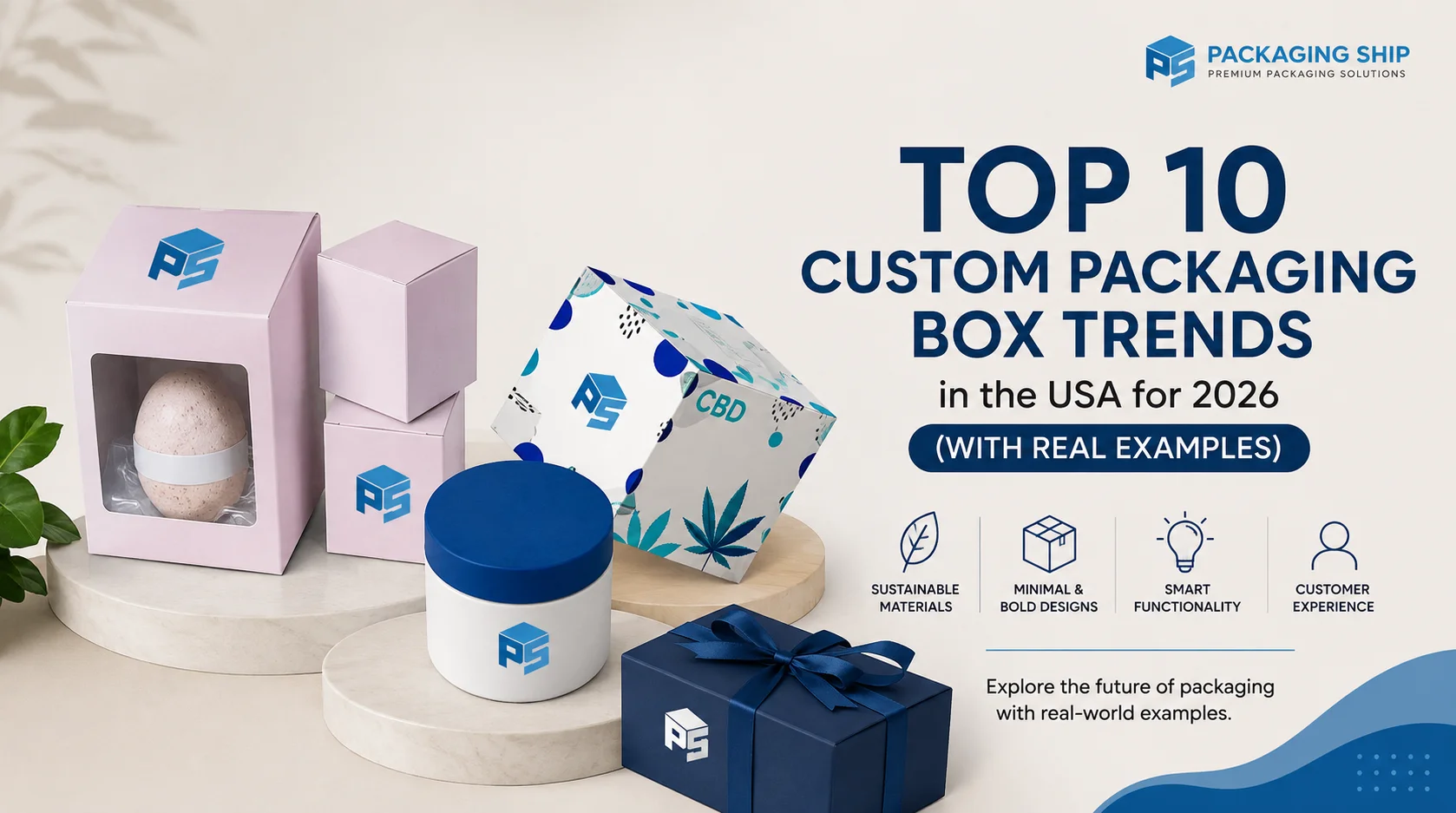
TLDR: Custom packaging trends USA 2026 include curbside recyclable materials, inside box printing for unboxing videos, minimalist design, QR codes, and sustainability claims that can actually be verified. This guide covers all ten, with real examples, and tells you honestly which ones are worth your money and which ones you can skip for now.
Scroll TikTok for five minutes and you’ll probably land on an unboxing video without even trying to find one. Watch three of them back to back, which happens more often than people admit, and a small nagging thought shows up. Your own packaging looks a little tired next to what you just watched. If that sounds familiar, you’re not behind, you just haven’t had a straight answer about what’s actually worth changing.
That’s what this guide is for. Custom packaging trends USA 2026 are moving in a few clear directions, but not every direction deserves your budget right now. Some of what gets called a “trend” online is just noise dressed up nicely. Below are the ten that are real, backed by what we’re actually seeing in production orders this year, plus which ones are safe to skip if your budget is tight.
Short answer first. The biggest custom packaging trends in USA 2026 are curbside recyclable materials, mono material construction that drops plastic liners, inside lid printing built for the unboxing moment, minimalist design, QR codes that actually do something useful, tactile finishes like soft touch coating, light personalization, retro inspired design making a comeback, smarter retail display structures, and sustainability claims that come with real proof behind them instead of just a nice sounding label.
People are done peeling plastic liners out of boxes before they can recycle them. Plain paperboard and kraft stock that goes straight into the bin are winning over plastic window boxes and mixed laminate mailers, and honestly, it’s about time. If you’re in food, pay extra attention here, since food packaging buyers now expect materials that are both food safe and easy to recycle without a second thought.
A box built from one material recycles cleanly. A box glued together with plastic film, foam, or foil doesn’t, no matter what the label says. Brands are quietly swapping plastic inner liners for paper based ones that still do the protective job.
This is the inside box printing trend for unboxing videos that people keep searching for, and it makes sense once you think about it. The camera points at the inside of the box the moment it opens, not the outside. A printed thank you note, a small design, or even just a bold color choice on the interior costs very little to add and gives that moment something worth filming.
Loud boxes trying to shout every feature at once are fading fast. Clean type, a color or two, room to breathe, that combination reads as confident rather than desperate. It’s also one of the cheaper trends here, since fewer print colors usually means a lower cost, not a higher one.
QR codes on boxes used to feel like a gimmick nobody scanned. Now they lead to care instructions, a brand story, a loyalty perk, or a fast reorder link, things people actually want. The trend only works when the code leads somewhere worth the tap. A code that just dumps you on the homepage isn’t a trend, it’s a missed opportunity.
None of this happens in a vacuum, by the way. A 2018 study run by Ipsos on behalf of the Paper and Packaging Board found that most consumers say packaging design shapes what they buy, and a similar number say the materials matter just as much. That’s a big part of why 2026’s shift leans so heavily on materials and finish, not just logo placement.
Soft touch coating, embossing, a little debossing here and there, these give a box something you notice with your hands before you even read the front. Years of shiny, plastic feeling laminate started to look cheap instead of premium, and people noticed.
Bigger brands print slightly different names or codes on individual boxes without paying for a whole separate print run, thanks to variable data printing. Smaller brands don’t need the full setup. A personalized insert or a handwritten style note inside the box gets you most of the same warmth for a fraction of the cost.
Bold vintage type, warmer color palettes, playful little illustrations, these are creeping back in, partly because everyone leaning minimal for the last few years made minimalism start to feel a bit crowded itself. Funny how that works.
Brands selling in physical stores are designing boxes that double as their own display, which means less spent on separate store fixtures. Custom display boxes built around this idea help a smaller brand hold its own next to competitors with three times the marketing budget.
This is the eco friendly packaging trend 2026 small business owners should watch closely. Shoppers have gotten sharper about spotting green claims with nothing behind them. The Forest Stewardship Council explains that chain of custody certification tracks forest based materials at every stage, from the source all the way to the finished product, which is the kind of proof that actually holds up. Want to build that kind of trust into your own packaging without guessing at it? Eco friendly packaging backed by real certification is the place to start.
Here’s something we’ve noticed on our own production floor this year, and it’s not a stat pulled from a report. Small brands ordering under five hundred units are choosing soft touch and kraft finishes noticeably more than they were a year ago. That tracks with pretty much everything on this list.
Not every trend here deserves equal attention or equal budget. Curbside recyclable materials and honest sustainability claims aren’t really optional anymore, treat those as baseline. Inside box printing and minimalist design are cheap, low risk upgrades almost any brand can make on their next order. Full smart packaging, the NFC chips and augmented reality layer type of thing, is still mostly a large brand play. Worth keeping an eye on, not worth rushing into unless your product genuinely calls for it.
Big brands win on scale. Huge minimum orders, in house design teams, budgets most small businesses will never touch. You’re not going to outspend that, so don’t try. What you can do is focus on it. Pick one or two trends that actually fit your product and do them properly, instead of spreading a small budget thin across five half finished ideas. A candle brand that nails a soft touch finish and backs up its sustainability claim with a real certification will usually beat a bigger competitor juggling five trends badly. Trending custom boxes across the USA aren’t always the priciest ones. They’re the ones that actually match what’s inside the box.
Low minimum orders make this kind of testing realistic for a small operation. You don’t need to commit to five thousand units just to try a new finish or a new interior print. Order a small batch, watch how people react, adjust before your next run. That’s how smaller brands are actually closing the gap in 2026, not by copying everything at once.
| Question | Direct Answer |
| What is the biggest custom packaging trend in 2026? | Sustainability claims that come with real proof behind them, not just the word eco friendly printed somewhere. |
| Is minimalist packaging design still relevant in 2026? | Yes, and it often costs less to print than a busier design would. |
| Do QR codes on packaging actually get used? | Only when they lead somewhere useful, like care instructions or a loyalty perk, not a generic landing page. |
| What packaging trend is fading in 2026? | Glossy plastic laminate and vague eco friendly labels with no certification behind them. |
| Do I need a large order to try a new packaging trend? | No. Small batch orders exist specifically so you can test a trend before committing to more. |
| How fast can I switch to a new packaging design? | Around seven to ten business days for a standard run once your artwork proof is approved. |
You don’t have to guess which of these trends is right for your brand. Tell us your product, your budget, and your timeline, and we’ll help build the box around that, not the other way around. Get your free packaging quote today and see real pricing before you commit to anything.
Custom packaging trends USA 2026 aren’t really about chasing every new idea that shows up on your feed. They’re about picking the handful that fit your product and your customer, and doing those well. Sustainability you can actually prove, printing built for the moment your box gets opened on camera, design that feels intentional instead of loud, those are the shifts with real staying power this year. Pick one trend that fits your brand honestly, test it on a small run, and build from there.