
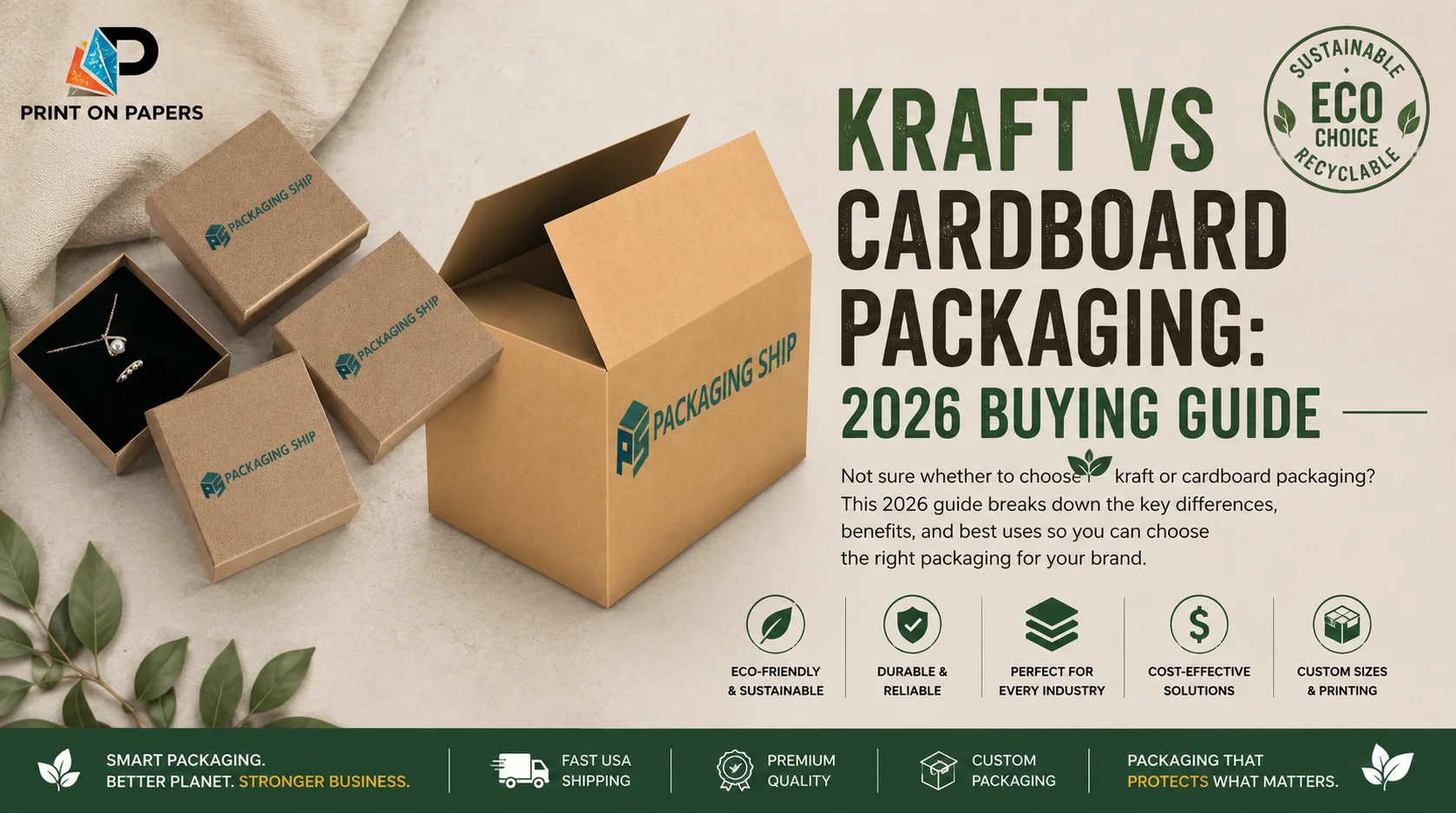
TL;DR: Kraft looks natural, costs less to start with, and breaks down easily. Cardboard holds its shape better and takes a beating during shipping. Which one you actually need comes down to your product, not a trend. Below you’ll find GSM numbers you can use right now, a real look at pricing, two tables, and a quick way to decide without spiraling into research mode for another week.
People searching “kraft vs cardboard packaging” usually already know they need a box. What they don’t know is which material fits their product. Quick version: kraft is unbleached paper, brown, a little rough around the edges in the best way, and it suits lighter items and brands with a natural feel. Cardboard is thicker, often bleached white, and built to hold shape under pressure. Your product’s weight is really what settles this argument.
| Attribute | Kraft Packaging | Cardboard Packaging |
| Typical look | Natural brown, textured | Smooth, often bleached white |
| Best for | Soap, candles, jewelry, gifts, light snacks | Shipping mailers, retail cartons, heavier goods |
| Starting cost | Usually lower per unit | Usually higher, depending on coating and thickness |
| Strength on its own | Tear resistant, flexible | More rigid, better impact protection |
| Sustainability story | Strong, unbleached and low chemical processing | Good, but depends on coatings and inks used |
| Branding style | Rustic, artisanal, eco forward | Clean, premium, retail ready |
Kraft comes from something called the kraft process, which is really just a way of pulping wood with chemicals to strip out lignin. Once the lignin’s gone, you’re left with fiber that’s naturally strong and doesn’t need bleach to hold together. That’s the whole reason kraft has that slightly rough, earthy look. It’s not a style choice by the manufacturer, it’s just what happens when you skip a processing step.
Cardboard’s a wider net. It covers single layer paperboard for folding cartons all the way up to multilayer corrugated fiberboard for shipping. You can bleach it white or coat it glossy, which is why cardboard tends to photograph better under studio lighting for a product shot.
Most articles stop there and call it a day. But the real question isn’t which material wins. It’s which one your product actually needs. A candle sitting still on a shop counter has a completely different life than a coffee mug bouncing around in a delivery van for three days.
Strength is more about structure than the raw material itself. On its own, kraft paper resists tearing and works fine for lighter things, soap, jewelry, dried snacks. Laminate it onto corrugated board though, and it turns into something genuinely tough, tough enough for mailers and retail cartons that need to survive a warehouse.
Cardboard, particularly double wall corrugated, usually wins on protecting heavier or fragile items without any help. Shipping glass? Electronics? Anything with sharp edges that could tear through a box? Cardboard’s layered build gives you more cushion per inch than kraft alone ever will.
GSM just means grams per square meter, and it tells you how heavy your paper stock is. Nobody needs a science degree for this. Lightweight cartons, think soap or candles, usually sit around 250 to 350 GSM. Rigid or premium boxes, the kind cosmetics brands use, climb to 350 GSM and up. Shipping mailers get measured a bit differently since corrugated board works in layers, but the logic stays the same either way, heavier products need heavier stock behind them. If none of this feels obvious yet, just tell your supplier what you’re shipping and how much it weighs. That’s a completely normal task. Nobody expects you to walk in already knowing your GSM.
Kraft tends to come in cheaper right out of the gate. Skipping the bleaching step keeps raw material costs down, plain and simple. Cardboard, especially bleached white stock with coatings or laminate finishes, usually costs more per unit.
That said, price isn’t only about which base material you pick. Print complexity, order size, and finishing touches like foil stamping or soft touch lamination can move your final cost around more than the material choice does. A plain kraft box loaded up with foil detailing can actually end up pricier than a simple printed cardboard box. If you’re working with a tight budget, just ask for quotes on both materials at your exact size and quantity. Don’t assume kraft wins on price until you’ve actually seen the numbers side by side.
Food brands run into a slightly different set of concerns here. Kraft shows up a lot in bakery boxes, coffee bags, and snack pouches, partly because it feels natural and partly because it’s often available with grease resistant, food safe coatings. Cardboard, corrugated especially, tends to be the go to for heavier food shipments like frozen goods, where the box needs to protect the product more than look good doing it.
One thing that matters more than the kraft versus cardboard question itself, if your packaging touches food directly, make sure whatever supplier you use meets FDA food contact compliance. That’s a non-negotiable regardless of which material you land on.
This is the one nobody seems to want to answer straight, so let’s just say it. A lot of founders worry that going sustainable means their box ends up looking plain, maybe even cheap, like they skimped on purpose.
Turns out that fear doesn’t really hold up. A national survey run by Ipsos on behalf of the Paper and Packaging Board found that roughly two out of three consumers said paper and cardboard packaging actually looks more premium, not less, and more attractive than other materials. Eco doesn’t have to mean bare bones. Foil stamping on kraft, embossed logos, soft touch coatings, all of that dresses up natural stock without losing what makes it feel authentic.
The recycling numbers hold up too. Per the American Forest and Paper Association’s 2024 recycling report, the US recycled around 46 million tons of paper that year, and cardboard’s recycling rate landed somewhere between 69 and 74 percent. So when you pick kraft or recyclable cardboard, you’re actually plugging into a system that works, not just slapping a green label on a box. If sustainability matters to your brand, take a look at Eco Friendly packaging built to look intentional, not stripped down.
| Question | Direct Answer |
| Is kraft paper stronger than cardboard? | Not really on its own. Kraft resists tearing but it’s thin. Corrugated cardboard wins for shipping and heavier products thanks to its layered build. |
| What GSM is best for shipping boxes? | Corrugated board is standard for shipping. For retail cartons, 250 to 350 GSM covers lightweight goods, and 350 GSM or higher suits rigid, premium packaging. |
| Does kraft packaging look less premium? | Not if you dress it up. Foil stamping, embossing, and soft touch lamination make kraft look just as high end as bleached cardboard, sometimes more distinctive. |
| Is cardboard or kraft better for the environment? | Both recycle well. Kraft skips most bleaching and heavy chemical processing, which is why people usually call it the greener pick. |
| What’s the cost difference between kraft and cardboard packaging? | Kraft is generally cheaper as a raw material, but printing, coatings, and finishing can close that gap fast, sometimes flip it entirely. |
| Can I order kraft or cardboard boxes without a big minimum order? | Yes. Plenty of suppliers, Packaging Ship included, accept orders starting at 50 units with no minimum requirement. |
Most small businesses can’t afford to order thousands of units just to test whether a product sells. That reality shapes this decision more than any spec sheet does.
Skincare and cosmetics brands tend to gravitate toward Kraft Boxes for that clean, natural beauty look, especially on serums and gift sets. Bakery and snack brands go either way, honestly, depending on whether the box needs a window cut or extra structural backbone. E-commerce sellers shipping through Shopify or Amazon usually end up with Cardboard Boxes or corrugated mailers because surviving the delivery truck matters more than looking pretty on a shelf. Retail brands selling in stores lean cardboard too, since a box that sags or slumps kind of defeats the entire purpose of custom packaging in the first place.
What ties all of this together is flexibility on volume. Nobody testing a new product should be forced into ordering 2,000 units before they even know if customers want it.
Stuck between the two? Skip another hour of research and just answer three questions instead.
Does your product need to survive rough handling in transit, or is it mostly just sitting on a shelf or counter waiting to be picked up? Rough handling points you toward cardboard or corrugated. Shelf life points you toward kraft.
Is sustainability actually core to your brand, or more of a nice bonus you’d like to have? If it’s central to who you are, kraft usually says that louder.
And are you testing something brand new, or reordering a product that already sells? First timers do better starting small in either material, that way you’re not sitting on a pile of boxes if the product needs a redesign three months in.
Enough comparing. Whether you land on kraft, cardboard, or some mix of the two, getting an actual quote takes less time than it took to read this far.
Nobody wins the kraft vs cardboard packaging argument outright, and honestly, that’s fine. Kraft gives you a natural look, a lower starting price, and a sustainability story that actually holds up. Cardboard gives you strength, shelf presence, and better protection when things get heavier. What matters is your product, not whichever material is trending on packaging blogs this year. Figure out what you’re shipping first. The material usually picks itself after that.