
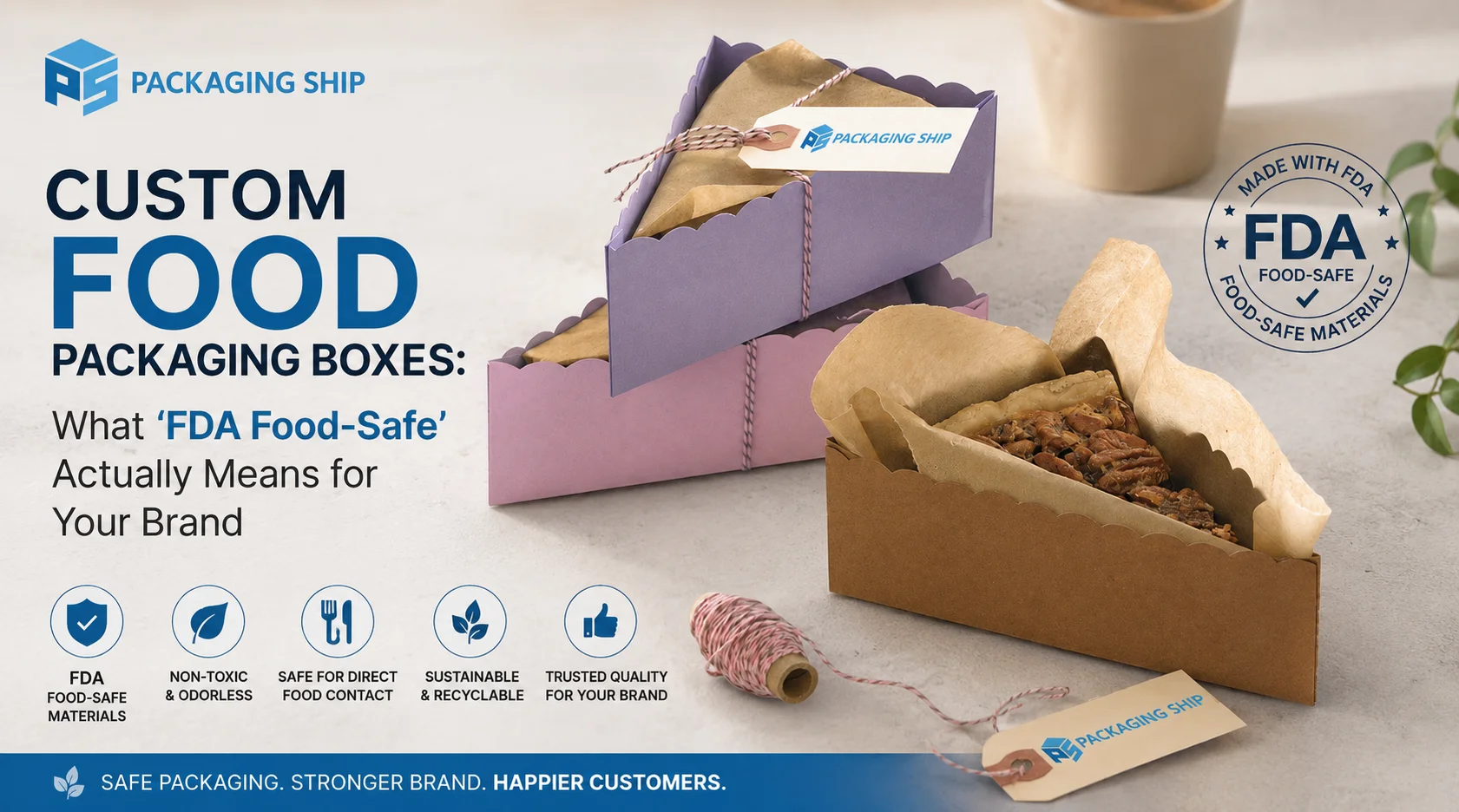
TL;DR
Most food brands order custom boxes without ever checking if the materials meet FDA food contact rules. “FDA food-safe” is not a label your supplier slaps on a box. It means the board stock, adhesives, and inks all clear specific federal thresholds under 21 CFR. No certificate exists for this. You verify it through documentation. And yes, you can get compliant custom food boxes starting from 50 units without a massive minimum order commitment.
Last spring, a cookie brand out of Houston printed 1,500 kraft boxes and felt great about them. The design was sharp. The stock felt premium. Then a regional retailer asked one simple question: can you confirm the inks are food-contact safe? The brand went back to their supplier. The supplier went quiet. The whole order sat in a warehouse for six weeks while they sorted it out.
That is not a rare story. It happens to small food brands constantly, and most of them never see it coming.
So what does FDA food safe packaging boxes actually mean, in plain terms?
Direct answer: FDA food-safe packaging means the box is made from materials cleared under Title 21 of the Code of Federal Regulations, specifically Parts 176 and 177, and printed with inks that won’t transfer harmful substances into or near your food.
Here is the part that trips up almost every new food brand: the FDA does not hand out a food safety certificate for packaging boxes. There is no stamp, no sticker, no approval letter. What exists instead is a set of federal rules that govern which substances are legal to use in food contact applications. Your supplier either follows those rules or they don’t. Your job is to get written proof that they do.
The FDA’s guidance on food contact substances is clear on one thing: any material touching food must go through a safety review confirming that chemical migration stays within limits considered safe for human consumption. That covers the board, the glue, and every color you see printed on the outside.
Not every food box touches food the same way. The FDA splits this into two categories, and the distinction shapes everything from which cardboard grade you need to which ink formulation your supplier must use.
Direct food contact means the box surface physically touches your product. A burger box sitting against a patty. A cake box where the frosting grazes the inner wall. Packaging in this category carries stricter material requirements because any chemical migration goes straight into whatever someone is about to eat.
Indirect food contact means something sits between the packaging and the food. Think of an outer gift box with a wax paper liner inside, or a shipping carton around an already-sealed inner package. Compliant materials are still required, but the migration threshold is slightly more forgiving because the food isn’t touching the box directly.
For small food businesses ordering custom food packaging, this matters most when you’re requesting a quote. Tell your supplier upfront whether your product will touch the box directly. That single detail changes the spec.
Cardboard is the backbone of most custom food packaging boxes wholesale orders. Under 21 CFR Part 176, paperboard intended for direct food contact must come from virgin fiber or from post-consumer fiber that’s been tested to confirm chemical contaminants fall within safe migration thresholds.
Recycled cardboard is not automatically food grade. Prior use can leave ink residues, mineral oils, or other chemical traces in the material. Before you order, ask your supplier if the board stock is virgin fiber or tested recycled material certified specifically for food contact use. If they can’t answer that question directly, that’s your answer.
A lot of food brands assume kraft paper is inherently safe because it looks natural and unbleached. That’s partly right. Unbleached kraft paper made from virgin wood pulp generally clears the bar under 21 CFR Part 176.170, which covers paper components used in food contact applications. The problem is the extras applied on top. Coatings, inks, and adhesives on a kraft box must each meet food contact standards on their own, separate from the base material.
Kraft is a solid choice for custom bakery boxes when the supplier can provide full material traceability on every layer, not just the paper itself.
Corrugated boxes used for food shipping fall under 21 CFR Part 177. Both the inner fluted medium and the outer liners must meet food grade specs, especially when food inside has no additional inner packaging separating it from the corrugated wall. Recycled corrugated is common, and when it’s used, the supplier needs to show that mineral oil aromatic hydrocarbons and mineral oil saturated hydrocarbons stay within FDA permissible limits.
Rigid boxes for premium food gifting use high-density greyboard wrapped in decorative paper. The greyboard core needs to clear indirect food contact requirements under 21 CFR Part 176. Beyond that, any wrapping paper, foil stamping, or lamination applied to the exterior must also be free from restricted substances. The more finishing layers a box has, the more documentation you should request.
Here is the thing most packaging suppliers won’t tell you upfront: the printing on the outside of a food box can travel through the box wall and reach your product. It’s called set-off migration, and it doesn’t require the ink to be wet or the box to be heated. It happens in sealed shipping environments at room temperature, slowly, over time.
The FDA doesn’t publish a single approved ink list for food packaging. Instead, it regulates ink components as indirect food additives under 21 CFR Parts 175 and 178. That means your supplier needs to use ink systems specifically formulated for food-adjacent printing, not just whatever ink runs on their standard print jobs.
Water-based, low-VOC inks are the standard. They don’t carry heavy metals and use binders and pigments that stay in the ink layer rather than migrating through paperboard. Solvent-based inks are a different story. They contain volatile organic compounds that can work their way through packaging walls, especially in enclosed environments like sealed shipping boxes during long transit.
UV-cured inks sit in the middle. Some UV ink formulations are designed specifically for food packaging and pass migration testing. Others are not. The difference is in the photoinitiator chemistry. A low-migration UV ink made for food contact is fine. Generic UV printing that wasn’t formulated with food contact in mind is not automatically compliant, even if it cures hard and looks great.
Three things to ask any supplier before you place a food packaging order: Can they give you a Safety Data Sheet confirming the inks are low-VOC and heavy metal free? Do they use water-based or low-migration UV inks specifically on food packaging runs? Can they confirm the ink system meets 21 CFR Part 175 indirect food additive requirements?
A supplier who can’t answer all three shouldn’t be printing your food boxes. That’s not difficult. That’s protecting your brand from a compliance problem you won’t see coming until it’s too late.
Finding a reliable supplier for FDA compliant food packaging in the USA isn’t complicated if you know exactly what to ask for. Here are five steps that cut through the noise.
Step one: Ask for the material specification sheet for the board stock used in your boxes. This is also called a Technical Data Sheet or TDS. It should reference compliance with 21 CFR Part 176.170 or the applicable food contact standard for your packaging type.
Step two: Get written confirmation that all inks used on food packaging orders are water-based, low-VOC, and free from restricted heavy metals. Verbal assurances don’t hold up when a retailer is asking questions.
Step three: Tell the supplier whether your packaging involves direct or indirect food contact. Make sure they adjust the material selection based on your answer, not a generic default.
Step four: Ask about adhesives. Box assembly uses glue, and adhesives are regulated under 21 CFR Part 175. They need to comply with indirect food additive rules the same way inks do.
Step five: Confirm the supplier provides a digital proof before production. This lets you check labeling requirements specific to your product before anything is printed.
A 2024 survey by the Paper and Packaging Board conducted with Ipsos found that 72% of consumers say packaging design influences their purchase decisions. That stat matters, but it also misses something: a non-compliant box that looks incredible is a legal liability, not a brand asset. Compliance has to come first.
Packaging Ship provides written material documentation on every food packaging order. You can request a free quote and ask for the TDS before committing to anything.
Small food businesses face a specific kind of compliance risk that larger brands usually don’t. They often order from general packaging suppliers who aren’t set up for food contact applications and don’t know the difference between standard cardboard and food grade paperboard.
The most common mistake is assuming all cardboard is food grade. It isn’t. Recycled boards that haven’t been tested for contaminants can carry mineral oils and chemical residues directly into a food packaging run. Always ask for virgin fiber or verified food-contact certified board stock. Not later, before you order.
The second mistake is ignoring the ink question entirely. Most small brands spend a lot of time on box design and zero time asking what ink system the supplier uses. Since ink covers most of the exterior surface area, that’s a significant oversight. The printing is as regulated as the box itself.
Third, and this one is very common, brands take a verbal “it’s food safe” as sufficient. It isn’t. “Here is our TDS confirming 21 CFR Part 176 compliance” is a different thing entirely. Get documentation in writing.
Fourth, ordering a large first run without testing it for compliance. If you’re launching a product, start with a small batch. Confirm the boxes, check out, get your retailer or co-packer to sign off on the materials, then scale. Packaging Ship accepts orders from 50 units with no minimum order requirement, which is specifically useful for this kind of compliant first-run validation.
Fifth, conflating “natural-looking” materials with safe materials. Kraft, bamboo, and sugarcane packaging all carry eco-friendly associations. But the coatings and inks applied on top of those materials must still clear FDA food contact standards independently of the base material’s natural origin.
At Packaging Ship, food packaging orders follow a production protocol that’s different from a standard custom box run.
All food packaging uses virgin fiber cardboard, corrugated, or kraft board stock sourced from FSC-certified mills. The board grades selected for food orders comply with 21 CFR Part 176 requirements for paper and paperboard components in food contact applications.
Every print run on food packaging orders uses water-based, low-VOC inks with no restricted heavy metals. This covers CMYK full-color printing across every food packaging category, including custom cake boxes, bakery boxes, burger boxes, and bagel boxes.
Every order gets a digital proof reviewed and approved by the customer before production starts. You check the design, the labeling layout, and the format before a single sheet is run.
Packaging Ship operates out of Valley Stream, NY, with printing, die-cutting, lamination, and finishing all handled in-house. Orders start from 50 units. No minimum order quantity. No die charges. No plate fees. Standard production runs 7 to 10 business days, with free FedEx or UPS shipping to all 50 states.
| Question | Answer |
| Does the FDA issue a certificate for food-safe packaging? | No. There is no FDA certificate for packaging boxes. Compliance means using materials that clear 21 CFR Parts 176 and 177. Ask your supplier for their Technical Data Sheet. |
| Is all kraft paper food safe? | Not automatically. Unbleached kraft from virgin pulp generally meets 21 CFR Part 176.170, but coatings, inks, and adhesives each need to be verified separately. |
| What inks are safe for food packaging? | Water-based, low-VOC inks with no heavy metals. Low-migration UV inks made specifically for food contact applications are also acceptable when properly formulated. |
| Can I order FDA compliant food boxes with no minimum? | Yes. Packaging Ship produces compliant food packaging from 50 units with no minimum order requirement. |
| What is 21 CFR and why does it matter? | Title 21 of the Code of Federal Regulations is the FDA’s rulebook for food contact materials. Parts 176 and 177 specifically cover paper, paperboard, and polymer-based packaging. |
| Does recycled cardboard meet FDA food-safe standards? | Only when it’s been tested and verified. Recycled board must hit the same migration thresholds as virgin fiber and must demonstrate the absence of contaminants like mineral oil hydrocarbons. |
Your food brand works too hard to get tripped up by a packaging compliance issue nobody warned you about.
Packaging Ship produces FDA food safe packaging boxes for bakeries, food brands, restaurants, and e-commerce sellers across all 50 US states. Every order comes with free design support, a digital proof before production, verified food-contact materials, water-based inks, and free FedEx or UPS shipping.
No minimum order. No die charges. No plate fees. 7 to 10 business days production.
FDA food safe packaging boxes are not a label or a marketing claim. They are a production standard built on verified materials, compliant inks, and a supplier who can back up every claim with documentation.
Small food brands lose retailer deals, co-packer approvals, and customer trust over packaging compliance issues that were entirely preventable. The fix isn’t complicated. It’s asking the right questions before you order, not after.
As the FDA’s guidance on food contact materials makes clear, the compliance burden sits with whoever uses the material, not with the brand buying the box. That means your packaging supplier must be the one who can prove it, and you need to require that proof as a condition of ordering.
Packaging Ship verifies compliance on every food packaging order, from 50 units up, with no minimum order requirement and full material documentation available on request. If you want to get your food packaging right from the first run, request a free quote today.