
Here is something most online sellers never think about until it is too late.
Your customer places an order. They wait three days. The package arrives. They pick it up, look at it, and immediately feel something about your brand. Not from the product inside. From the box itself.
That first impression happens before they even open it. And if you are shipping in a plain brown box with no branding, no custom sizing, nothing that says “we thought about you,” that impression is quietly neutral at best. Forgettable at worst.
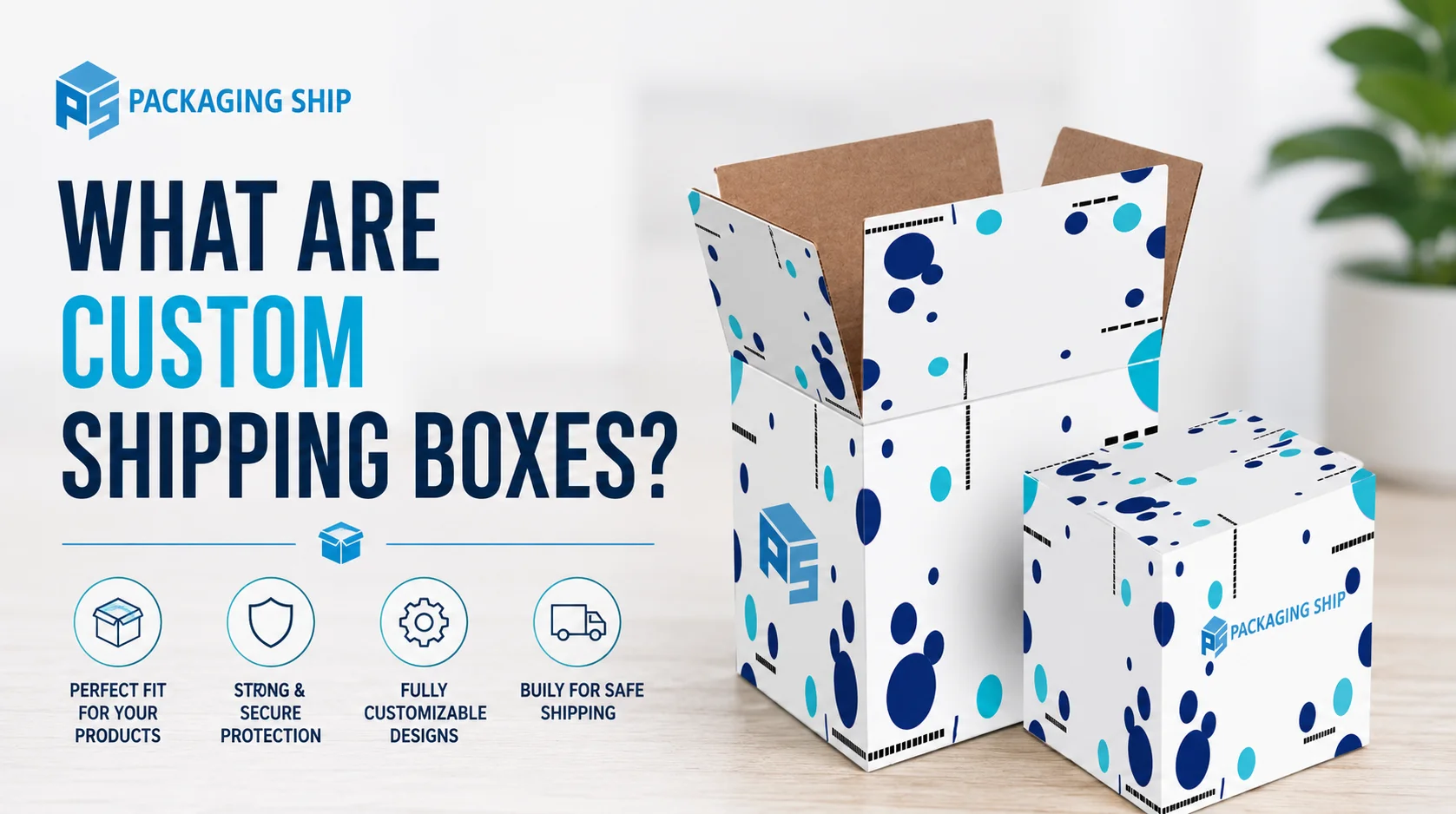
So, what are custom shipping boxes exactly? They are boxes built specifically around your product and your brand. Made-to-measure dimensions, your logo and colors printed on the outside, your choice of material and finish. Not the generic stock boxes that come off a warehouse shelf and get used by a thousand different sellers. Yours. Built for your products, carrying your identity, doing marketing work on your behalf the moment they land on a customer’s doorstep.
That is the short version. The longer version is what this guide covers.
Think about the difference between a suit off the rack and one tailored specifically to you. Both cover the body. Only one actually fits.
Custom shipping boxes work the same way. Standard stock boxes come in fixed dimensions, designed to roughly fit a wide range of products. You stuff in bubble wrap just to stop things from shifting around. You are literally paying to ship empty air. The box tells your customer nothing about who you are.
Custom shipping boxes start from your product measurements. Length, width, depth, weight, fragile or not, ships alone or with other items. A box gets built around those details. Walls sized correctly. Product sitting without rattling. Your logo on the outside, exactly where the customer looks first.
Getting them made is not complicated. Share your specs, work with a design team on the look, approve a proof, and production begins. At Packaging Ship, the whole thing takes around six to seven business days for production, with free US shipping on top of that. No minimum order. With no die charges. No fees that appear at checkout and ruin your day.
Honestly, the number of box styles out there confuses a lot of first-time buyers. So let me break down what actually matters.
They are what most people picture when they think about ecommerce packaging. Three layers, two flat outer sheets with a wavy fluted middle pressed between them. That middle layer is doing most of the work. It catches impact, absorbs pressure from stacking, and keeps whatever is inside from getting knocked around during a rough delivery run. Heavy products, fragile items, anything going cross-country, corrugated is almost always the right call.
They are a different experience entirely. Mailer boxes fold shut on their own without tape, which already saves you time on the fulfillment floor. But the reason beauty brands and subscription companies love them is the opening. When a customer lifts that lid, they see the inside of the box too. Printed inside, printed outside, sometimes with a tissue layer on top. It turns receiving a package into something that feels more like opening a present. That matters more than people give it credit for.
These boxes are folded together at both ends. Tuck boxes contain lighter products, mostly. Candle makers use them. Soap brands, cosmetic lines, small food products. They are genuinely cost-effective, take up less storage space before assembly, and print well on every panel. If your product does not need heavy transit protection, a tuck box gets the branding job done without overengineering the packaging.
They are the ones that serve two purposes at once. Display boxes protect the product during shipping and then become a retail display unit at the point of sale. Gift brands and food companies use these a lot because once the box arrives at a store, it just opens up and sits on the shelf already presenting the product.
They are in their own category. Thick greyboard, no flex, wrapped in printed paper. Pick one up and it feels heavy and solid before you even see what is inside. Jewelry companies use them. Premium skincare brands use them. The packaging itself signals that whatever is inside was worth spending money on.
Most brands we work with end up using more than one type depending on the product.
People ask us this one constantly, so it is worth spending a minute on it properly.
A mailer box closes by itself. No tape, no extra tools, just fold and lock. It is built to look intentional on the outside and create a genuine unboxing experience on the inside. The whole point is that the customer notices it. They feel something when they open it. DTC brands selling beauty, wellness, or apparel use mailer boxes specifically because that emotional response drives repeat purchases.
A regular shipping box, what the industry calls an RSC or regular slotted container, has four flaps at the top that you tape shut. It is not trying to be pretty. It holds more volume than a mailer, handles heavier contents, stacks better in a warehouse, and moves faster through a fulfillment operation. For brands shipping bulk products or operating at high daily order volumes, it is the practical choice.
Neither one is objectively the right answer. It comes down to what you sell and what you want the customer to feel when the box shows up.
I want to push back on something here. Custom packaging is often framed as a luxury, something nice to have once you are big enough. That framing is wrong, and the numbers back me up.
A 2024 Ipsos survey found 72% of U.S. consumers say packaging design shapes their purchasing decisions. Not their awareness of your product. Their decision to actually buy. That means your box is functioning as a sales asset on every single delivery, and also every time a friend or family member spots it sitting on someone’s kitchen table.
On the operational side, product protection during shipping improves dramatically when a box is sized to fit what is actually inside it. Less interior space means less product movement, and less movement means fewer things arriving cracked, crushed, or bent.
Repeat purchases are the other piece of this. Dotcom Distribution research found that 52% of consumers are considerably more likely to order again from a brand that shipped in premium packaging. Think about what that means at the unit economics level. If a custom box costs a bit more per unit but meaningfully lifts your reorder rate, it has paid for itself many times over by the third month.
One more thing that gets overlooked. FedEx and UPS both price based on dimensional weight, meaning the size of your package factors into your shipping bill regardless of actual product weight. A custom box sized correctly for your product eliminates dead space, reduces what you need to spend on void fill, and lowers your DIM charges across every shipment. For brands shipping several hundred orders a month, that difference is not small.
Here is the honest answer. Stock boxes make your brand completely invisible.
Every package looks the same. The customer gets the product, puts the box in recycling, and by Thursday has forgotten who sent it to them. You got a sale. You did not build a brand.
The global custom packaging market was valued at USD 62.38 billion in 2024. Market Research Future projects it will reach USD 100.08 billion by 2035. That growth is coming from brands in beauty, food, apparel, CBD, and ecommerce who have worked out that packaging is not a line item to minimize. It is a channel. One that operates every single time an order goes out the door.
Stock boxes have one job. They move a product from a warehouse to a doorstep. Custom boxes do three things at once: they protect the product, communicate your brand, and shape how your customer feels about you before they even see what is inside.
That last one is worth sitting with. The customer’s impression of your brand at that moment is being formed entirely by your packaging. Not your website. Not your Instagram. Your box.
Before you request a quote, have four things in front of you: your product dimensions, your brand logo and color codes, a rough quantity, and your preferred material if you already have a sense of it.
You do not need a designer. Packaging Ship includes free design support with every order. Our team takes your inputs and handles the artwork from there. You review, approve, and we go to production.
No minimum order quantity means you can run a small test batch on a new product before committing to volume. Wholesale pricing is available when you scale up. Free US shipping comes with every order.
Most are corrugated cardboard, which has three layers including a fluted middle layer that absorbs shock in transit. Kraft paper is used for eco-focused brands. Rigid greyboard is used for luxury products that need a premium unboxing feel.
Packaging Ship pricing starts at $0.20 per unit. Final cost depends on dimensions, material, how much of the surface is printed, any finishing options like matte lamination or foil stamping, and the quantity ordered.
Yes. No minimum order quantity at Packaging Ship. Order 50 to test or 5,000 for a seasonal run. Same process either way.
Six to seven business days for production. Four to five additional days for delivery within the US.
Significantly. When the box fits the product, the product does not move around inside during transit. That is where most transit damage comes from. Custom inserts can also be added for particularly fragile items.
Digital printing is better for smaller runs and complex full-color artwork. Offset printing is the right call for high volume because color consistency is tighter across thousands of units. Packaging Ship offers both.
Your packaging is either building your brand on every delivery or doing nothing at all. Those are the only two options.
Packaging Ship delivers fully custom shipping boxes with free design support, free US shipping, no minimum order, and production in six to seven business days. More than 50,000 brands served and 10,000 completed projects.
Get Your Free Quote Today, No Commitment Required →
So, what are custom shipping boxes? They are the first physical thing your customer interacts with. They protect what is inside, carry your brand to someone’s front door, and shape the customer’s first impression of you before they have even opened the package.
The data keeps pointing the same direction. Packaging influences buying decisions. Premium presentation drives people to reorder. Right-sized boxes reduce shipping costs and damage claims. None of that is abstract. It shows up in your margins.
If you are still shipping in plain brown boxes in June 2026, you are handing brand equity to no one on every single order you send out.
Getting started with custom shipping boxes is genuinely simple. One free quote is all it takes.