
TL;DR
Seven packaging mistakes drain small business profits every day. Wrong box dimensions push up your FedEx bill. Plain brown boxes kill repeat buyers. Flimsy materials trigger returns. This guide names each mistake, shows the real dollar damage, and gives you a fix that starts at $0.20 per unit, no minimum order, anywhere in the USA.
Custom packaging boxes are made-to-spec, printed containers built around your product’s exact dimensions, your brand colors, and your chosen material. They are not stock brown boxes from a supply warehouse. Custom printed boxes in the USA carry your logo, your message, and your identity, printed in full color, cut to size, and finished with coatings like matte lamination or spot UV.
Here is what most small business owners do not realize: your box is a salesperson. It works before the product is opened. A 2018 Ipsos study commissioned by the Paper and Packaging Board found that 72% of American consumers say packaging design directly influences what they decide to buy.
Now let’s get into the 7 specific packaging mistakes small businesses make, and what each one is actually costing you.
Sarah runs a candle brand out of Nashville. She ships about 40 orders a week. For eight months, she used a box that was three inches too tall for her product. She never thought about it. Then her accountant flagged that her shipping costs were $3.80 higher per order than her competitor’s. Over 35 weeks, that was $5,320 in unnecessary spend.
The reason? Dimensional weight pricing.
Both FedEx and UPS in the USA calculate your shipping cost based on whichever is greater: the actual weight of your package, or its dimensional weight. The formula for UPS Ground is: Length x Width x Height, divided by 139. So a box that measures 12 x 12 x 12 inches carries a dimensional weight of 12.5 lbs. If your product weighs 2 lbs, you pay 12.5 lbs. Every. Single. Shipment.
This wrong box size costs compounds fast on Shopify or Amazon. It is one of the most quietly expensive common packaging errors among DTC brands in the USA, and most founders only catch it after months of overspending.
The fix: Measure your product with its protective fill in place. Find the snuggest corrugated box that leaves no more than 1.5 to 2 inches of empty space on any side. Use custom sizing, not stock sizing. A right-sized box costs a little more upfront. However, it pays back on every single shipment going forward.
Marcus built a men’s grooming brand over two years. His formula was dialed in. His price was right. But he shipped in plain kraft boxes from a wholesaler because “the product is what matters.”
In month four, he ran a customer survey. When he asked why repeat purchases were low, the top answer he got back was: “The packaging felt cheap. I thought the product might be too.”
That is how wrong packaging hurts brand reputation, not with one big complaint, but with dozens of quiet decisions by customers who simply felt let down before they even opened the box.
The Dotcom Distribution 2022 e-commerce packaging consumer survey found that 40% of buyers would share a photo of packaging on social media if it looked distinctive or gift-like. A plain brown box earns zero of that organic reach.
When a customer receives a custom mailer box carrying your brand colors, your logo, and a clean interior finish, the unboxing moment becomes a brand experience. Shopify’s internal merchant data shows DTC brands using branded packaging see repeat order rates roughly 23% higher than those shipping in plain stock boxes.
Branded packaging solutions are not a luxury line item for small businesses anymore. They are standard practice in 2026. And with custom printed boxes USA manufacturers like Packaging Ship offering runs from 50 units at $0.20 per unit, there is genuinely no financial argument left for the plain brown box.
A Texas cookie brand launched in October. By November, they had 31 one-star reviews. Every single one said the same thing: “Arrived crushed.”
Product damage during shipping is the third most common reason for e-commerce returns in the United States, according to Invesp research on online return behavior. Returns are not just refunds. Each one carries outbound shipping cost, return shipping cost, processing labor, and a customer who will likely never trust the brand again. Research shows between 30 and 50% of customers who receive a damaged product do not repurchase, even after a full refund.
The bad packaging impact here is not just financial. It hits your review score, your repeat rate, and your brand’s credibility at the exact moment a new customer was forming their first impression.
The structural fix depends on your product category. For anything fragile or high-value, corrugated boxes rated ECT-32 or ECT-44 resist stacking pressure and side-impact force that regular cardboard does not. For cosmetics, skincare, or multi-item food orders, custom display boxes with formed interior inserts hold each product in place so nothing shifts in transit. Nothing shifts, nothing breaks, and your review score reflects the actual quality of what you make.
A Portland candle brand ordered 3,000 custom boxes before their Etsy launch. Six weeks in, they changed their product dimensions. Three thousand boxes went to the landfill.
That was a $5,400 sunk cost, not counting the new run they had to order.
Most large-format packaging manufacturers in the USA require minimum orders of 1,000 to 5,000 units. For a startup testing a new product, that commitment is dangerous. The packaging mistakes that cost small businesses money in the USA most consistently are not about bad design or wrong color. They are about over-committing to inventory before knowing whether the product, the size, or the audience is right.
The practical approach is a 50 to 200 unit first run. Ship it to real customers. Collect feedback. Adjust. Then scale. Custom packaging for small businesses with no minimum order was built for exactly this workflow.
At Packaging Ship, orders start at 50 units. Digital printing handles small runs with the same CMYK quality as large offset print jobs. You test your packaging the same way smart brands test everything else: in the real market, on real orders, before locking in volume.
Not all cardboard is the same. This is the thing that surprises most first-time buyers of custom packaging boxes wholesale, and it catches them out in expensive ways.
There are four primary material categories in the US custom packaging market, and each one is built for a different job.
It is used for retail shelf packaging, folding cartons, and cosmetic boxes. It takes CMYK printing beautifully and supports finishes like soft-touch lamination and hot foil stamping. It is not built for long-distance shipping without an outer box.
It is built for products that travel. Single-wall ECT-32 handles most DTC shipments under 15 lbs. Double-wall handles heavier products and stacked pallets. If your product ships cross-country, this is the material it needs around it.
It is what luxury brands and premium cosmetics use. It does not fold flat. It does not compress. It communicates quality before a word is read. The perceived value lift rigid packaging delivers is measurable in both average order value and social sharing rates.
It is recyclable, biodegradable, and increasingly what eco-conscious buyers expect. It is not weaker than white cardboard. Kraft corrugated ships with heavy products without issue.
Choosing cheap thin cardboard for a product that crosses three states is a packaging fail in e-commerce that leads directly to damage, returns, and avoidable one-star reviews.
A skincare founder in Austin approved her first packaging order without requesting a digital proof. The color she specified was warm ivory. What came off the press was cool gray. Five hundred boxes, unusable. A $1,400 reprint cost. A three-week product launch delay.
This is entirely preventable. A digital proof shows exactly how your CMYK colors render on your chosen material, under your chosen coating, before a single box is cut. Every order at Packaging Ship includes a full-color digital proof delivered within 24 to 48 hours of receiving your artwork. Before you approve any run, check your color values, confirm your logo has the right clear space, verify any barcode placement, and read every panel for spelling.
A proof is not a step you can skip on a tight timeline. Missing it on 500 boxes costs far more time than reviewing it did.
McKinsey’s 2025 Sustainability in Packaging global report surveyed over 11,000 consumers. It found that recyclability, recycled content, and reusability rank among the top four packaging priorities in every country surveyed except India. In the United States, sustainability expectations among buyers aged 25 to 45, which is the core DTC demographic, have moved from a preference to a purchase filter.
Small businesses that treat eco-friendly packaging as optional in 2026 are not behind a trend. They are behind their customers.
FSC-certified kraft stock verifies that the paper was sourced from responsibly managed forests. Recycled-content cardboard is made from post-consumer waste fiber. Water-based, low-VOC inks meet food safety standards and remove the chemical off-gassing risk that solvent inks carry. All three are available at Packaging Ship at the same starting price point as standard materials.
One rule worth following in 2026: do not print the word “eco-friendly” on your packaging unless you can name the certification behind it. FSC-certified, recycled content percentage, and water-based ink formulations are verifiable claims. “Green” on its own is not, and regulators in the USA are paying closer attention to that distinction.
| Mistake | What It Costs You | The Fix | Starting Point |
| Wrong box size | $2 to $5 extra per FedEx or UPS shipment | Custom-sized corrugated box matched to your product dimensions | From $0.20/unit, no MOQ |
| Generic plain box | 23% lower repeat order rate vs. branded shipping | Custom mailer box with full-color printing and your brand logo | From $0.20/unit, 50 units |
| Weak packaging material | 30 to 50% of damaged-product customers don’t repurchase | Corrugated ECT-32 or ECT-44, rigid board with interior inserts | Free material consultation |
| Over-ordering upfront | Thousands in sunk inventory if product changes | Start at 50 units, test, then scale | No minimum order |
| Wrong material choice | Damage, returns, one-star reviews | Match material to product journey: corrugated for shipping, rigid for luxury | Free design support |
| No digital proof | $1,000+ reprint cost, 2 to 3 week delay | Free digital proof within 24 to 48 hours before any print run | Included on every order |
| No eco-friendly option | Lost customers who use sustainability as a purchase filter | FSC-certified kraft, recycled content board, water-based inks | Same price as standard |
You do not need a large order. You do not need a designer. And you do not pay die charges or plate charges.
Packaging Ship produces custom packaging boxes for small businesses across all 50 states, from Valley Stream, NY. Orders start at 50 units. Production runs 7 to 10 business days. Every order comes with free design support, a digital proof before printing, and free FedEx or UPS shipping to your door.
Get Your Free Quote in Under 2 Minutes →
| Question | Answer |
| What packaging mistakes do small businesses make most often? | Wrong box sizing causes the highest recurring cost because it inflates dimensional weight charges on every FedEx or UPS shipment. Generic unbranded boxes are the second most common mistake, directly lowering repeat purchase rates. |
| Why do customers return products because of bad packaging? | Products arrive damaged when the packaging material lacks the structural integrity for the shipping distance involved. Between 30 and 50% of customers who receive a damaged item do not repurchase, even after a full refund, according to e-commerce return research. |
| How does wrong packaging hurt brand reputation? | Unbranded or poorly printed packaging signals low quality before the product is seen. It removes the unboxing moment that drives social sharing, reviews, and repeat buying, which together form the foundation of DTC brand loyalty. |
| Can I order custom packaging boxes wholesale with no minimum order? | Yes. Packaging Ship accepts orders from 50 units with no minimum. Custom printed boxes USA pricing starts at $0.20 per unit, including free design support, free digital proof, and free FedEx or UPS shipping on every order. |
| What is the best packaging material for shipping small products? | For products under 5 lbs shipping inside the USA, corrugated single-wall ECT-32 with right-sized custom dimensions handles protection and minimizes dimensional weight charges. For luxury items, rigid boards with a formed interior insert is the standard. |
| How do I know if my packaging is too big? | If there is more than 2 inches of empty space on any side after packing your product with its fill material, the box is oversized. Switch to a custom size, and your FedEx or UPS dimensional weight cost will drop on every shipment from that point forward. |
| Is eco-friendly packaging more expensive for small businesses? | No. FSC-certified kraft and recycled-content cardboard are available at the same starting price as standard packaging materials at Packaging Ship. The only thing that changes is the certification on the material, not the cost per unit. |
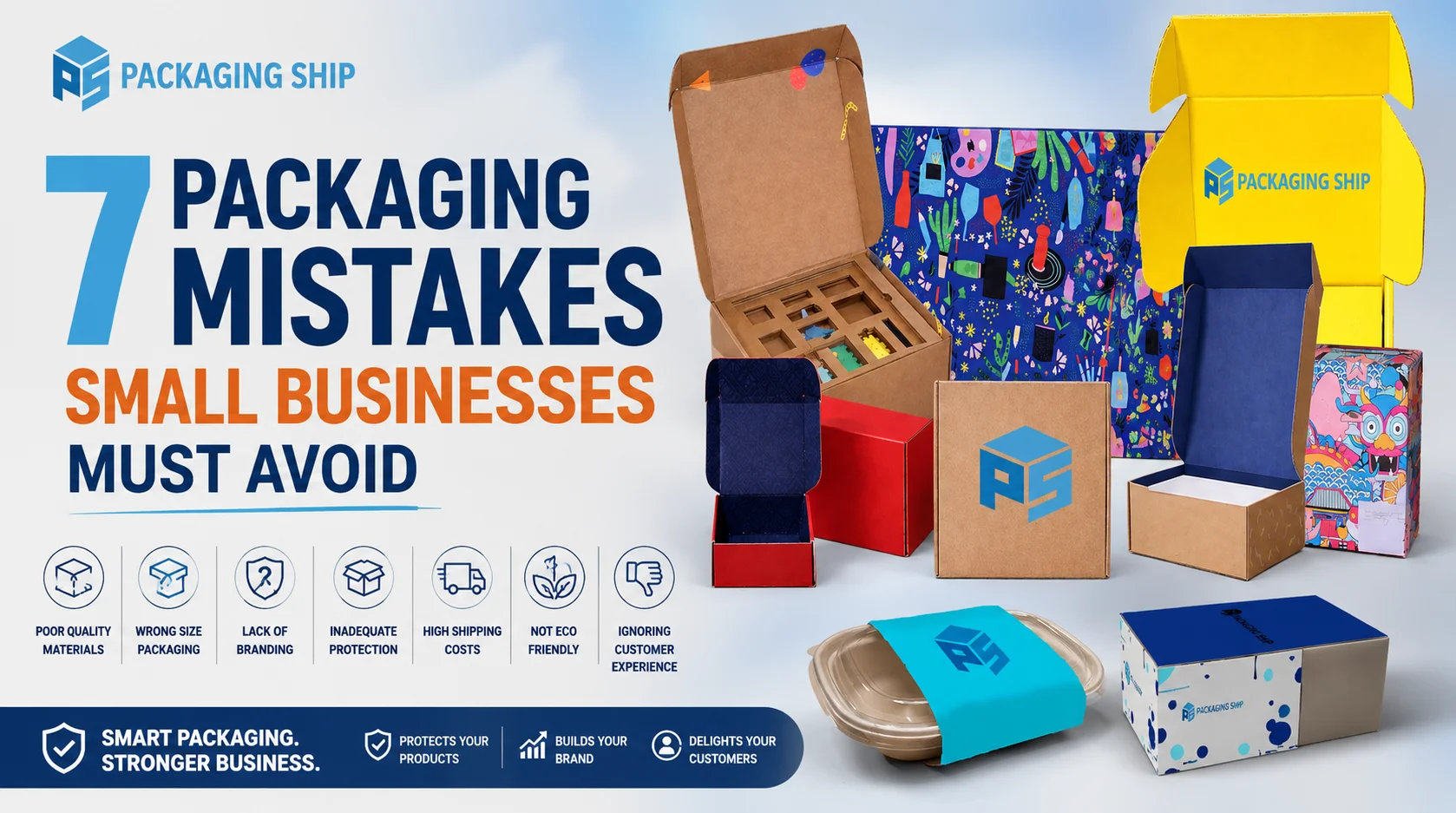
The 7 packaging mistakes small businesses make are not design problems. They are business problems with real dollar figures attached to each one. Wrong box sizes inflate your shipping bill on every order. Generic packaging lowers your repeat rate. Bad materials trigger returns and one-star reviews. Over-ordering upfront locks your cash into inventory that may not fit your final product. Wrong material choices cause damage in transit. Skipping the proof costs you a reprint and a launch delay. Ignoring sustainability costs you customers who are ready to buy.
Every one of these is fixable, and none require a bulk order commitment. Custom packaging for small businesses in the USA now starts at 50 units, from $0.20 per unit, with professional quality that competes with brands 10 times your size.
In 2026, the brands winning on Shopify, Amazon, and Etsy are not necessarily the ones with the best product. They are the ones whose product arrives in a box that earns a second order. Fix the packaging, and the repeat business follows.