
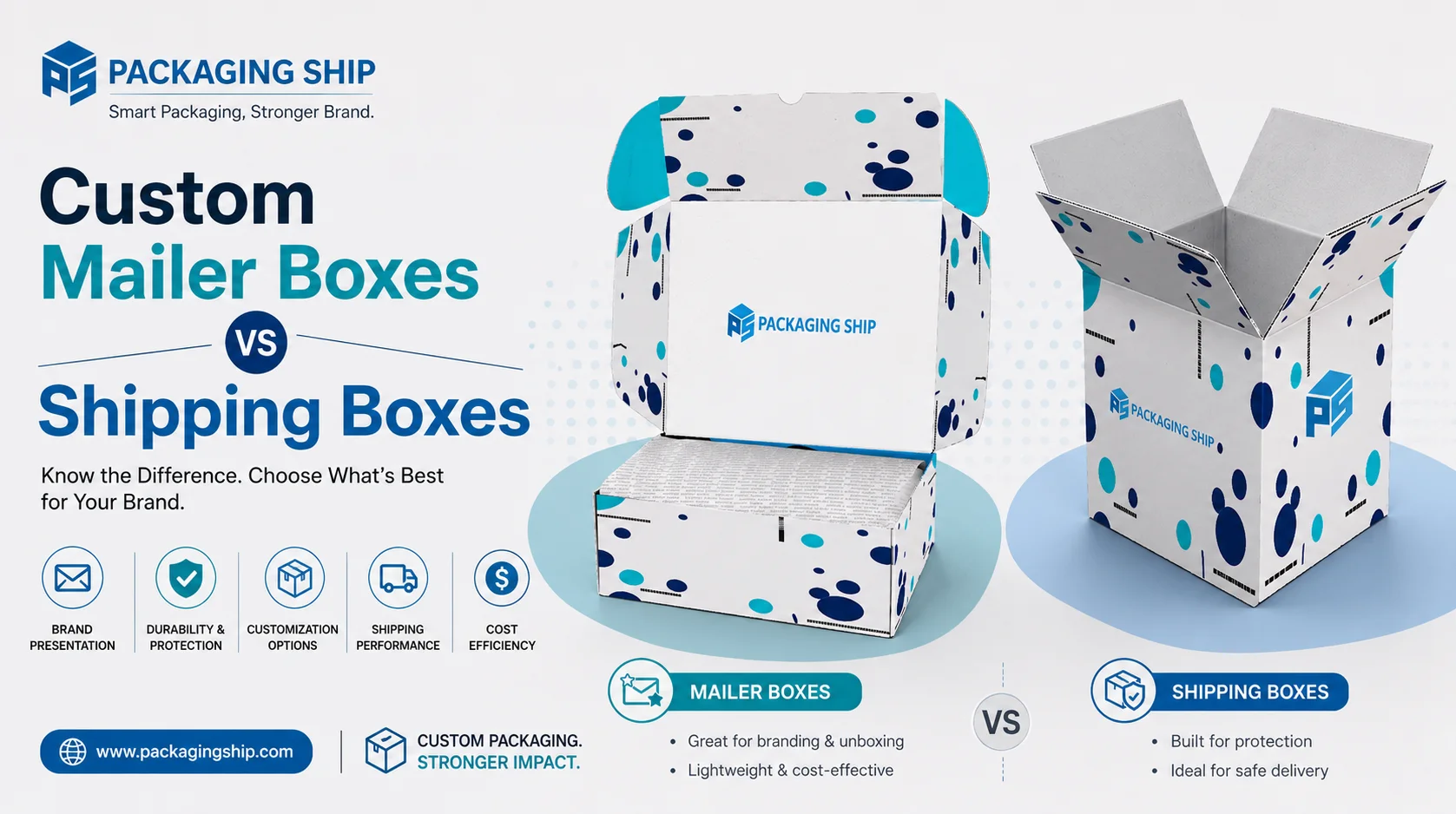
TLDR: Mailer boxes are light, self-locking, and built to look good when a customer opens them. Shipping boxes are sturdier and built to survive a rough ride. Which one you need comes down to what you’re shipping, not which one you like the look of more.
A mailer box is a lightweight corrugated box that folds and locks shut on its own, no tape required, built mostly for light items and for making a good first impression. A shipping box is heavier, needs tape to close, and is built to take a beating in a truck. If your product is light and you care about presentation, go mailer. If it’s heavy or breakable, go to the shipping box.
That’s the textbook answer anyway. In practice, most founders aren’t picking between two abstract categories. You’re standing in front of a spreadsheet trying to figure out why your damage claims went up last quarter, or you’re three weeks from launch and just need someone to tell you straight which box to order. So let’s actually get into it.
| Factor | Mailer Box | Shipping Box |
| Good for | Apparel, cosmetics, small accessories, books | Bulk orders, fragile or heavy goods, multi item bundles |
| How it closes | Folds and locks, no tape | Needs tape or adhesive |
| Branding | Plenty of room, built for the unboxing moment | Functional, less about flash |
| Cost per unit | Usually cheaper for light, flat products | Cheaper per cubic inch once you’re shipping heavier stuff |
| Putting it together | Fast, fold it and you’re done | Takes longer, has to be sealed |
| Protection | Fine for light, durable items | Better for anything fragile or heavy |
Both are made from the same stuff at the core, corrugated cardboard with a wavy fluted layer pressed between two flat liners. What changes is the engineering. A mailer box is die cut so it folds into a locked shape around your product. A shipping box gets built with thicker walls and more stacking strength, which is the whole reason it can sit at the bottom of a pallet without caving in.
Skip the guessing. Ask yourself these, in order, and you’ll know your answer by the third one.
Anything under about two pounds and reasonably flat, a mailer box will hold up fine. Heavier than that and you should already be leaning toward a shipping box.
Folded apparel, a candle in a tin, most cosmetics, sure. Glass, ceramics, anything with moving parts inside, no. That’s a shipping box, full stop.
Straight to a customer’s front door, a mailer box is usually enough. Going through a 3PL or freight, or landing on a retail partner’s shelf, it’s going to get handled more roughly than you’d expect, and a shipping box gives you margin for that.
For a subscription box or a gift set, yes, a lot. That’s often the one case where a mailer box wins even though a shipping box would technically protect the product just as well.
Still torn after running through those four? Order the sturdier option. A few extra cents per box is cheaper than a refund and an angry email.
This is the part most packaging blogs skip entirely, and it’s exactly where small brands get stuck calling suppliers asking “wait, what’s a flute again?”
You don’t need to know the engineering behind it. Just three things. A thinner flute, usually called E flute, suits lighter products and gives you a cleaner surface to print on. Standard B or C flute is what most general purpose shipping boxes use, more cushioning, more stacking strength. Double wall board, which is two flutes combined, is for heavy or expensive items that genuinely can’t afford to get crushed.
If a supplier quotes you a price without ever mentioning flute or wall strength, ask. It’s a completely fair question and any manufacturer who actually knows what they’re doing can answer it in a sentence. You can look through the corrugated boxes lineup by flute and wall type before settling on a quantity, so you’re not just trusting a quote on faith.
Here’s where this stops being a packaging question and starts being a money question. The National Retail Federation’s 2025 Retail Returns Landscape report puts the expected online return rate at 19.3% for 2025, and packaging failures are a recurring piece of why those returns happen. A return isn’t just a refund either. It’s the product cost, the return shipping, and very often a customer who quietly stops ordering from you.
Packaging shapes that decision more than most founders give it credit for. A study run by Ipsos for the Paper and Packaging Board found that 72% of consumers say packaging design affects their purchase decisions, and 67% say the same about the materials it’s made from. That doesn’t stop at the first sale either. A box that shows up crushed or flimsy makes people hesitate before ordering again.
None of this means “always buy the strongest box.” Overbuilding a mailer box for a t-shirt just wastes money and adds shipping weight you didn’t need to pay for. Underbuilding a shipping box for a set of glass jars basically guarantees you’ll see that order again, except this time as a return. The actual goal is matching the box to the product, not maxing out protection because it feels safer.
Running a Shopify store and shipping anything under two pounds, custom mailer boxes are usually the right call. They arrive flat, take up almost no storage space, and you can fold and lock one shut in seconds, which matters a lot when you or one other person is the entire fulfillment team. They also hand you free advertising space, since a good unboxing moment is the kind of thing customers actually screenshot and post.
Subscription businesses lean on mailer boxes even harder, because the unboxing is part of what people are paying for, month after month. Stuff a subscription box into a plain shipping carton and you’ve quietly removed half the reason someone signed up.
Where you’d want to switch to a shipping box on Shopify is multi item orders, wholesale pallets, or anything genuinely fragile. Three glass skincare bottles bundled together belong in a proper shipping box with dividers, not folded into a flat mailer and hoping for the best.
Here’s the part most suppliers would rather you not think too hard about. A lot of the big manufacturers want 1,000 to 5,000 units before they’ll even run a custom print job, which is a rough ask if you’re still testing whether a product sells.
You don’t actually have to commit to that. Digital printing makes it realistic to order custom mailer boxes in small runs, sometimes as low as 50 to 100 units, and skip the setup fees that only pay for themselves at higher volume. Before you order, just ask directly whether a supplier charges die or plate fees on small batches, because that’s usually where a quote that looked cheap turns out not to be. Once you’re consistently moving a few hundred units a month, offset printing tends to bring the per unit cost down further, so it’s worth checking back on your format every quarter instead of locking in once and forgetting about it.
| Question | Answer |
| What’s the difference between a mailer box and a shipping box? | A mailer box is a self locking corrugated box made for light products and branding. A shipping box is heavier, needs tape, and is built for weight and rougher handling over distance. |
| Can a mailer box go straight into the mail with nothing else? | Usually, yes. For light, durable items it holds up fine on its own, though anything fragile inside might still want a wrap or insert. |
| Are mailer boxes more expensive than shipping boxes? | Generally not. For light, flat products they’re often cheaper, partly because they use less material and partly because they avoid dimensional weight charges. |
| What’s the smallest order I can place for custom mailer boxes? | A lot of suppliers will now do 50 to 100 units through digital printing with no die or plate fees tacked on. |
| Which one’s better for a subscription box business? | Mailer boxes, almost always. The unboxing is the point for subscription brands, and that’s exactly what mailer boxes are built for. |
| Do shipping boxes actually protect fragile items better? | Yes. Thicker walls and more stacking strength make them the safer pick for glass, ceramics, or anything bundled with multiple pieces. |
If you’ve read this far, you probably already know which box your product needs. What’s left is getting an actual number instead of guessing.
Get a Free Packaging Quote in Under 2 Minutes →
Mailer box or shipping box isn’t really a question of which one looks nicer in a product photo. It comes down to what your product weighs, how fragile it is, and what story you want the box itself to tell before the customer even opens it. Light, brand forward products belong in a custom mailer box. Heavier, fragile, or bulk shipments belong in a shipping box. Get that match right and you’re protecting your margins, your product, and the customer who decides whether they’re ordering from you again.