
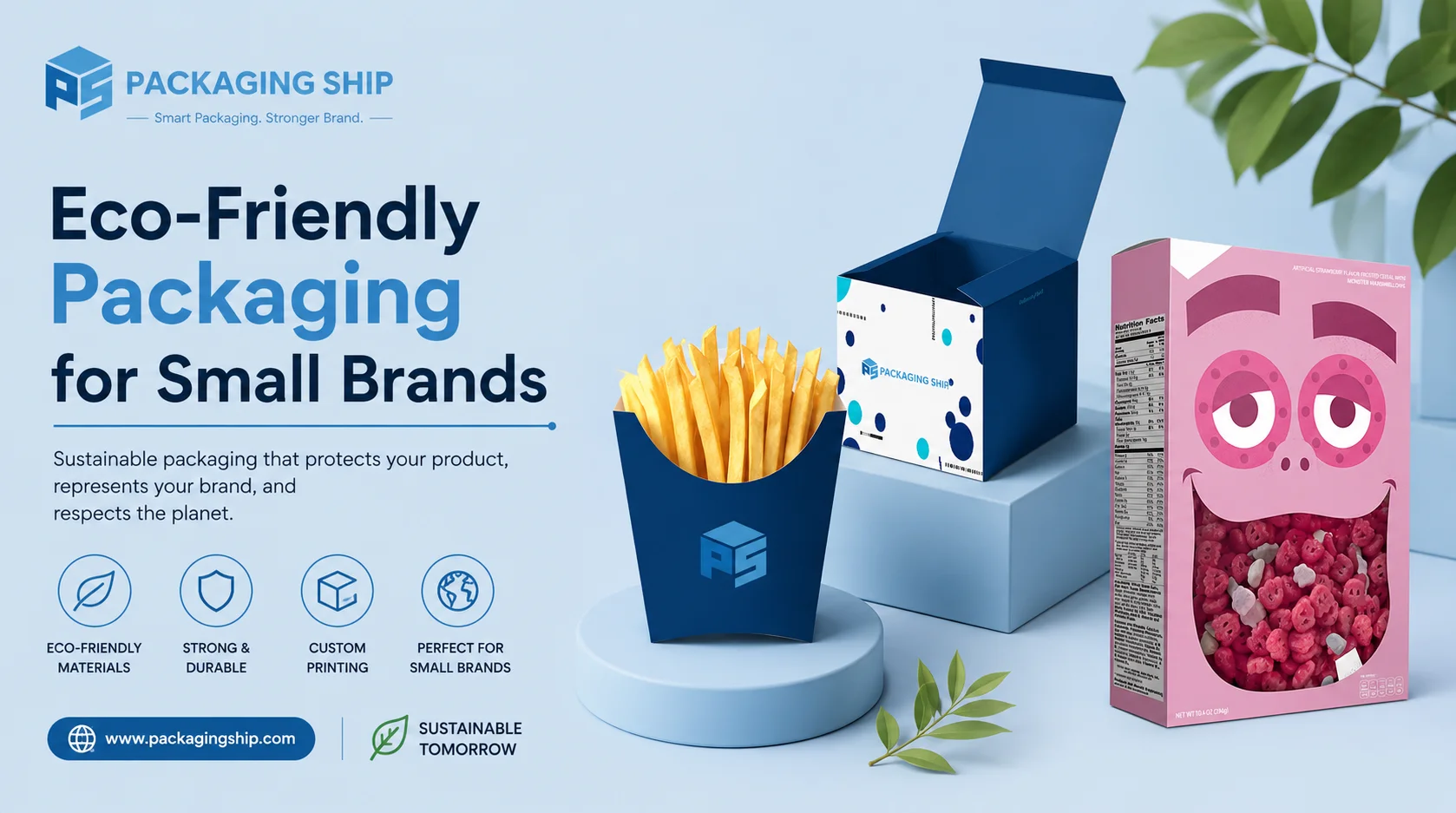
TL;DR: Recycled kraft and FSC-certified boxes are available from $0.20 per unit, no minimum order. Trivium Packaging’s 2023 survey of over 9,000 consumers found 82% willing to pay more for sustainable packaging. Shorr’s 2025 US-only survey of 2,016 shoppers found 39% had already switched brands over packaging choices. Both reports are linked in the body. This blog is a practical guide, not a pitch.
Short version: packaging made from materials that don’t wreck things when they’re done being packaged.
Longer version, because the short one doesn’t quite capture the nuance: it’s a category covering FSC-certified kraft paper, post-consumer recycled corrugated board, water-based inks, biodegradable void fill, and combinations of the above. The common thread is traceability. You should be able to tell someone where your packaging materials came from and what happens to them after the customer opens the box.
What it isn’t: it’s not necessarily expensive. It’s not necessarily complicated. And it doesn’t require minimum orders of 500 units anymore, which was the thing that actually kept most small brands out of this for years.
One thing worth getting out of the way early: the phrase “eco-friendly” has almost no legal meaning in the US. Brands can print it on anything. What has legal and commercial meaning is third-party certification, specifically FSC for fiber materials and recognized recycled content standards. More on that in section three.
I want to share two pieces of data here, and I’ll link both studies because I think you should read them yourself rather than just take my word for it.
Trivium Packaging partnered with Euromonitor International to survey more than 9,000 consumers across North America, Europe, and South America. The 2023 Buying Green Report found 82% of respondents said they’d pay more for products in sustainable packaging. Consumers aged 18 to 24 came in at 90%.
Then Shorr Packaging ran a US-specific consumer study in 2025. They surveyed 2,016 American shoppers. The number that jumped out to me: 39% of respondents had already switched to a competing brand because that brand offered more sustainable packaging. Not because the product was better. The product was probably identical..
That’s not a preference. That’s a purchasing decision already made, in the past, by over a third of your potential customers.
And then there’s the cost side, which I’ll address properly in section seven. The short version is that recycled corrugated board often undercuts virgin material on price. The assumption that sustainable packaging costs more is mostly out of date.
FSC stands for Forest Stewardship Council. Founded in 1994, independent non-profit, sets internationally recognized standards for responsible forest management. When a packaging supplier holds FSC Chain of Custody certification, it means the fiber in their paper and board can be traced back through the supply chain to forests that meet those standards. Trees get replanted properly. Waterways don’t get poisoned. Workers get paid fairly.
When you order FSC-certified kraft boxes from a legitimate supplier, you can pass that story on. Your customer sees the FSC logo on the box, and they’re not looking at a marketing claim. They’re looking at a verified third-party certification that has existed for over three decades.
Ask any supplier you’re considering for their FSC Chain of Custody certificate number before you place an order. A real one takes about 10 seconds to provide.
Now, what FSC certification isn’t: it isn’t a guarantee that everything else about the packaging is sustainable. The inks might still be petroleum-based. The coating might be non-recyclable. FSC covers the fiber source, not the full product. It’s an important piece. It isn’t the whole picture.
Why does this matter specifically for packaging for small brands? A few reasons. If you ever want to sell through natural grocery chains or sustainable gift retailers, FSC documentation increasingly appears on their vendor qualification checklists. Getting there now costs nothing extra. Being caught without it when a buyer asks is a problem you don’t need.
These three terms get used interchangeably in product descriptions. They mean genuinely different things.
Recycled packaging contains material that has already gone through a full consumer use cycle, been collected, processed, and reincorporated into new material. Post-consumer recycled content, PCR for short, is the most meaningful version of this. It reduces virgin material demand and keeps waste out of landfill right now, not hypothetically.
Recyclable packaging can theoretically be processed into new material after use. Whether it actually gets recycled depends entirely on what recycling infrastructure exists near your customer, and whether they use it. Thin-film poly mailers are technically recyclable. Their real-world recycling rate in the US is approximately 2%. Worth knowing before you put a “recyclable” claim on one.
Biodegradable is the most misused of the three. It just means something breaks down biologically at some point. That point could be six weeks in an industrial compost facility. It could be 40 years in a sealed landfill. The term has almost no regulatory definition in the US. Products labeled biodegradable without specifying conditions are telling you almost nothing useful.
For a small brand shipping orders through USPS or UPS in 2026, the most defensible combination is FSC-certified fiber with post-consumer recycled content, printed with water-based inks, in a mono-material structure so there’s no lamination layer preventing kerbside recycling. That’s it. It’s not complicated. Most of the industry jargon exists to make this feel more complicated than it is.
Kraft corrugated mailer boxes cover the majority of use cases. E-commerce, DTC, Etsy, Shopify, whatever platform you’re on. They’re protective, lightweight, FSC-certifiable, and they take digital print well. If you’re starting from scratch, this is where to start.
For premium product categories, rigid kraft boxes change the experience of receiving a package in a way that corrugated mailers don’t. The structure itself signals something before your customer even lifts the lid. Paired with matte lamination or soft-touch coating, they create an unboxing moment that people photograph. This matters. Photographed unboxing experiences are free marketing.
Food and bakery brands get an interesting opportunity here. Custom cake boxes in FSC-certified kraft connect the story of handmade food with the story of thoughtful materials. Those two things belong together in the customer’s mind. When they come apart, when beautiful handmade goods arrive in anonymous white cardboard, there’s a small but real dissonance.
CBD and wellness brands are working with a different constraint in 2026: compliance and sustainability now overlap. Custom CBD boxes built on recycled board with accurate sizing and water-based printing handle both simultaneously. Fewer material trade-offs than some brands expect.
Seasonal campaigns are where sustainable materials really earn their premium. Custom Christmas boxes in recycled kraft with matte foil or embossing give holiday gifting a texture that glossy plastic-coated alternatives don’t have. Customers notice. They post about it. In November and December, when brand visibility matters most, the packaging often does more work than the product.
| Material | Best application | FSC available | Kerbside recyclable | Starting price |
| Kraft corrugated mailer | E-commerce, DTC shipping | Yes | Yes | From $0.20/unit |
| Rigid kraft box | Luxury, cosmetics, gifts | Yes | Yes | From $0.52/unit |
| Recycled PCR corrugated | Retail, bulk shipping | Yes | Yes | From $0.20/unit |
| Kraft paper bag | Bakery, apparel, retail | Yes | Yes | From $0.20/unit |
| Cardboard tuck box | Cosmetics, retail shelf | Yes | Yes | From $0.52/unit |
| Mylar bag with kraft exterior | Food, CBD, supplements | Partial | No | From $0.53/unit |
Everything in the table above is available with custom printing through Packaging Ship. Free design support, free US shipping, 7 to 10 business day production turnaround, no minimum order.
Starting at $0.20 per unit. No minimum order. Free design. Free shipping.
Those aren’t promotional numbers invented for this article. That’s the actual pricing structure at Packaging Ship. And for the question of whether eco-friendly materials cost more than conventional ones: recycled corrugated board often comes in at the same price or slightly below virgin material. Molded pulp inserts run about 65% cheaper per unit than plastic foam.
The minimum order issue was the real barrier for years. Suppliers requiring 500 or 1,000 units before producing a custom print run effectively locked out any brand doing under a certain volume. If you were shipping 80 orders a month on Etsy, 500 custom boxes meant six months of inventory sitting in your spare room. That model is gone now, or it should be. Any supplier still enforcing those minimums on small runs in 2026 hasn’t kept up.
The sustainable e-commerce packaging market was valued at $325.94 billion in 2026 and is projected to reach USD 463.41 billion at a 7.29% by 2031, according to Mordor Intelligence data compiled and published by EcoPackables. That growth isn’t coming from large corporations renegotiating contracts. It’s coming from small and mid-sized brands adding sustainable packaging and keeping it.
Packaging for small brands is the first thing a customer touches. Not the product. The box it came in. That contact happens before the candle is smelled, before the jewelry is tried on, before the baked good is eaten. And it happens every single order.
Brands that use that moment well build something: recognition, association, a feeling about what they stand for. Brands that ship in generic brown boxes miss it every time.
McKinsey’s 2024 research found 44% of consumers consider environmental impact very important in packaging decisions, according to research aggregated by Meyers Packaging. That’s not a niche segment. That’s close to half your buyers carrying that value into the moment they open your shipment.
If you want to see what eco-friendly packaging options look like for your product specifically, click here to explore the full range at Packaging Ship, with no minimum order, free design support, and free US shipping: packagingship.com/category/eco-friendly-packaging.
Nearly four in ten US consumers have already switched brands over packaging. That’s not a future risk. It happened. And the businesses that lost those customers mostly didn’t know why.
Switching to FSC-certified and recycled packaging for small brands isn’t complicated in 2026. The material is available. The prices are fair. The minimum order barrier is gone. What’s left is just making the decision.
Your packaging is the first physical thing your customer holds. It probably takes them about three seconds to form an impression of it. Those three seconds compound over thousands of orders.
Make them count.
Get a free custom eco-packaging quote today
No minimum order. Free design support. Free US shipping. Production in 7 to 10 business days. From $0.20 per unit.
👉 Get Your Free Quote at PackagingShip.com
It means the fiber in your packaging, the paper, the board, comes from forests verified to meet the Forest Stewardship Council’s environmental and social standards. The FSC has been running since 1994. It’s a third-party certification with a traceable chain of custody, not a brand claim. Suppliers hold FSC Chain of Custody certificates with verifiable license numbers.
In many cases, no. Recycled corrugated board is often priced identically to or below virgin alternatives. At Packaging Ship, custom eco-friendly packaging starts at $0.20 per unit with no minimum order. The perception that it costs more is mostly outdated, based on market conditions from five or more years ago.
Recycled means the material already went through a use cycle and was reprocessed before becoming your box. Recyclable means it can be processed after your customer uses it, if the right infrastructure exists where they live. Recycled content has immediate, guaranteed impact. Recyclable content has potential future impact, which depends on behavior and infrastructure you don’t control.
Yes. Packaging Ship has no minimum order. You can order a small test run, see how your design looks in real life, check how customers respond, and scale from there. No warehouse full of boxes you might change your mind about.
FSC-certified corrugated kraft with post-consumer recycled content and water-based inks. Holds up in transit, prints cleanly, kerbside recyclable in most US markets, and meets the sustainability expectations that have become baseline for online shoppers in 2026.