
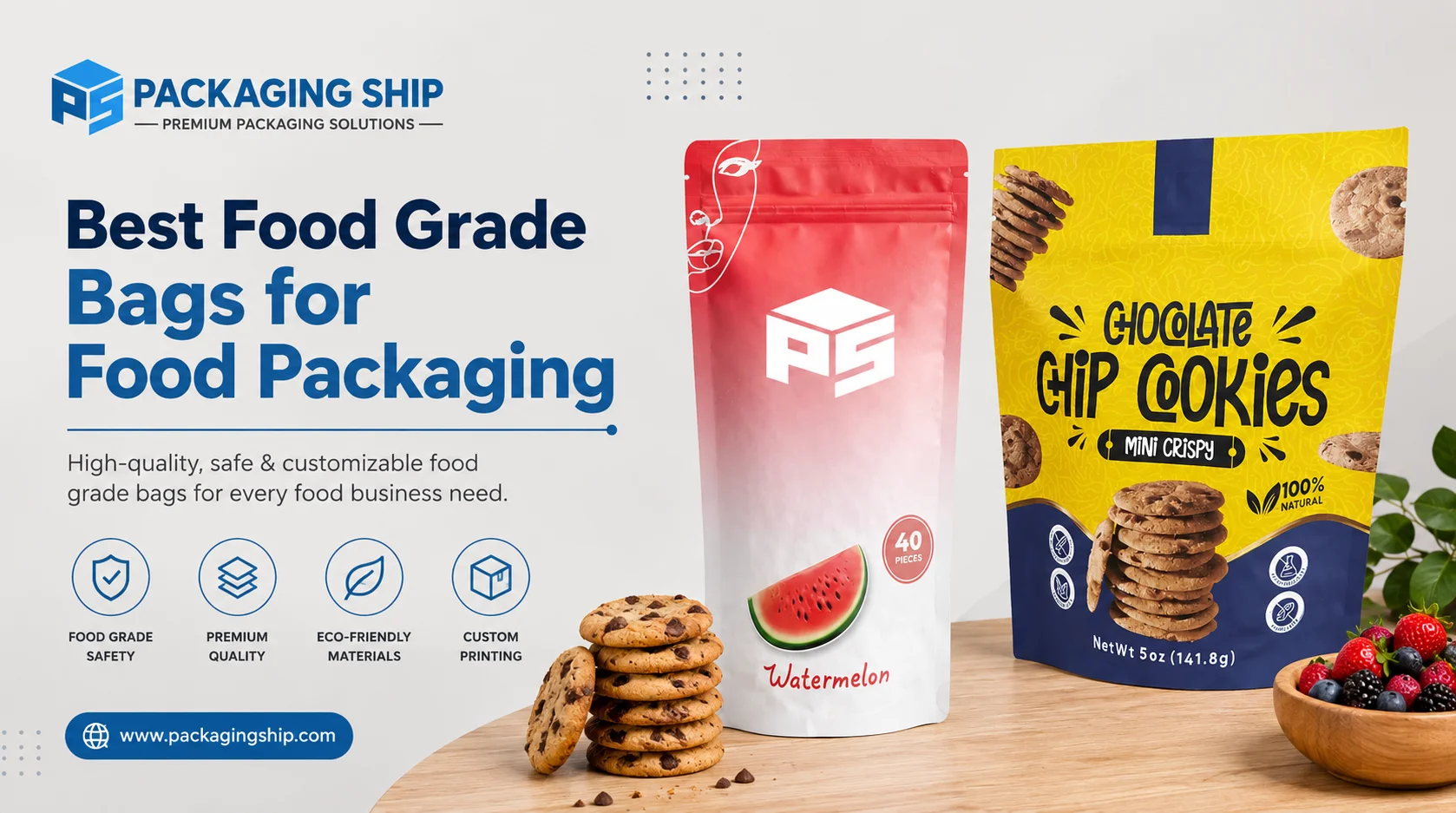
Last spring, a Texas-based cookie brand finally landed the wholesale account they had been chasing for two years. A regional grocery chain. Orders jumped from 200 to 2,000 units almost overnight. Three days later, the buyer’s compliance team sent one email: “We need documentation that your packaging is food contact safe.”
The founder stared at her screen. She had been packing cookies in bags from a local supplier. No certifications with no migration test reports. No 21 CFR reference anywhere on the product spec sheet.
She lost the account.
This guide exists so that does not happen to you. By the end of it, you will know exactly what the best food grade bags for food packaging actually are, how to verify FDA compliance before a buyer asks, and which bag type fits your specific product, cookies, baked goods, snacks, or perishables.
Food grade bags are packaging materials manufactured and tested specifically for direct contact with food. They do not leach harmful chemicals into your product. And they do not alter flavour. They do not introduce contaminants during storage or transport.
Here is what most suppliers do not tell you: “food safe” printed on a bag means nothing without documentation behind it. It is a marketing phrase, not a regulatory status. Genuine food grade packaging has test reports, material specifications, and compliance with FDA standards under 21 CFR Parts 174 to 179. If your supplier cannot produce those documents, that bag is not verified food grade, regardless of what the label says.
The FDA maintains a living database of every material legally permitted to touch your food. As of 2026, that database holds over 1,700 effective Food Contact Substance Notifications under 21 CFR, and your bags need to appear in that framework before a single cookie goes inside one.
Most food businesses treat packaging as a cost, not a compliance asset. That mindset is expensive.
Wrong bag choices lead to:
The good news? The right food safe packaging bags protect your product, strengthen your brand, and scale with your business. They also open doors, retail buyers, eCommerce platforms, and distributors all check food packaging standards before onboarding a supplier.
Walk into any independent bakery in the US and you will likely find kraft paper bags behind the counter. There is a reason for that. Kraft paper is strong, printable, and naturally positions your brand as eco-forward without trying too hard. A greaseproof-coated version handles cookies, pastries, and bread loaves without oil bleed-through on the surface.
If you run a bakery and want packaging that works both in the display case and on a retail shelf, kraft bags paired with Custom Bakery Boxes give you that complete, shelf-ready presentation without needing two separate suppliers.
Best for: Cookies, bread loaves, pastries, dry snacks, coffee
Low-Density Polyethylene bags are the quiet workhorse of the food packaging world. They are FDA-compliant under 21 CFR Part 177, transparent enough to show the product, flexible enough to run through automated lines, and tough enough to handle freezer temperatures without cracking or becoming brittle.
That combination is why LDPE is the single most widely used material in U.S. food processing facilities. It does not try to do everything, it does the fundamentals exceptionally well at a price point that scales.
Best for: Fresh produce, frozen goods, baked goods in high-volume operations
Stand-up pouches use multi-layer laminate films, typically PET or nylon bonded with LDPE to build barrier properties that block oxygen, moisture, and light at the same time. That structure alone makes them one of the strongest food packaging bags available in flexible format.
But the real reason they move product? Resealability. Consumers do not just grab a stand-up pouch because it looks good on the shelf. They come back for it because they can close it. Flexible Packaging Europe found that 65% of buyers specifically choose resealable pouches for that one reason. One feature. Drives the repeat purchase. And the sales data backs it up stand-up pouches held 38.67% of North America’s flexible packaging market in 2024, with food brands accounting for the largest share of that demand.
Best for: Granola, trail mix, snacks, protein powders, specialty foods
Mylar is metallized polyethylene terephthalate, and it is in a different performance category from most food packaging bags. It blocks over 99% of oxygen transmission. And it resists light degradation. It does not let moisture in or out. For any product where shelf life is the primary driver of the purchase decision, specialty foods, long-storage items, emergency food supplies Mylar is the right call.
For CBD-infused food products, Mylar also solves a second problem. The opacity and tamper-evident structure it provides are exactly what most regulatory and retail compliance requirements ask for in that category.
Best for: Long-shelf-life foods, specialty products, emergency food supplies
PLA bags are made from plant starches, usually corn and carry ASTM D6400 certification for industrial composting. They meet food contact safe packaging standards and they connect emotionally with the growing segment of consumers who read ingredient labels and packaging claims with equal scrutiny.
One thing worth saying clearly: PLA bags require industrial composting to break down properly. Before you position them as home compostable on your label or website, verify what your local waste infrastructure actually supports. Getting that wrong is the kind of greenwashing claim that attracts regulatory attention.
For brands building a genuine sustainability story, our Eco Friendly Packaging range pairs PLA bags with certified materials across your full packaging line, so the eco claim holds up at every touchpoint.
Best for: Organic food brands, farmers market sellers, zero-waste product lines
Cookie packaging is one of the most searched, most mishandled food packaging decisions in the small business space. Here is why it is more complex than it looks.
Cookies have three simultaneous enemies: moisture, oxygen, and physical breakage. A bag that handles one but ignores the other two fails your product within 48 hours of packaging.
The best bags for cookie packaging combine:
For gifting or wholesale cookie orders, a kraft bag with a windowed front panel hits every practical need while giving retail buyers the visual appeal they require. Pair that with structured food boxes and packaging and you have a complete cookie packaging system — not just a bag.
When a supplier tells you their bags are “FDA approved,” ask one specific question: “Which section of 21 CFR covers your materials?”
If they cannot answer that, find a different supplier.
Here is what genuine FDA compliance looks like for food packaging bags:
The FDA’s Food Contact Substance Notification database is publicly accessible and updated regularly. You can verify any supplier’s claim before placing an order.
According to the FDA’s own regulatory framework under 21 CFR Part 174, food contact substances must also not transfer to food in amounts that would negatively affect consumer health, even when they appear on the approved list.
Moisture is the single most common cause of food quality failures inside otherwise compliant packaging.
Two metrics determine whether your bag actually protects your food:
Most generic bags do not publish these values. Certified food grade bags do. Always ask for WVTR and OTR data when sourcing bags for moisture-sensitive products.
The best food brands do not think in individual components. They think in packaging systems.
Your food grade bag handles the primary containment. But what protects it during shipping? What creates the unboxing moment that earns a repeat purchase?
Food brands scaling into eCommerce or wholesale need a second layer: a structured mailer or shipping box that keeps the bag, and the product inside, intact from warehouse to doorstep.
Our Mailer Boxes are designed to work alongside food grade bags as a complete system. They add structural protection, brand visibility, and an unboxing experience that turns a first-time buyer into a loyal customer.
BPA-free is one chemical exclusion. FDA compliance is a full regulatory framework. They are not the same thing.
A bag without published WVTR and OTR values is a guess, not a specification.
The cheapest bag often fails the first compliance audit. The recall costs far more.
Oily foods need grease-resistant barriers. Dry foods need moisture vapor control. One bag does not fit all products.
Your packaging is your first food safety decision. It is also your first branding decision. Both matter from day one.
Choosing the best food grade bags for food packaging is not complicated once you know the framework. Match your material to your product’s specific barrier needs. Verify FDA compliance with actual CFR references. Build your packaging as a system bags, boxes, and mailers working together, not as isolated components.
The cookie brand in Texas that lost her wholesale account rebuilt with the right food contact safe packaging. Within six months, she had certification documentation, branded bags, and a new wholesale buyer. The packaging decision she treated as minor turned into the business decision that changed everything.
Your food deserves packaging that protects it. Your brand deserves packaging that sells it.
Ready to Get Your Food Packaging Right?
At Packaging Ship, we supply FDA-compliant food grade bags, custom printed options, and complete packaging systems for food brands across the US, with free design support, no minimum order, and free shipping on every order.
Food grade refers to materials certified for direct food contact under FDA standards. Food safe is often a marketing term without mandatory testing behind it. Always verify 21 CFR compliance before purchasing.
Yes. Mylar bags are made from polyethylene terephthalate (PET), which is FDA-approved for food contact use. Their high barrier properties make them among the strongest food storage bags available.
Greaseproof kraft bags with heat-seal closure are the top choice for small-batch cookie packaging. They handle grease, maintain freshness, and print cleanly for branded presentation.
Yes. Even under cottage food laws, your food contact packaging must meet food packaging standards to avoid contamination liability. FDA-compliant materials apply regardless of business size.
Absolutely. Custom printing on food grade packaging uses food-safe inks that comply with FDA regulations on indirect additives. At Packaging Ship, every custom bag uses compliant print processes.