
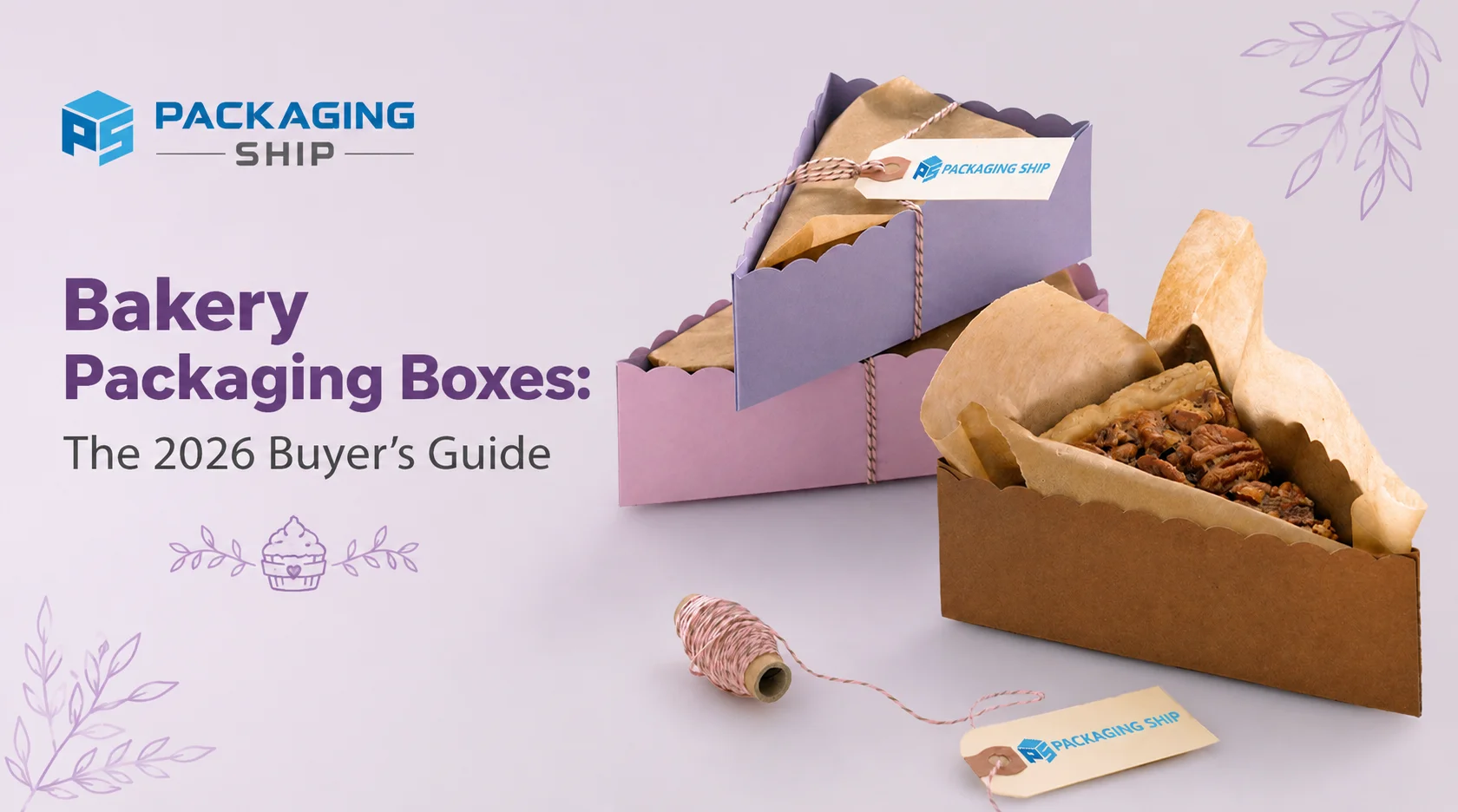
What are bakery packaging boxes? They are food-safe containers, made from SBS board, kraft paper, or corrugated fiberboard, used to carry, protect, and present baked goods from your kitchen to your customer.
A bakery owner in Denver once told me her packaging nearly cost her a wholesale account before she even knew there was a problem. She had landed a regional café chain. Forty-eight units a week. She was ecstatic. By the third delivery, boxes were arriving with grease bleed-through on the base and dented corners from stacking. The café manager called once. Then they just stopped ordering.
Her product was genuinely excellent. Her packaging spec was wrong in three specific ways, all of which were fixable. She just did not know to ask the right questions before placing her first order.
That story is not unusual. Most bakery founders and procurement managers encounter it at some point. And the frustrating part is that the fix is never complicated, it just requires knowing what to look for before you commit to a run.
The bakery packaging market reached USD 3.65 billion in 2025 and is expected to climb to USD 4.71 billion by 2030, growing at a 5.24% CAGR, according to Research and Markets. That growth signals something real: more bakery brands are competing for the same retail shelf space, the same café accounts, the same direct-to-consumer customers. The ones winning those accounts share one common thread. Their packaging does its job.
This guide is for bakery owners and procurement teams who want to get that right the first time.
There is no single correct answer here, and anyone who tells you otherwise is selling one product. The right box depends on three things: what you are packaging, where you are selling it, and what your customer does the moment they pick it up.
These are the most versatile option in the market. They assemble quickly, hold their structure at wholesale volumes, and take print well on all four sides. For cookies, brownies, single-layer pastries, or anything that does not require height support, they are the reliable choice. If you are moving products through retail counters or café partnerships, a gloss-laminate finish on the exterior changes the perception of the box entirely without adding meaningful cost.
It deserve a dedicated mention. The die-cut acetate or PLA panel lets the product sell itself. For cookie boxes, pastry packaging, and dessert boxes sold at specialty grocers, farmers markets, or through e-commerce fulfillment, that visibility matters more than most bakery owners realize. Customers pick up windowed boxes and put them back down based entirely on what they see inside. If your product looks as good as it tastes, the window earns its cost back quickly.
For cupcakes, the box is only half the conversation. Our Custom Cupcake Boxes are built with internal insert options at 275gsm and above because cupcakes without inserts shift in transit. Frosting hits the lid. The customer’s first impression is a ruined presentation before they have even tasted anything. We absorb the die and plate charges so you get full custom print without the setup cost that most suppliers quietly pass on.
The Cake boxes are a different spec conversation entirely. A 10-inch single-tier cake needs a minimum 11×11×5-inch interior and a base board heavy enough to carry the load without flexing mid-stack. Our cake boxes are engineered to that standard, structurally rigid, clean enough to hand directly to a customer at a wedding pickup, and available in custom print at any quantity.
For bakeries shipping at wholesale volume, a corrugated outer carton around your presentation box adds a second layer of protection for the courier journey. The inner box handles presentations. The outer handles the logistics.
Most bakery packaging failures trace back to one of these five points. None of them are complicated. All of them matter.
SBS board solid bleached sulfate, is the standard material for food packaging boxes that require direct food contact. Under FDA 21 CFR 176.180, paper and paperboard components intended for contact with dry food must meet specific compositional requirements and extractive limitations. SBS meets that standard for dry bakery applications and gives you the bright white surface that CMYK printing requires. Packaginglaw
The limitation people miss: SBS alone is not right for every product. Anything with significant butter content, cream filling, or grease above roughly 15% will bleed through unlined board during storage or transit. For those products, you need a PE-lined interior or a grease-barrier kraft insert specified to the application. Ask your supplier directly which liner is in the board they are quoting. If they cannot answer that question, treat it as a signal.
PLA windows are compostable and increasingly expected by specialty retail buyers who ask about sustainable sourcing. Acetate is more rigid and marginally cheaper per unit. Cellophane is biodegradable but less structurally reliable over longer shelf periods. For brands selling into premium grocery channels, the PLA cost difference per unit is small. The commercial conversation it enables is not.
Matte finishes reading as artisan and handcrafted. Gloss reads as fresh and mass-market. A clean serif typeface on a natural kraft board communicates something entirely different from bold sans-serif on white SBS, and retail buyers read those signals before they read your ingredients label. Bakery box design is not a cosmetic choice. It is a positioning decision with direct revenue implications.
At PackagingShip, free design support means you bring the brand elements and we handle the technical execution. No external agency required.
Digital printing is practical for runs under 500 units. Offset CMYK is cost-effective at 1,000 units and above and delivers better color fidelity for brand-critical applications. Flexographic printing suits corrugated outer cartons. The choice is not just aesthetic, it determines your cost per unit at each volume tier. We absorb die and plate charges entirely, which removes the hidden setup cost that catches most first-time wholesale buyers off guard.
Bakery and confectionery held the largest application share within the global food packaging market at 38.82% in 2026, which means courier networks are moving bakery boxes at enormous daily volume. A box that photographs beautifully in a studio and collapses at a sorting facility has failed its primary job. Test your box under realistic load and stack conditions before you commit to a wholesale run. Fortune Business Insights
Most packaging suppliers have a quiet pricing threshold. Under 500 units and they are genuinely not interested in running custom print for you. That barrier is real, and it pushes small and growing bakeries toward generic food packaging boxes, plain white, unbranded, shelf-invisible, while their better-funded competitors show up with branded packaging built to move product.
We built PackagingShip differently. No minimum order quantity. Whether you need 50 custom cookie boxes to test a new retail account or 5,000 branded cake boxes for a national launch, the pricing structure is honest. Free US shipping means your landed cost is exactly what we quote you. No die charges and there are no plate fees. No design fees.
That combination changes the math for growing bakeries. You can test a new box design on a small run, validate it in the market, and scale without renegotiating pricing tiers or absorbing setup costs on every new SKU.
Sustainability has moved from a brand preference to a procurement checklist item. Regional grocery buyers and specialty food retailers are increasingly asking about FSC certification, compostable window materials, and soy-based ink usage before they finalize vendor agreements.
The cost reality is more manageable than most bakery brands expect. Recycled SBS board performs comparably to virgin boards across most bakery applications. Kraft paper carries an inherent sustainability signal without requiring certification at smaller run sizes. The paper and paper-based materials segment of the food packaging market is expected to grow at a CAGR of 5.2% from 2026 to 2033, which reflects where buyer expectations are heading, not where they might eventually arrive. Grand View Research
If you want to explore our full range of sustainable bakery packaging options, click here to browse our bakery box collection at PackagingShip.
The wrong box does not just look bad. It loses accounts. One dented wholesale delivery can end a retail relationship that took months to build. One grease-stained cookie box, opened in front of a customer, does damage to a brand that took years to earn.
Getting it right means knowing your board weight before you order, not after the first complaint. It means matching your window material to what your retail buyers actually require. It means working with a supplier who does not charge you setup fees to customize packaging that represents your brand.
At PackagingShip, we make that straightforward. No minimums. No setup costs. Free design support. Free US shipping. Bakery packaging boxes built for the product you actually make and the accounts you are genuinely trying to win. Ready to Order Custom Bakery Boxes with No Minimums?
Free design support. Zero setup fees. Free US shipping on every order — 50 units or 5,000.
Get Your Free Quote at PackagingShip →
A 6-inch round cake needs a minimum 7×7×4-inch box. For taller decorated cakes with fondant or stacked frosting, move the height to 5 or 6 inches. Always leave at least half an inch of clearance on each side to protect decoration during handling.
Yes, provided they use SBS or a kraft board that meets FDA 21 CFR 176.170 or 176.180 for the specific contact application. Always ask your supplier for food-contact compliance documentation. Generic cardboard does not automatically qualify, the board specification matters.
There is no minimum. Order 50 units or 5,000. Custom print, no die charges, no plate fees, free US shipping on every order.
SBS is bright white, takes CMYK print cleanly, and meets FDA food-contact standards for dry bakery applications. Kraft is unbleached and naturally brown, it reads artisan and eco-conscious at a glance on a retail shelf. Neither is universally better. The right choice comes down to your brand position and your product’s contact characteristics.
Yes. Any quantity, PLA or acetate window, full custom print, free design support. Same terms regardless of order size.