
Picture this. You are at a farmers market. Your soap smells amazing. The woman two stalls down is sold out by noon, and honestly, her soap is nothing special. But her packaging looks like it belongs in a boutique. That is the uncomfortable truth about the handmade soap packaging business. The product gets you in the room. The packaging closes the sale.
The global handmade soap market sits at USD 168.2 million in 2024 and is on track to hit USD 304.1 million by 2034. North America holds 40% of that share. More brands are entering this space every single month. So if your packaging still looks like an afterthought, 2026 is the year to fix that.
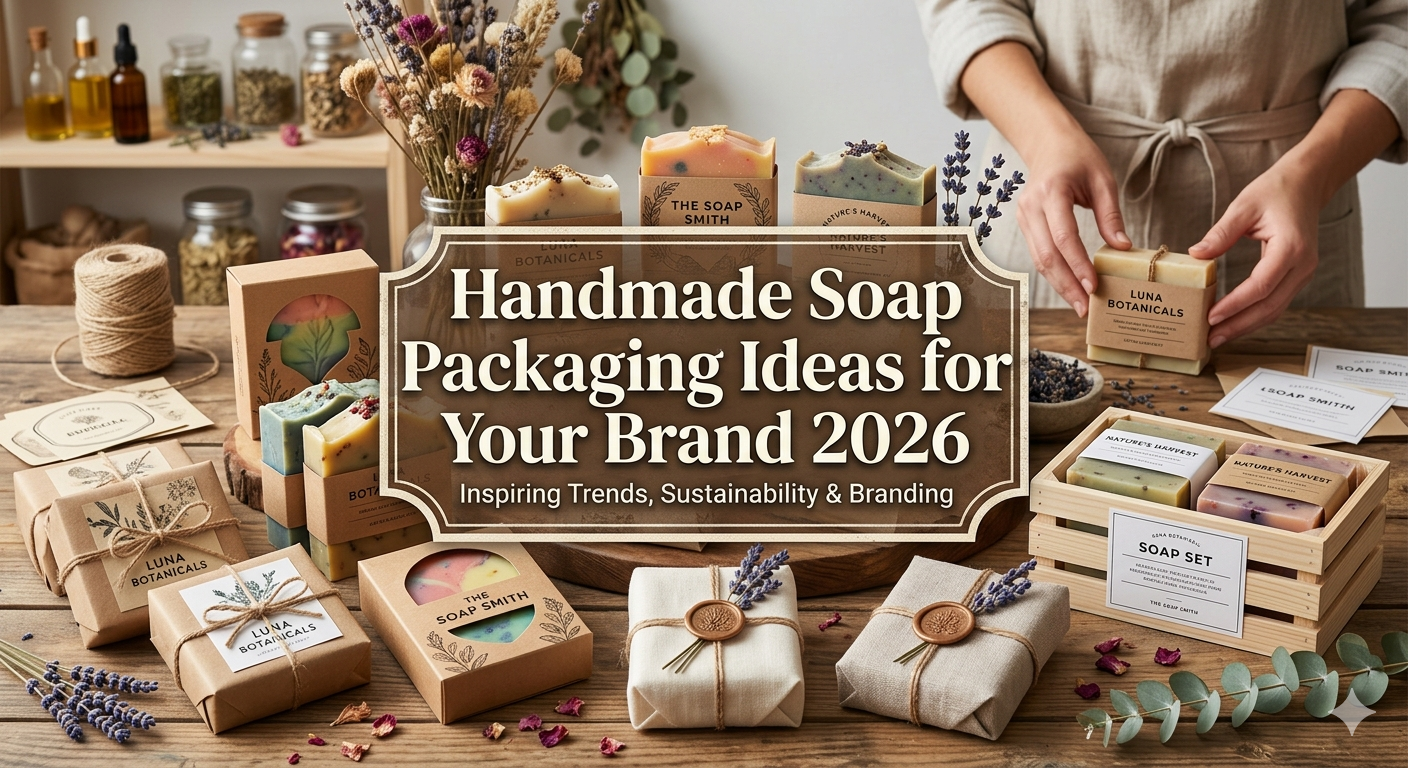
Kraft boxes are still leading because they look right for artisan products. Custom sleeves work well when the budget is tight. Window tuck boxes let the soap do the talking at retail. Rigid boxes make sense once you push past the $12 price point. And printed wrapping paper is quietly one of the smartest moves for DTC brands right now because customers share the unboxing and you get free reach. None of these are one-size-fits-all. Your sales channel decides which one fits you.
.
A buyer spots your soap from across a table. They have not touched it yet. They have not smelled it. In roughly three seconds, they have already decided if it is worth walking over to. That is the reality of selling at retail or at any market. For artisan soap, packaging takes on even more pressure because the bar is wrapped; there is nothing to test until someone is already holding it. So the box, the sleeve, the label whatever you are using it has to do all the convincing before any human interaction happens.
Your packaging is quietly doing a lot of work. It needs to keep the bar in good condition through storage, transit, and sitting on a shelf for weeks. It needs to say something honest about who made it and why it costs what it costs. And it needs to answer the practical questions a retail buyer or an online shopper is running through in their head before they commit. Get all three right, and the packaging sells for you. Miss one and you often never find out why the sale did not happen.
Kraft soap boxes suit cold-process and small-batch brands better than almost anything else. The uncoated surface, typically 300 to 350 GSM board, reads as honest and handmade in a way that glossy white never quite does. It pairs well with simple one-colour printing, a letterpress effect, or even a rubber stamp if you are still testing your branding.
When a buyer picks up a kraft box, it already says “someone made this carefully.” For eco-conscious shoppers, the material itself is part of the story you are telling.
A soap sleeve wraps around the bar and leaves the top and bottom open. It costs less than a full box, ships flat, and still gives you a full branded panel front and centre. For small business soap packaging, this is usually where it makes sense to start.
Sleeves work well on display tables, boutique shelves, and in DTC shipments. They also let the soap’s natural colour and texture show, which matters to buyers who want to see exactly what they are getting before they commit.
A tuck-end box with a die-cut window solves something sleeves cannot: it protects the bar fully while still letting buyers see it. That combination works particularly well in gift shops, spas, and independent retailers where your box needs to sell itself without anyone nearby to explain it.
Keep the design clean on these. Your scent name, a simple ingredient callout, and your logo. The window is doing the heavy lifting.
If your soap retails above $12 a bar, the packaging needs to match that price point, or buyers will feel the disconnect immediately. Rigid boxes, usually 1,200 to 2,000 GSM grey board wrapped in printed paper, communicate premium before the box is even opened.
They also remove the “is this gift-ready?” hesitation entirely. A well-constructed rigid box with a ribbon pull or magnetic closure is its own wrapping. That convenience has real value to the gift buyer.
For soap brands selling online, custom soap wrapping paper does something a plain mailer never can. A sheet of printed tissue around the bar, a branded sticker to seal it, and a short handwritten-style insert that combination turns a shipment into something people photograph.
And they do photograph it. That organic social content costs you nothing beyond the paper itself. At current per-unit costs, it is one of the highest-return investments in your entire packaging budget.
Over 36% of new soap launches in 2025 adopted biodegradable packaging as a deliberate differentiator (Business Research Insights, 2024). If your brand leads with natural ingredients, essential oils, or cold-process methods, your packaging needs to carry the same values or the story falls apart.
Compostable kraft wrap, recycled SBS board, and seed-embedded paper sleeves are all genuinely accessible now at small batch quantities. This is no longer a premium option. For your most loyal buyers, it is what they expect.
Here is something most competitors skip entirely. The FDA treats “true soap” where all cleaning action comes from saponified oils, differently from cosmetic bars that make additional skin claims. If your soap moisturises, soothes, or does anything beyond clean, FDA 21 CFR Part 701 applies. That means a full INCI ingredient list in descending order, net weight, and your manufacturer details, all on the label.
Your soap labels are not decoration. They are compliance documents. Design your packaging with enough panel space to carry that information correctly, because without it you cannot enter retail distribution.
The straight tuck or reverse tuck end box is the practical default for growing soap brands. It assembles without glue, prints in full colour, and ships flat. At PackagingShip, there are no die charges, no plate fees, and no minimum order, which makes this the most accessible entry point for brands moving from craft market tables to actual retail shelves.
If your model is subscription or primarily online, the mailer box is your primary brand touchpoint. Get it right. Custom printed exterior, tissue inside, a small card with your story or a QR code to behind-the-scenes content; together they build the kind of customer experience that generates repeat orders without you having to chase them.
Gift buyers want sets. A soap bar paired with custom bath bomb boxes in a coordinated system same kraft stock, same typeface, same label format becomes a product line instead of two separate items. Retailers respond to that level of cohesion. It also justifies a higher shelf price because the perceived value of a matched set is meaningfully greater than the sum of its parts.
Three things determine the right answer: your sales channel, your price point, and how much you are producing.
Craft markets and pop-ups can go simple. A kraft sleeve or a basic wrap with a stamp keeps your costs low and still reads as intentional. Retail placement needs a full tuck box with a compliant label barcode, ingredient list, net weight, the works. E-commerce and DTC reward investment in the unboxing moment. Tissue, inserts, and wrapping paper add perceived value well beyond what they actually cost.
Material choice matters as much as structure. Uncoated kraft signals artisan and eco-conscious. Gloss white with spot UV says clinical luxury. Matte laminate with tight typography reads as modern and minimal. Pick the material that your buyers already associate with the quality level your brand occupies.
Buyers research this before they contact any vendor. A kraft soap sleeve runs roughly $0.30 to $0.80 per unit at small-business quantities. A full custom tuck box with CMYK printing lands between $0.60 and $1.50 depending on board weight and finish. Rigid gift boxes start around $2.50 to $5.00 per unit.
At Packaging Ship, there are no die charges, no plate fees, and free US shipping. That changes the math considerably for brands running smaller or seasonal batches.
The artisan soap space keeps growing, and the shelves keep getting more crowded. The brands that pull ahead in 2026 are not always making the best soap. They are making the strongest first impression. Start with your channel, match your material to your brand, get your compliance right, and build packaging that your buyer remembers after the bar is long gone. That is what good handmade soap packaging ideas actually do. They work long after you have left the room. Ready to Upgrade Your Soap Brand Packaging?
You have spent serious time getting your formula right. Give it packaging that earns the same level of trust.
PackagingShip offers custom soap wrapping paper, tuck boxes, sleeves, and rigid gift formats. No minimums, no die charges, free US shipping, and free design support on every order.
Get Your Free Custom Packaging Quote Today →
Honestly, soap sleeves. They cost less than a full box, ship flat, and still put your brand front and centre on any shelf. For a small soap business watching every dollar, sleeves give you the most return for the least spend.
It depends on what claims you make. If your soap just cleans, the rules are simpler. But the moment you say it moisturises, soothes, or helps with any skin condition, FDA 21 CFR Part 701 kicks in. At that point, you need your full INCI ingredient list, the net weight, and your business name and address on the label. Skip any of that and retail doors close fast.
Retail packaging stands alone on a shelf. It needs a barcode, compliant label, and structural integrity. DTC packaging works hardest at the moment of delivery. Tissue, inserts, and custom wrapping paper create an emotional moment that retail packaging rarely needs to do.
Uncoated kraft board, recycled SBS, and compostable paper wraps are the natural fit for brands built on organic or artisan positioning. The material and the product tell the same story.