
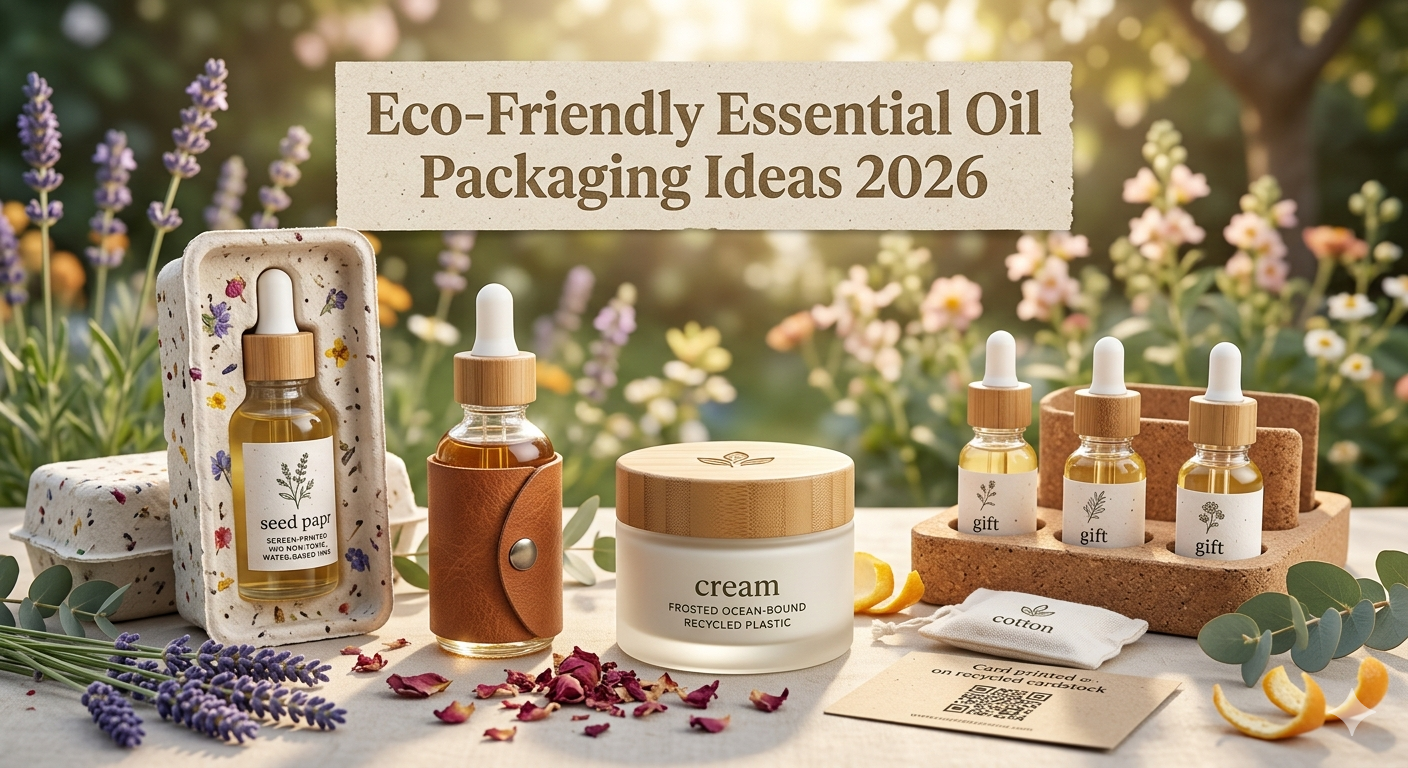
Picture this. A small-batch lavender oil brand in Portland spent two years building a “pure, natural” identity, then shipped their oils in glossy plastic-laminated boxes. Customers noticed. Reviews started mentioning the disconnect. The brand relaunched with unbleached kraft tuck boxes and water-based inks. Repeat purchase rates climbed. Their packaging finally matched their promise.
Most wellness buyers notice when something feels off. They pick up a bottle of pure lavender oil, read the “all natural, chemical free” copy, and then turn the box over to find a glossy plastic-laminated finish and a synthetic coating that squeaks under their thumbnail. It creates doubt before the product is even opened. In 2026, that kind of disconnect costs brands real money. The good news is it costs almost nothing to fix.
The essential oils market is on track to hit $19.79 billion by the end of 2025, growing at 13.3% annually, according to Free Yourself market analysis. Inside that growth, one shift stands out above the rest. More than 39% of brands are actively moving toward zero waste packaging and cleaner sourcing because their customers are demanding it, according to Global Growth Insights. Your packaging stopped being just a container a long time ago. Today it functions as a compliance document, a brand statement, and a conversion tool, all in the same moment a buyer picks it up off the shelf.
When wellness brands ask what eco-friendly essential oil packaging actually means in practice, the answer comes down to three things. Material choice, label integrity, and print process. Unbleached kraft paperboard, amber glass bottles, FSC-certified board, and paper-based biodegradable labels form the foundation. Together, they reduce plastic dependency, hold up under FTC Green Guides scrutiny, and send the right signal to buyers who read every line on the box.
Wellness buyers are not sentimental about packaging. They are practical. They read ingredient labels, they check certifications, and most of them evaluate at least three or four vendors before they commit to a wholesale order. Sustainability is not what convinces them to buy. It is what keeps them from ruling you out.
The sustainable packaging market is moving from USD 292.71 billion in 2024 toward USD 423.56 billion by 2029, at a 7.67% CAGR, driven by consumer demand, circular economy policies, and tightening single-use plastic regulations, according to Meyers. That kind of growth does not happen because brands suddenly grew a conscience. It happens because the market made sustainability a commercial requirement.
There is also the compliance dimension. Getting your environmental claims wrong is not just a branding problem. Under FTC Green Guides (16 CFR Part 260), vague or unsubstantiated recyclability and biodegradability claims on packaging carry real legal exposure. Sourcing FSC-certified, verified materials from the start means you never have to walk a claim back. You print it on the box with confidence because the paper trail behind it is clean.
This is the section where most small wellness brands get tripped up. They hear “eco-friendly” and assume it means paying more for materials that look worse and hold up less. That is rarely true. In most cases, the right sustainable material for essential oil packaging costs the same or less than its conventional counterpart, and it performs better on shelf because it reads as authentic to the buyer holding it.
It is the most practical starting point. It is curbside recyclable across 48 US states, accepts soy-based inks cleanly, and communicates authenticity without a single word of copy. For tuck box formats, 300 to 350 GSM kraft board holds structure without excess material. It costs less than UV-laminated coated board and ships flat, reducing transit waste at every step.
It remains the gold standard for the oil itself, and for good reason. Glass does not interact chemically with the formulation inside. It does not leach anything into the product over time the way certain plastics do. Amber and cobalt glass specifically block UV wavelengths that degrade oil potency, which means fewer returns and longer shelf life. It is also infinitely recyclable without any loss of quality, making it one of the cleanest material choices available across the entire natural product packaging chain.
They are the part most brands forget to audit. A fully recyclable kraft box paired with a non-recyclable synthetic label is no longer recyclable as a unit. The label compromises the whole thing. FSC-certified paper labels with water-based adhesives keep every part of the packaging in the same recyclable stream. The How2Recycle program offers standardized on-pack labeling guidance, and putting that symbol on your product is a recognition signal most US buyers already understand and trust.
They have improved significantly over the past two years. Kraft-lined foil-free pouches, compostable PLA-blend barrier bags, and moisture-resistant coated paper wraps now cover most use cases that foil mylar was previously the only answer for. These work particularly well for brands shipping to humid markets or building gift set collections where secondary packaging adds a layer of protection around the primary bottle.
Choosing a material is only half the decision. The structure determines how your product ships, shelves, and presents at the point of unboxing.
Our tuck boxes in unbleached kraft are the go-to format for single-oil retail packaging. They are shelf-ready, customizable to any SKU dimension, and printable with soy-based inks in full CMYK. No UV laminate required. And there are no die or plate charges. No minimum order quantity. For a wellness brand launching three to five SKUs, this is the lowest-risk entry point into recyclable essential oil packaging.
For premium single-origin oils and curated gift sets, rigid boxes are worth the investment. A 2mm greyboard rigid box communicates quality without saying a word. The physical weight of it in a buyer’s hands does real work before they even see the product inside. Wrap it with FSC-certified tissue, add a paper-based ribbon closure, and the unboxing moment becomes part of the product experience itself, something people photograph and share without being asked.
For DTC subscription brands shipping direct, mailer boxes in recycled kraft eliminate the need for bubble wrap or plastic void-fill entirely. A well-designed mailer box with custom interior printing removes the single-use plastic problem at the source rather than trying to solve it downstream.
Material choice sets the foundation. Custom design is where you close the sale before the customer opens the box. Custom essential oil packaging lets you control color, typography, finish, and structural details that communicate your brand positioning, whether that is clinical and clean, botanical and artisan, or premium and minimalist.
The brands winning in wellness retail right now treat packaging as a second product, not an afterthought. Embossed logos on kraft, spot UV on matte aqueous, custom drawer box formats for multi-oil collections, these are not luxury options anymore. They are standard at competitive price points. If you want to explore what custom packaging can look like for your specific product range, click here.
Print choices can either preserve or completely undermine your eco positioning.
Soy-based inks come from a renewable agricultural source. They release significantly fewer volatile organic compounds during printing than petroleum-based alternatives, and they break down cleanly inside standard paper recycling streams. Standard CMYK petroleum inks do not behave that way. For any brand making a recyclability claim on its packaging, the ink formulation matters just as much as the board weight. You cannot have one without the other and call the package fully recyclable with a straight face.
Aqueous matte coating does the same protective job as UV gloss laminate but without adding a plastic-like barrier to the surface. UV gloss is the shiny finish on most conventional retail packaging. It looks premium in person but it effectively turns a paper box into a non-recyclable item by sealing the fiber under a synthetic layer. Matte aqueous coating protects the print, holds up during transit, and keeps the board recyclable throughout its life. It also photographs better for product listings and social content, which matters more than most brands expect.
Switching to recyclable essential oil packaging should feel like a brand upgrade, not a compromise. At PackagingShip it is exactly that. Every custom order includes structural design support at no cost, free shipping across the US, and zero die or plate fees regardless of order size. The kraft board we use is FSC-certified as standard. The print team defaults to soy-based ink formulations. And because there is no MOQ, a brand launching its first 50 units and one reordering 5,000 receive the same level of service and access to the same sustainable structures.
Regulatory pressure on packaging is building in the US and it is not slowing down. North American frameworks are increasingly requiring recyclable, refillable, and bio-based materials across consumer product categories, according to IndexBox. Brands that build their packaging strategy around verified sustainable materials now are not just staying ahead of the curve. They are removing a future compliance problem before it ever becomes one.
Eco-friendly essential oil packaging has moved past the trend. It is now the baseline expectation for any wellness brand with serious retail ambitions. Kraft boxes, glass bottles, biodegradable labels, and plastic-free structures are available at competitive price points right now, and they scale cleanly from launch volume to full commercial distribution.
The brands getting reorders are not spending more on packaging. They are making smarter material decisions earlier. They pick structures that communicate quality before the box is opened, materials that back up the claims printed on the label, and finishes that hold up through a DTC shipping cycle without relying on plastic. That combination is not complicated. It just requires working with a supplier who understands the wellness category and does not treat sustainable essential oil packaging as an upsell.
Your packaging is the first physical thing your customer holds. Before they smell the oil, before they read the benefits panel, they feel the box. Make sure it tells the right story. Ready to align your packaging with your brand values?
Get Your Free Custom Quote — No Minimum Order Required
Free US shipping. Free design support. No die or plate charges. No MOQ.
The strongest combination right now is unbleached kraft paperboard for the outer box, amber glass for the bottle, and FSC-certified paper labels with water-based adhesive. Every component in that stack is curbside recyclable. Every environmental claim it supports is defensible under FTC Green Guides. No single element undermines the others.
Yes. Kraft paperboard is used for the outer box, not in direct contact with the oil. The glass or aluminum bottle contains the oil itself. There is no safety concern with kraft as secondary packaging for essential oils.
FDA governs what claims appear on the label itself. FTC Green Guides govern how environmental claims are worded and substantiated on packaging. These two regulatory frameworks operate independently of each other. A brand can meet both standards at the same time without any conflict, as long as the materials match the claims and the claims are specific rather than vague.
A Kraft board with a water-based aqueous coating handles moderate moisture exposure without losing structural integrity. For brands shipping into humid climates or storing product in unconditioned warehouses, PLA-lined kraft pouches step up to provide a functional moisture barrier while keeping the overall packaging biodegradable. The right choice depends on your distribution environment, not a one-size-fits-all recommendation.
At PackagingShip there is no minimum order quantity on any custom eco-friendly packaging. Every order ships free within the US. There are no die charges and no plate charges on any structure. A brand ordering 100 units gets the same pricing structure and design support as one ordering 10,000.