
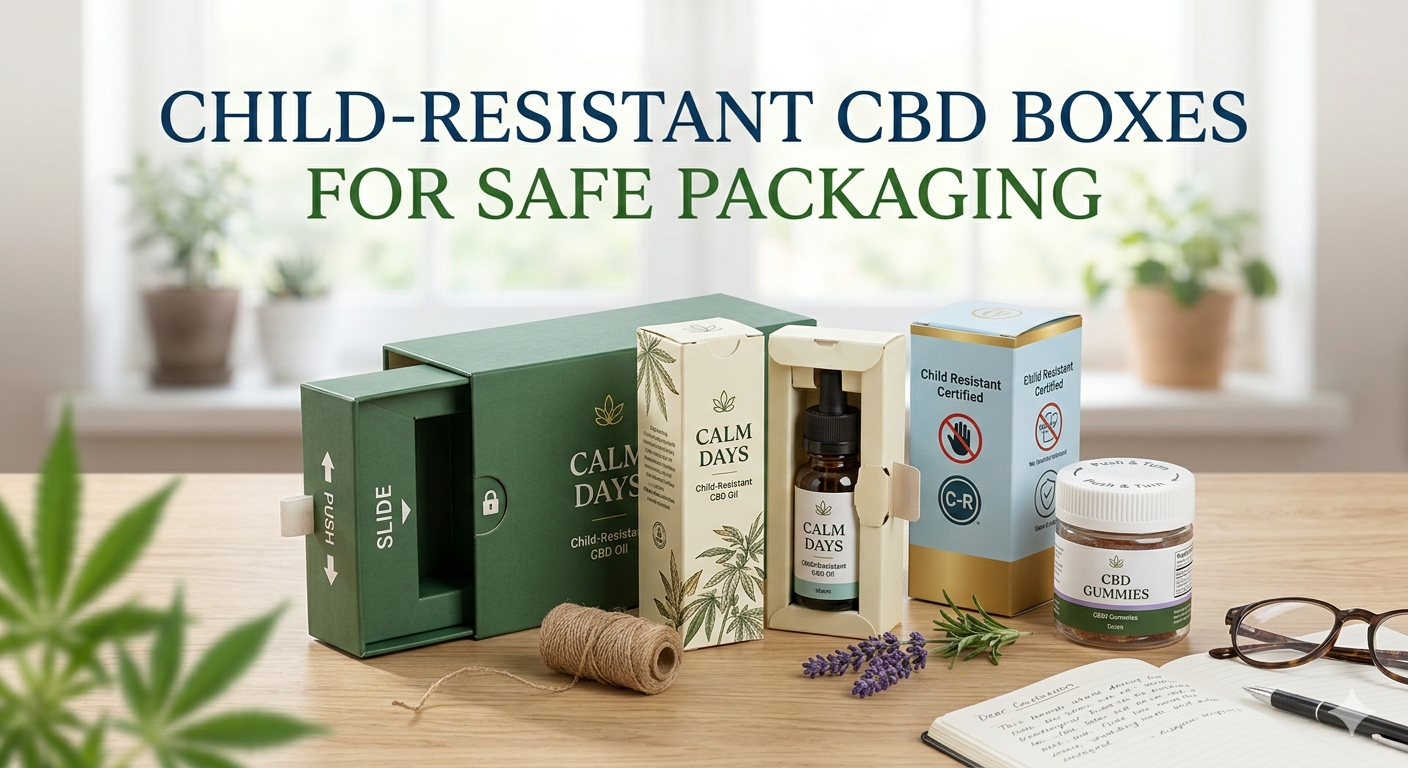
Picture this. You’ve spent eight months developing a CBD tincture line. The formula is solid. The brand looks great. You found a packaging supplier offering low MOQs and fast turnaround, so you placed the order. Three weeks after launch, a regional retail chain sends your product back. The reason? Your boxes were not child-resistant certified.
This happens to CBD brands every single year. Not because they ignored compliance. Because nobody told them that “child-resistant looking” and “child-resistant certified” are two completely different things.
Safe CBD packaging starts with understanding that difference. Everything else builds from there.
A lot of brands use the term loosely. Regulatory bodies do not.
The U.S. Consumer Product Safety Commission sets the standard under the Poison Prevention Packaging Act. Any packaging claiming to be child-resistant must pass third-party testing under 16 CFR 1700.20. That testing uses panels of children aged 42 to 51 months. At least 85% of them must fail to open the package within the first five minutes. The 80% must still be unable to open it after a full ten minutes. At the same time, at least 90% of adults must open it successfully within five minutes.
A box that snaps shut firmly does not pass this test by default. Only a packaging mechanism that has been physically tested by a CPSC-recognized third-party firm and documented with a certificate earns that designation. You can read the full standard directly on the CPSC website at cpsc.gov/FAQ/Special-Packaging-PPPA-FAQs.
When you order CBD boxes, ask your supplier for that certificate. Ask them specifically which testing firm ran the protocol and under which CFR reference. If they cannot answer both questions, keep looking.
Walk into any CBD brand’s first compliance failure and you will usually find one of three things.
The first is uncertified stock packaging. Suppliers selling generic tuck-end boxes at scale will sometimes describe them as child-safe or child-friendly. Those words mean nothing without a 16 CFR 1700.20 test certificate attached to the specific SKU. One word swap in a supplier’s product description should not be enough to satisfy a state compliance review, but brands take that shortcut all the time.
The second is mixing up child-resistant and tamper-evident requirements. These two are not the same job. Child-resistant packaging stops a child from getting in. Tamper-evident CBD packaging tells the buyer at the shelf that nobody else already did. Most serious retail partners require both. A shrink band, a breakable seal, or a perforated tab qualifies as tamper-evident. Neither replaces the other and both need to be on the same box if your retail target is any mid-to-large chain.
The third is treating your CBD warning labels as secondary to design. In states with active cannabis or hemp regulations, label requirements are law. Font size, contrast, required symbols, batch numbers, potency per serving, manufacturer details, and in California, a Proposition 65 warning. If any of that is missing or undersized, your product fails before the buyer even opens the box.
Your child-resistant CBD box needs five things working together.
A certified CR closure mechanism that has been third-party tested and documented. A tamper-evident seal that is visible and unbroken at point of sale. Your product name, net quantity, and CBD milligram strength per serving printed clearly on the panel. A full ingredient list with allergen disclosures and whether the product is full-spectrum, broad-spectrum, or isolate. And a batch or lot number plus manufacturer contact details so the product is traceable.
State-specific add-ons layer on top of all of that. Colorado uses a red triangle universal symbol. California adds Prop 65 language for products with detectable THC. New York has its own labeling format requirements. If you are selling nationally, your packaging needs to be built to the strictest state requirements in your distribution footprint, not just the easiest ones.
CBD oil packaging has a compliance wrinkle that catches brands off guard. The tincture bottle’s dropper cap is often CR-certified at the primary packaging level. But in several states, the outer carton is also required to meet child-resistant standards separately.
Brands that certify the bottle and ignore the box end up with a compliance gap at secondary packaging review. Your outer carton is also the thing a retail buyer holds in their hand when they are deciding whether to stock your product. Getting it structurally certified and visually branded at the same time is not a tradeoff. If you want to go deeper on this, click here to read our full CBD packaging breakdown.
Here is something worth pushing back on. A lot of CBD founders assume that child-resistant, compliant packaging means boring, clinical, stock-looking boxes. That assumption costs them shelf presence.
The CR mechanism is part of the box’s structure. The exterior is still your brand. Full color printing, matte or gloss lamination, embossing, spot UV, foil stamping none of that affects the certification of the closure. The brands that are winning retail space right now are the ones who figured out that secure CBD packaging and beautiful branded packaging are the same box.
Custom CBD Display Boxes at PackagingShip are built with certified closures and full customization from the first design brief. For brands running broader cannabis product lines, Custom Weed Pen Boxes and Custom Pre Roll Joints Boxes carry the same approach; compliance is baked into the structure, and your brand runs the exterior.
Safe CBD packaging is not complicated once you know what it actually requires. A certified child-resistant closure. A tamper-evident seal. Complete and accurate labeling for every state you sell into. Those three things together are what separates brands that grow their retail presence from brands that keep getting their products sent back.
The brands doing well in 2026 are not spending more on packaging. They are spending smarter on packaging that was built right the first time.
PackagingShip builds child-resistant CBD boxes with structural CR certification, free design support, and free U.S. shipping on every order.
[Get Your Free Compliant CBD Packaging Quote Today]
No. Ingestible formats oils, gummies, capsules, edibles require it in most U.S. states with hemp or cannabis regulations. Topicals are typically exempt. Check the specific requirements for each state you distribute into because the rules are not uniform.
No. Child-resistant packaging stops a child from opening it. Tamper-evident packaging shows it has not been opened before purchase. Most retail accounts and several state regulations require both on the same unit.
Yes. Printing and finishes are applied to the exterior surface. They do not interfere with the structural closure mechanism. Your certification stays valid as long as the closure itself is not modified after testing.
Ask for a third-party test report referencing 16 CFR 1700.20, a certificate of conformance for your specific packaging SKU, and confirmation that the certified closure performs after final printing and assembly. All three documents. Not one, not two.
Yes, directly. Retail buyers in the CBD category now ask for compliance documentation before approving new SKUs. Brands with CR certification and correct labeling move through the review process faster than brands that try to patch compliance issues after a rejection.