
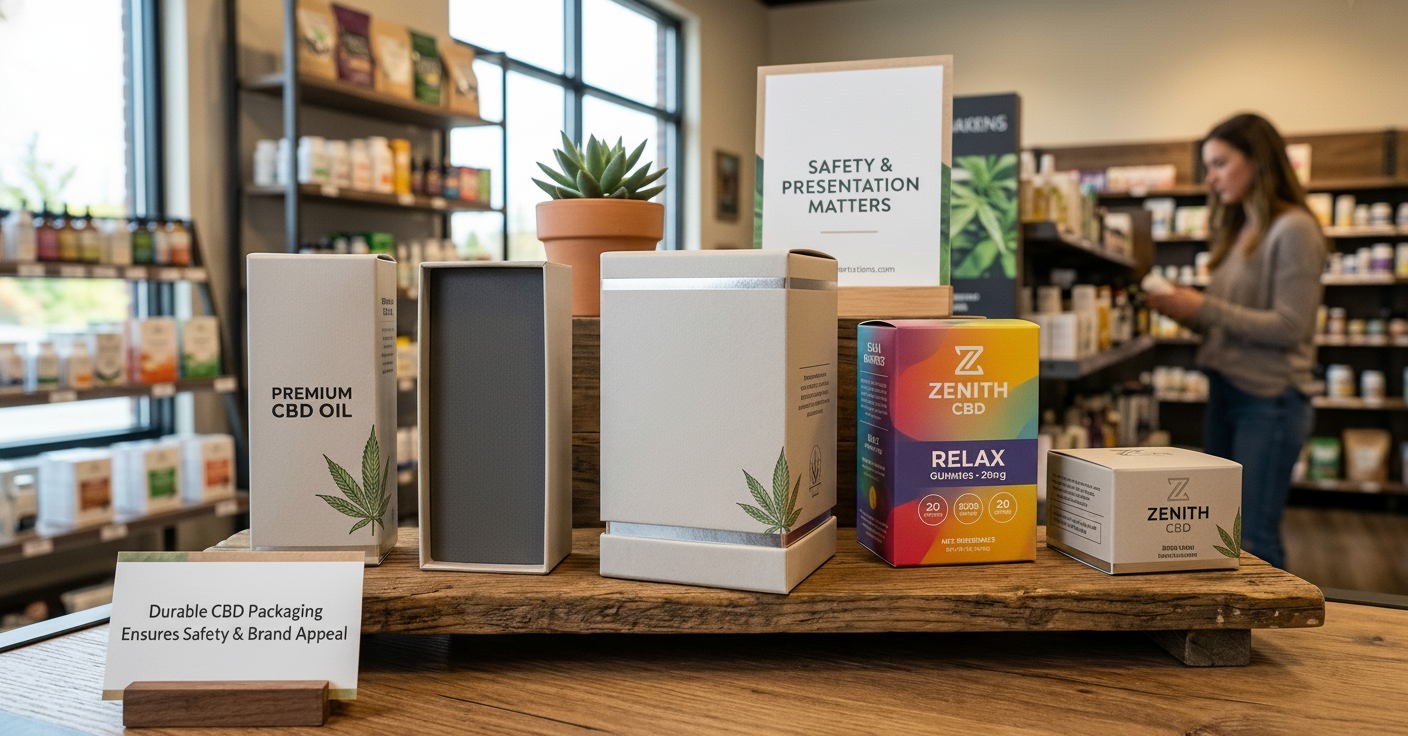
A CBD brand owner from Denver once told me something I never forgot. She had spent four months landing a retail account with a regional health chain. Her products arrived at the warehouse. The buyer called the next morning not to confirm the order, but to cancel it. Three boxes were dented. Two had broken seals. Her label was peeling. That was it. Four months of work, gone in one shipment.
Her packaging wasn’t bad because she didn’t care. It was bad because no one told her that protective CBD packaging solutions do more than hold a product. They hold a reputation.
Protective CBD packaging solutions are custom boxes, rigid containers, and child-resistant packaging designed to preserve product quality, meet US compliance standards, and strengthen brand presence on retail shelves helping CBD businesses reduce damage, pass inspections, and grow repeat sales.
Most people think protection means padding. In reality, it means three things working together: structural durability, regulatory compliance, and shelf-level brand integrity.
Miss one, and you pay for it in returns, rejections, or lost retail placements.
According to the CPSC, child-resistant packaging must be designed so that at least 85% of children (ages 42–51 months) cannot open it within the first five minutes of testing, and at least 80% still cannot open it after a full ten minutes. This isn’t optional guidance. It’s enforceable law in states like California, Oregon, Minnesota, and Virginia.
Structural protection is equally critical. CBD oils, tinctures, and glass-bottled products are fragile under courier pressure. A corrugated B-flute box with internal inserts absorbs impact that a standard cardboard mailer simply cannot handle during transit sorting.
Brand integrity completes the picture. A dented, unbranded, or low-finish box signals low quality before the customer ever opens it.
Let’s be direct. Poor packaging creates three specific business losses.
Edible CBD products gummies, chocolates, beverages — carry the highest compliance risk. Edible cannabis and CBD products often come in forms that appeal to children, such as gummy shapes, which is why regulators treat them with pharmaceutical-level packaging scrutiny.
The child-resistant reclosable edible bag market is projected to grow from USD 1.8 billion in 2025 to USD 3.1 billion by 2034, driven directly by tightening state safety mandates according to research cited in cannabis regulatory analysis published in 2026.
Pre-roll products carry equal legal weight. Custom Pre Roll Joints Boxes with certified child-resistant closures (CRC) are now required in most regulated US states. Selling without them isn’t a risk it’s a liability.
At Packaging Ship, every CBD packaging solution we produce can be spec’d with CRC closures, tamper-evident seals, and state-compliant labeling panels. And we do it with no minimum order quantity.
Choosing the wrong material is where most wholesale buyers lose money silently.
| Material | Best For | Protective Strength | Finish Options |
| Cardboard (300–400 GSM) | Tinctures, topicals, retail boxes | Medium | Gloss, matte, foil |
| Corrugated (B/E flute) | Shipping, bulk orders | High | Basic print |
| Rigid Board | Premium oils, gift sets | Very High | All premium finishes |
| Kraft | Eco-brand products, hemp lines | Medium | Natural, spot UV |
Corrugated boxes are non-negotiable for wholesale shipments and DTC deliveries. Rigid boxes serve CBD gift sets and high-end tincture lines. Cardboard at 350 GSM is the sweet spot for most retail-facing CBD packaging.
Not every CBD product ships in the same box. And it shouldn’t. CBD boxes comes in different packaging styles for different products
CBD oil tinctures need tall, narrow tuck-top boxes with internal inserts to prevent glass movement. Gummies and edibles need resealable, airtight packaging with CRC closures and clear labeling panels. Topicals and creams do well in rigid or sleeve-style packaging that communicates premium quality at retail.
For wax pens and vape cartridges, secure fit matters as much as aesthetics. Custom Weed Pen Boxes with foam or cardboard inserts prevent cartridge breakage and deliver a clean unboxing experience that premium cannabis consumers now expect.
Mylar bags work well for flower and pre-measured edible portions, smell-proof, moisture-resistant, and fully printable for bold retail branding.
Matching your packaging style to your product category is the starting point for building sturdy CBD boxes that protect products and earn shelf placement.
Check these quickly:
If two or more of these hit your packaging is actively costing you revenue right now.
Your CBD product might be the best on the market. But if it arrives damaged, looks generic, or fails a compliance check none of that matters.
Protective CBD packaging solutions protect more than your product. They protect your retail relationships, your brand reputation, and your revenue. Every shipment is a brand touchpoint. Every box on a dispensary shelf is a sales tool.
At Packaging Ship, we build CBD packaging that does all three jobs protects, complies, and converts. No minimum orders. Free design support. Free US shipping. 6+ years. 10,000+ projects delivered.
Ready to Build CBD Packaging That Protects Your Product and Grows Your Brand? Get Your Free Custom CBD Packaging Quote →
No minimum order. Free design support. Free shipping across the USA.
They are custom-designed boxes, rigid containers, and compliant closures built to preserve CBD product integrity through shipping, retail display, and consumer handling combining structural durability with regulatory and brand standards.
In most US states, yes especially for edible and ingestible CBD products. States like California, Oregon, Minnesota, and Virginia mandate CRC-compliant packaging for edible hemp-derived products under standards aligned with the federal PPPA.
Corrugated is best for shipping protection. Rigid board delivers the most premium retail presentation. Cardboard at 300–400 GSM is the most versatile for retail-ready CBD boxes. Choice depends on product weight, fragility, and retail environment.
Yes. Packaging Ship offers custom CBD boxes with no minimum order quantity, free design support, and free US shipping. Ideal for brands at any stage from launch to wholesale scale.
Retail buyers evaluate structural integrity, label visibility, print consistency, and shelf-fit before stocking any product. Packaging that fails any of these checks gets rejected before customers see it.