
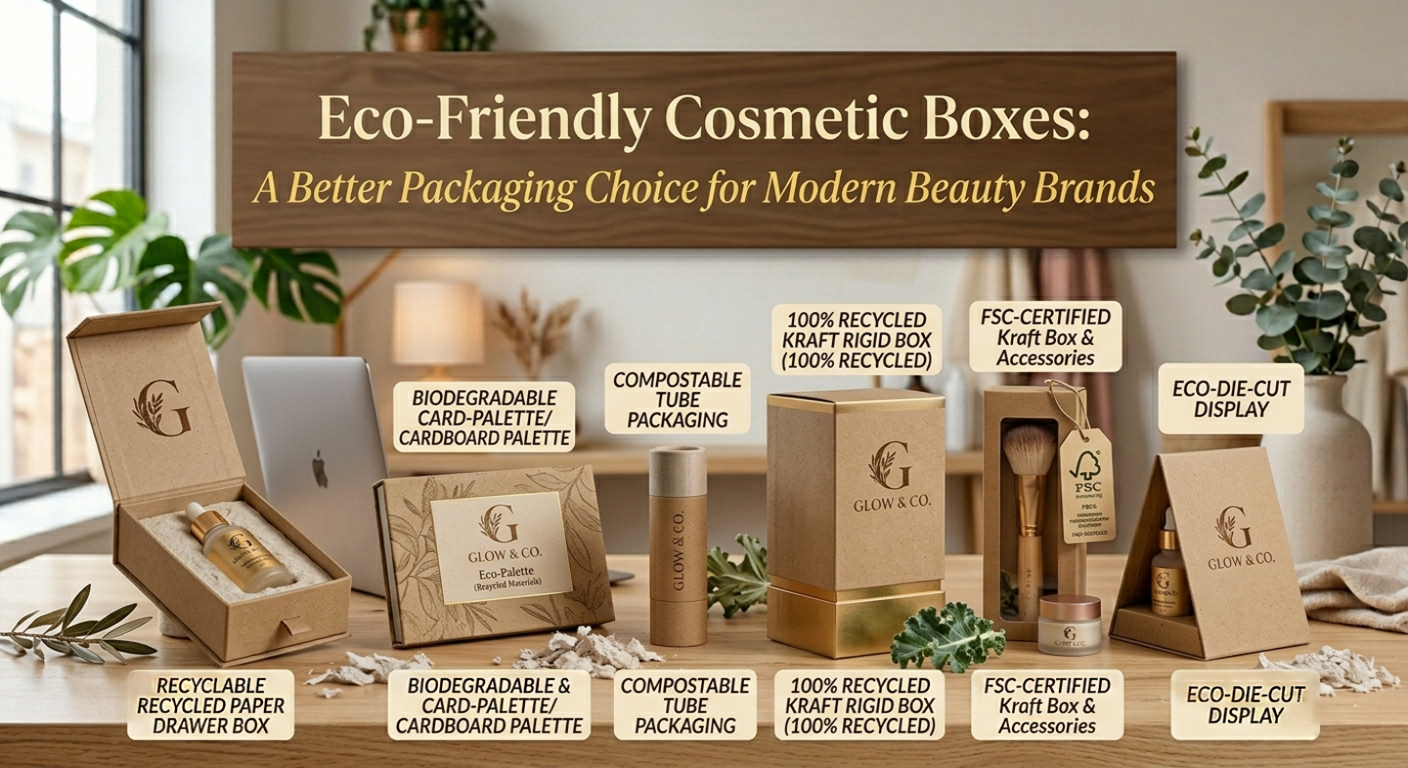
What Are Sustainable Cosmetic Packaging Solutions in 2026? Sustainable cosmetic packaging solutions are beauty product boxes built from eco-certified materials. Think FSC-certified kraft paper, post-consumer recycled paperboard, and corrugated recycled cardboard. They use soy-based inks and water-based coatings throughout production. They carry verifiable certifications. These certifications are accepted by US retail buyer compliance programs. They cover makeup, skincare, and hair care categories.
A Los Angeles hair care brand spent seven months rebuilding their product line in 2024. New formulas. New branding. A sustainability story front and center on every marketing channel they owned.
Three months after relaunching, a major wellness retail chain sent a supplier qualification form. It asked for FSC chain-of-custody certification documentation, recycled content percentage by SKU, and coating chemistry confirmation for the full product range.
The brand had none of it. Their hair packaging boxes were marketed as eco-friendly. They carried no FSC certification, no documented recycled content figure, and no coating specification confirming recyclability. The procurement team closed the inquiry the same week. The retail opportunity was gone.
That founder learned the difference between claiming sustainable cosmetic packaging solutions and being able to prove them. In 2026, that difference is what separates beauty brands getting onto retail shelves from brands that stay in their DTC lane indefinitely.
The global sustainable packaging market was valued at $303.80 billion in 2025 and is forecast to reach $463.41 billion by 2031, growing at 7.29% annually, according to Mordor Intelligence’s 2026 Sustainable Packaging Market Report. Extended Producer Responsibility regulations now span 63 countries, which means eco-packaging compliance is a cross-border business requirement, not a regional preference that brands can opt into when convenient.
Within the beauty industry, the shift is accelerating at the brand level. Estée Lauder reports 71% of its packaging already meets verified sustainability criteria, per the same Mordor Intelligence data. When major prestige houses operate at that benchmark, boutique and indie beauty brands face real pressure from the same retail buyers who stock both tiers on the same shelves. A boutique wellness chain that stocks sustainable prestige brands will not grant shelf space to a supplier who cannot produce eco-documentation on request.
Beauty and personal care brands also report that 61% of shoppers actively seek eco-aligned brands, per Mordor Intelligence’s 2026 sustainable e-commerce packaging data. That consumer demand is translating directly into retail buyer behavior, and into supplier qualification forms that beauty brands simply cannot pass without verified eco-packaging credentials in hand.
“Sustainable packaging in the beauty industry is no longer a value statement. It is a commercial requirement that determines retail access. The brands that understand this are the ones getting shelf space in 2026.” — Senior Packaging Consultant, Packaging Ship
FSC-certified kraft paper is the most widely accepted eco-material across US beauty retail supplier compliance programs. The Forest Stewardship Council certifies the full chain of custody from forest to finished box. That chain-of-custody documentation is what retail procurement teams actually request on compliance forms, not just an eco logo printed somewhere on the side panel. At 120 to 157 GSM, kraft handles most cosmetic product weights without structural compromise. Uncoated kraft biodegrades in 2 to 5 months and clears most US curbside recycling programs without issue.
For green cosmetic packaging at the clean beauty and natural brand level, FSC-certified kraft delivers the aesthetic authenticity and verified credentials that both retail buyers and eco-conscious consumers actually trust when they read the packaging claim.
Recycled paperboard built from post-consumer waste gives you the documented recycled content percentages that supplier qualification forms require. Vague language like “made with recycled materials” fails retail compliance audits. Documented figures, whether 30%, 50%, or 100% post-consumer recycled content confirmed in writing by the supplier, pass them. At 300 to 350 GSM for folding cartons, recycled paperboard delivers full-color printing for retail-ready lipstick packaging boxes, custom eyeshadow boxes, and makeup brush set packaging while keeping the material genuinely circular throughout the supply chain.
For e-commerce shipping of fragile cosmetic products, corrugated recycled cardboard at B-flute structure provides the protective strength glass cosmetic containers need without petroleum-based foam or bubble wrap. Pair it with kraft honeycomb paper inserts, which are plastic-free and recyclable curbside, and you have a direct-to-consumer shipping solution for serum bottles, foundation jars, and lipstick gift boxes that arrives plastic-free at the customer’s doorstep. Natural skincare packaging in corrugated recycled configurations is increasingly the baseline expectation among wellness retailers evaluating skincare brand suppliers for the first time.
This is precisely where most beauty brands and most of their current packaging suppliers quietly fail the sustainability test. A kraft box or recycled SBS carton with petroleum-based gloss lamination is not recyclable at most US curbside facilities, regardless of what the substrate material says on the spec sheet. Water-based matte coatings preserve recyclability. Soy-based inks replace petroleum pigments without compromising print resolution or Pantone color accuracy across the production run. The coating and ink specification determines whether an eco-packaging claim is true or whether it is greenwashing, and in 2026, retail buyers know the difference.
In FSC-certified SBS boards at 300 to 350 GSM communicates sustainable credentials without sacrificing the structural integrity that communicates premium positioning on a retail shelf. FSC-certified SBS takes full-color offset printing and foil stamping cleanly, which means a sustainable lipstick box does not have to look like a compromise on quality.
It for a palette format needs to survive retail handling across a full sales cycle. Recycled paperboard at 350 GSM with water-based matte lamination handles repeated opening and closing on a retail shelf without showing structural wear. The recycled content percentage goes on the compliance form. The matte finish goes on the palette presentation at the point of sale.
A Set packaging in eco materials needs to protect bristles during shipping and retail display at the same time. A recycled corrugated outer box with a kraft honeycomb paper insert holds the brush set securely without plastic foam anywhere in the box. The entire unit, outer box and insert together, recycles curbside without separation.
It is for wellness and clean beauty brands face some of the strictest retail supplier sustainability requirements in any beauty product category. Wellness retail buyers often require FSC certification documentation, a documented recycled content percentage, and written confirmation that no solvent inks or petroleum laminates are present anywhere in the packaging specification. Packaging Ship provides all three on request for every eco order placed.
It is in sustainable materials where eco-packaging meets the gifting channel’s premium unboxing expectation. Recycled rigid board at 2mm thickness with water-based soft-touch coating delivers a gift box that feels genuinely premium at first touch, opens cleanly, and carries verified eco-credentials without the petroleum lamination that makes a standard luxury gift box non-recyclable at the curbside level.
For sustainable beauty packaging across every one of these product categories, the right supplier provides material documentation alongside the physical product, not just a logo on the box panel and a vague eco claim on the website.
Recyclable, biodegradable, and compostable are three different claims. Using them interchangeably is greenwashing, even when completely unintentional, and sophisticated retail procurement teams are increasingly trained to identify the difference at the audit stage.
Recyclable means the material processes through standard recycling infrastructure. FSC-certified SBS board and kraft paper without petroleum lamination both qualify when no solvent-based coating has been applied. Biodegradable means natural biological breakdown over time under standard conditions. Uncoated kraft paper achieves this in 2 to 5 months. Compostable means breakdown within a defined timeframe under composting conditions, typically 90 days in industrial composting environments, and it requires BPI certification to claim it legitimately without regulatory risk.
When beauty brands order eco-certified cosmetic packaging from Packaging Ship, every order includes material documentation specifying exactly which claim applies to each component. Marketing teams write accurately. Procurement teams submit a compliance document with actual figures, not a vague supplier statement that fails the first line of a retail qualification form.
At low volumes, under 200 units, eco-certified cosmetic boxes run 12 to 18% higher per unit than standard non-certified alternatives. That gap closes meaningfully at wholesale volume. At 500 units, FSC-certified kraft folding cartons for lipstick boxes or eyeshadow packaging typically land within 5 to 8% of standard SBS paperboard pricing. At 2,000 units with offset printing, cost parity is achievable because production efficiency closes the remaining material cost premium entirely.
Meanwhile, the business protection value, which includes retail access, supplier qualification, and brand credibility with the 61% of beauty shoppers actively seeking eco-aligned brands, consistently outweighs any remaining per-unit cost difference. The Los Angeles hair care brand from the opening of this article understands that calculus clearly now.
Ready to Order Sustainable Cosmetic Packaging That Opens Retail Doors? Your beauty formulas deserve packaging that matches their quality and proves their sustainability to every retail buyer who asks for documentation during supplier evaluation.
Packaging Ship works with beauty brands across the United States, from indie founders placing their first 100-unit eco run to established brands managing wholesale accounts across multiple retail channels. Free design support on every order. No minimum order quantity. FSC chain-of-custody documentation included on request. Free shipping across the United States on every order placed.
Get Your Free Sustainable Cosmetic Packaging Quote Today →
Free design support. No MOQ. FSC documentation included. Free US shipping on every order.
FSC-certified kraft paper and post-consumer recycled paperboard are the most widely accepted eco-friendly materials for cosmetic boxes across US beauty retail supplier compliance programs. Both carry verifiable chain-of-custody documentation. Packaging Ship provides FSC certification documentation with every eco order on request at no additional charge.
At low volumes, yes, approximately 12 to 18% more per unit. The 500 units, that gap narrows to 5 to 8%. At 2,000 units with offset printing, cost parity is often achievable. Retail access and supplier qualification consistently outweigh the remaining per-unit cost difference for beauty brands pursuing serious wholesale retail relationships.
Require FSC chain-of-custody certification covering the full supply chain from forest to finished box, a documented recycled content percentage stated in writing, written confirmation of water-based coatings and soy-based inks, and How2Recycle label eligibility from the Sustainable Packaging Coalition. These four credentials cover the core requirements of most major US retail beauty buyer sustainability compliance programs in 2026.
Yes. Packaging Ship has no minimum order requirement. Digital printing works for smaller eco runs from 100 units. Offset printing delivers Pantone-accurate color at the best per-unit cost for orders of 2,000 units and above. This makes it ideal for beauty brands managing wholesale accounts.
Yes. FSC-certified, uncoated kraft cosmetic boxes are recyclable through most US curbside programs and biodegrade in 2 to 5 months under standard conditions. Applying petroleum-based lamination removes both claims entirely. Water-based matte coatings preserve recyclability and are standard across Packaging Ship’s full eco cosmetic packaging range.
At Packaging Ship, FSC chain-of-custody documentation is available on request with every eco cosmetic packaging order. The documentation specifies material origin. It includes certification numbers. The documents state recycled content percentage clearly. The team covers coating chemistry too. These fields match what retail beauty buyer compliance forms require. Suppliers need all of this during the evaluation process.