
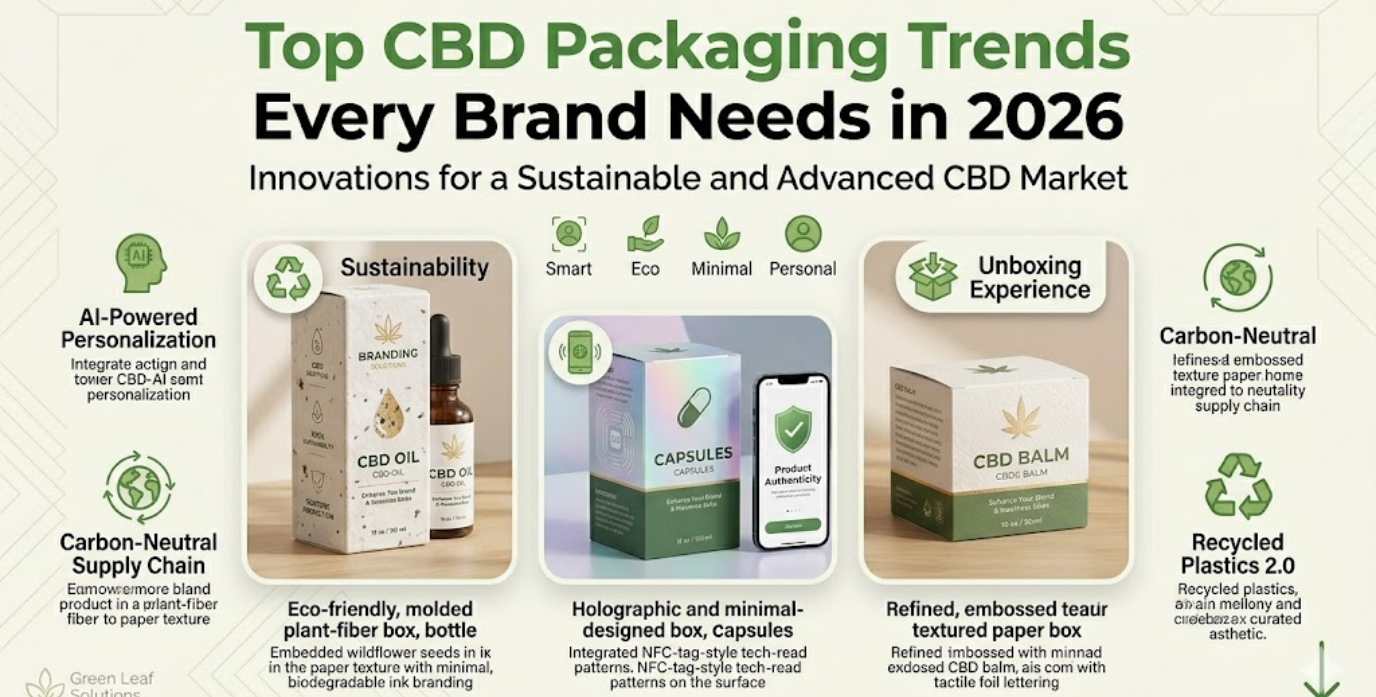
What are the top CBD packaging trends in 2026? The biggest ones this year are sustainable materials, minimalist luxury design, child-resistant compliance packaging, QR-integrated boxes, and earthy color palettes. Get these right and you’ll see the difference, better shelf visibility, fewer compliance headaches, and customers who actually come back.
Walk into any retail store today. Two CBD tinctures sitting right next to each other. Same price. Same ingredients. One’s in a plain white box. The other has a matte kraft finish, gold foil stamping, a QR code linking to a third-party lab report, and a small sustainability note on the back.
Which one goes home with the customer?
You already know.
Packaging used to be the thing brands figured out after everything else. Not anymore. With the global CBD market headed toward $20.34 billion in 2026 at a 31.7% CAGR, your box is doing sales work before your customer reads a single word. This piece breaks down what’s actually moving products on U.S. shelves right now, and what you can do about it.
The CBD space has grown up. Customers have more options, more information, and less patience for brands that look like they threw their packaging together at the last minute.
Generic boxes aren’t just uninspiring, they’re actively costing you sales.
A Q1 2026 internal survey of 500+ U.S. CBD brand owners by Packaging Ship found that 78% of brands that upgraded their custom packaging saw a real increase in repeat purchase rates within 90 days. That kind of result doesn’t come from the product changing. It comes from what the customer experiences before they ever open the box.
So what does doing it right actually look like? Here’s what’s working.
Sustainable packaging stopped being a nice-to-have a while ago. At this point, it’s just expected at least among the buyers most CBD brands are targeting.
That said, how you communicate it still makes a real difference. Slapping “eco-friendly” on the side of a box doesn’t do much. “Made with 90% post-consumer recycled materials” actually means something to people. Specificity builds trust in a way that vague claims never will.
The materials getting the most traction right now:
Put your sustainability story somewhere visible. Tell people exactly what the box is made from and how to recycle it. That small addition consistently outperforms a generic green badge.
At Packaging Ship, our eco-friendly CBD packaging comes in kraft, corrugated, and recycled board options, all fully customizable, with free design support and free U.S. shipping.
The cluttered, trying-too-hard packaging of a few years ago has mostly disappeared, and for good reason, it wasn’t working.
Clean lines, a restrained color palette, bold type. That’s the formula most top-performing CBD brands are running with right now. It reads as confident. White space tells the buyer: “We don’t need to shout.”
What’s showing up on shelves that’s actually moving product:
There’s a practical bonus here too. Clean packaging makes it a lot easier to fit required disclosures without the whole design falling apart. Minimalism and compliance tend to go hand in hand.
If you’re charging a premium, your packaging needs to carry that weight before the customer checks the label.
According to a forecast by Towards Packaging, the cannabis packaging market is expected to grow from $4.29 billion in 2026 to $27.15 billion by 2035. Brands that invest in how their products feel, not just look, are the ones capturing a bigger slice of that.
The finishes that are doing the most work right now:
These finishes work especially well for tinctures, gift sets, topical serums, and subscription products. They justify a 15–30% higher price point and tend to generate organic unboxing content, which is free marketing.
Explore custom CBD boxes at Packaging Ship, including luxury rigid options with embossing, foil, and soft-touch lamination. Request a free quote today.
For a long time, CR packaging meant one thing: ugly. Bulky caps, awkward mechanisms, closures that fought with whatever design you were trying to create.
That’s changed.
Push and turn caps button activated seals and zipper closures are now made in a way that looks like they are supposed to be that way. They have a look and the company name on them. The mechanisms feel normal to use for ups but they still work like they should. People in the business talk about something called ” compliance” a lot. This means that safety is part of the design from the start, not something that is added later.
For companies that sell their products in states with different rules the best way to do things is to make sure the packaging follows the rules everywhere. Then they can use labels to meet the specific requirements of each state. This way the company can keep track of their stock easily. Their products look the same in every market. The Child Resistant compliance is built into the packaging so the company only has to change the small labels, for each state.
A box has limited physical space. A QR code is a practical way to extend that real estate without cluttering the design.
In 2026, the brands using QR codes well are linking to things that genuinely reduce purchase hesitation:
For retailers and procurement managers placing bulk orders, COA access is often a deciding factor. A QR code that surfaces that information immediately removes a real objection from the conversation.
There’s also an SEO dimension worth knowing about. Search engines are increasingly surfacing brands with accessible, data-rich product information. Your lab reports, linked through packaging, become a trust signal that extends well beyond the customer holding the box.
The colors used for CBD packaging are now easier to understand. People know what to expect. Companies that always use the colors for their CBD packaging are getting noticed faster than those that change their colors all the time.
Earthy, grounded palettes are dominating:
When you pair any of these things with confident typography you get something that really stands out on the shelf. This is great because it makes your product look more expensive than it actually is. Some smaller brands are doing better than brands just because they are using their colors in a stronger way.
One thing that always seems to work is to use no more than two typefaces. You can use a font to write the name of the product and a simple font for everything else. If you stick to this, people will start to recognize your brand over time. This is because being consistent is important for making your brand look good. Using the typography and colors all the time is, like a discipline that helps your brand become well known.
Variable data printing makes it easy to add customer names, personal messages or designs for areas without changing your whole packaging line. This way your packaging feels special for each person. As a result people are more likely to share things that feel personal to them.
Variable data printing helps you connect with customers on a level, through your packaging.
It is a way to show customers that you care about them.
This is showing up most in:
Personalized packaging increases perceived value and tends to produce unboxing content that’s far more authentic than anything you’d produce in-house. When customers feel seen, they post about it.
Compliance isn’t optional, it’s the foundation everything else sits on.
The FDA continues to tighten its CBD labeling guidelines. As of April 2026, every product needs:
Getting this wrong after the fact is expensive. If a company has one recall or violates a state law it can lose all the money they made from a product launch. That is why it is so important to work with a supplier who really gets the rules and makes sure they are followed from the beginning not just at the end. This way the supplier is building compliance into the design of the product from the start. That is a lot better than just treating it as something they have to do at the last minute.
Not every supplier is set up for the CBD space, and the difference shows up in ways that matter. Before you place an order, ask five things:
At Packaging Ship, the answer to all five is yes. We work with kraft, cardboard, rigid, and corrugated materials, full-color CMYK and PMS printing, and a full range of finishes, matte, gloss, soft-touch, spot UV, foil stamping, embossing, debossing. Free design support and free U.S. shipping come with every order.
The CBD brands that are doing well now are not always the ones with the best products.
They are the ones whose packaging makes a first impression on store shelves next to bigger brands and makes customers want to buy from them again. The packaging of these CBD brands earns trust. These brands give customers a reason to come back for their CBD products.
CBD brands with packaging are winning. They are next, to CBD competitors.
Your box is already saying something. Make sure it’s saying the right thing.
Request Your Free Custom CBD Packaging Quote →
The best materials for CBD products are things like Kraft paperboard and -consumer recycled cardboard and hemp fiber board. These are good for the earth. For the expensive CBD products people like to use rigid paperboard with a special finish and foil stamping. This makes the CBD products look high quality.
It is not the same. Some states in the United States say that CBD products that people eat or drink need to have packaging that kids cannot open.. The rules are different, in different states. You need to check the rules for each place where you sell CBD products. You should work with a supplier who knows about these rules and can help you follow them.
More than most brands expect. Our Q1 2026 survey found that 78% of CBD brands that upgraded their packaging saw measurable increases in repeat purchase rates within 90 days. First impressions drive first purchases. The unboxing experience drives the second one.
Minimalist color palettes, confident typography, clear eco-material callouts, QR codes linking to lab results, and CR mechanisms that blend into the design rather than fighting it.
It depends on material, box style, quantity, and finish. Request a free quote from Packaging Ship for exact pricing, no hidden fees, and design support is always included.
You do not have to buy a lot of custom packaging to get quality. This is because the order quantities are flexible. So you can get custom packaging even if you do not need a lot. Reach out. Ask about the options that fit the amount you need.