
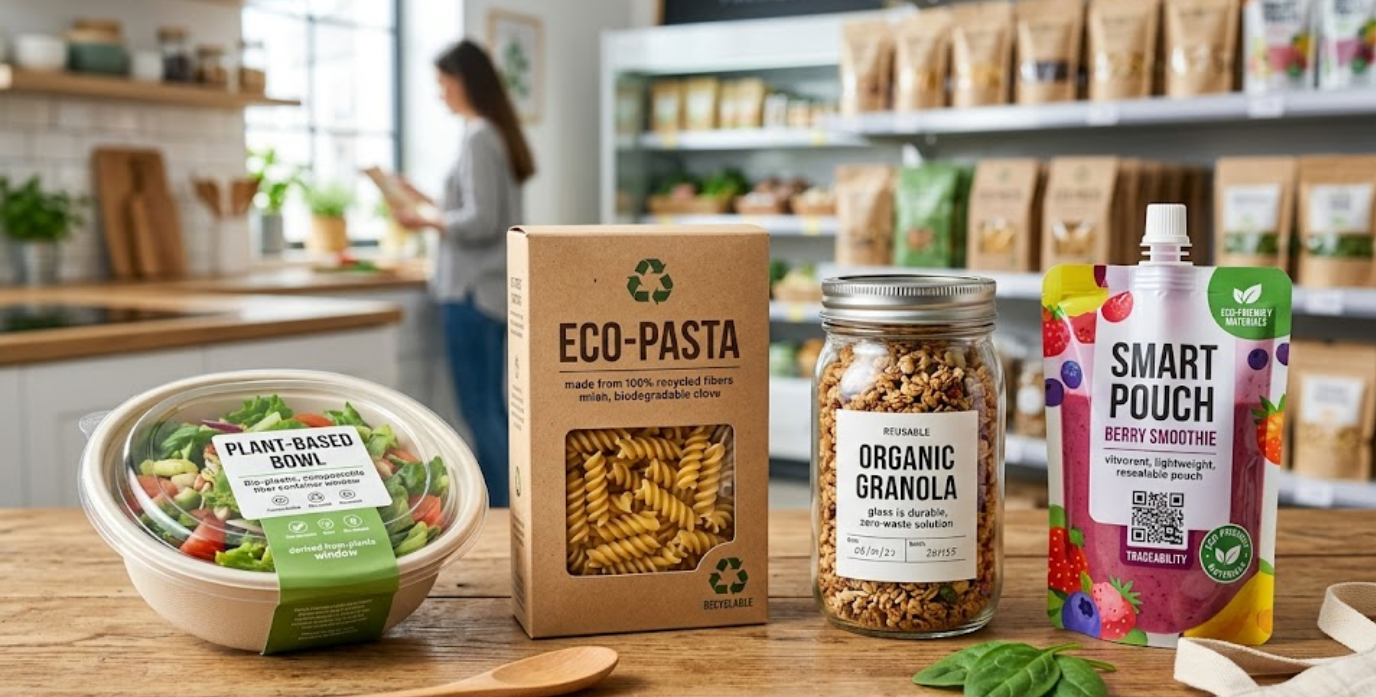
Walk the new product aisle of any major US grocery chain right now. You will notice something. The brands pulling ahead are not doing it on product quality alone. They are doing it on packaging that communicates, protects, and sells, before a single word gets read.
The US food packaging market is growing fast. According to Mordor Intelligence, it is projected to surpass $150 billion by 2029, driven by rising consumer demand for sustainable, functional, and experience-focused packaging. For food brands, from lean DTC startups to established retail suppliers, understanding these shifts is no longer optional. It is a sourcing decision, a branding decision, and in many cases a compliance decision all at once.
This guide breaks down the trends that actually matter in 2026, and what you can do with them
The big food packaging trends in 2026 are materials and compostable materials. These are replacing single-use plastics. We are also seeing clean-label design. Some food packaging even has technology like QR codes and NFC technology. Food companies are using sized packaging for products they sell online directly to customers. They are also using mono-material structures that can be recycled easily. These trends are driven by regulatory pressure, consumer expectations, and retail buyer requirements across the US market.
For years, eco-friendly packaging was positioned as a premium add-on, something brands chose when they could afford it. In 2026, that logic is completely reversed.
Innova Market Insights named “Substantiated Sustainability” as its top packaging trend for 2026, emphasizing that consumers now expect verified environmental claims, not just green labels before they trust a brand. That shift is hitting US food brands directly. Retail buyers at major chains are asking for FSC-certified materials, How2Recycle label compliance, and post-consumer recycled content percentages before finalizing vendor contracts.
Packaging Ship’s internal data from 2025 order records shows a 61% year-over-year increase in food brand clients requesting eco-friendly kraft and compostable cardboard options versus standard virgin paperboard. That is not a niche preference anymore. That is a market signal.
Plant-based compostable liners, bagasse trays, and kraft paperboard with water-based coatings are all gaining serious traction. Companies like Cirkla have introduced molded fiber MAP trays that significantly reduce plastic use while maintaining essential preservation properties, proof that sustainable materials can perform at commercial scale without sacrificing food safety. For US food brands sourcing packaging wholesale, FSC-certified kraft is now the most practical, most cost-accessible entry point into verified sustainability.
When you walk down a grocery aisle take a look around. Notice how many brands have packaging with one main color, easy to read words and a lot of empty space. Then look at the brands with busy packaging that has a lot of graphics and words all over the place. You will see that the simple ones are doing better.
People like food packaging design because it is not just about how it looks. It is also about how it communicates with people who are shopping. When a brand has a simple label it means they are being honest about what is in their product. This makes people think the product is quality. It makes them trust the brand. A clean label is important because it shows that the brand is confident in what they’re selling and it helps people trust them. Minimalist food packaging design is a way for brands to show people that they care about what they’re selling and that is why people like it.
A plant-based snack brand in Oregon added a QR code to their kraft bags last year. Scan it, and you see the farm where the oats were grown, the harvest date, and a 30-second video from the founder. Their repeat purchase rate climbed 22% in the following quarter. The product did not change. The packaging did.
Smart packaging technology in 2026 covers a broader spectrum than most brands realize. QR codes are the most accessible entry point, affordable, printable on any standard packaging run, and immediately actionable for consumers. But NFC tags, freshness indicator films, and time-temperature labels are moving into mid-market food packaging at a faster rate than most procurement teams expect.
According to IFCO’s 2026 packaging analysis, packaging is no longer just a transport mechanism, it is generating an important source of supply chain and consumer data, driven by broader regulatory reporting requirements and the wider availability of cost-effective digital tools.
Direct-to-consumer food brands made enormous strides between 2020 and 2024. But one problem followed many of them into 2026, packaging designed for retail shelves does not work for shipping.
Oversized boxes with excess void fill drive two specific outcomes: higher per-shipment costs and worse customer perception. Packaging Ship’s 2025 client audit found that 43% of DTC food brands were using box sizes at least 30% larger than their product required, adding an average of $0.68 per unit in unnecessary material and dimensional weight charges.
Right-sized packaging is the solution. It means working backward from your product dimensions and designing a box that minimizes excess space without sacrificing protection. For fragile food products, glass jars, bottled sauces, specialty oils, die-cut inserts in corrugated kraft are the most cost-effective protection options available.
Explore Packaging Ship’s custom food packaging solutions for DTC-optimized box structures built for e-commerce fulfillment.
Mono-material packaging, structures made entirely from one material type, typically paperboard or a single plastic polymer, is gaining significant traction among food brands navigating retailer recyclability requirements.
The logic is straightforward. Multi-layer packaging, foil-lined paperboard, laminated pouches, plastic-coated kraft, cannot be recycled in most US curbside programs because the materials cannot be cleanly separated. Mono-material structures can. And as the How2Recycle label program expands its retail partner requirements, brands with non-recyclable multi-layer packaging are facing active delistings from health food and natural grocery chains.
This trend does not apply equally to every category. High-barrier food products, coffee, fresh produce, raw meat, still require multi-layer protection for food safety reasons. But for dry goods, snacks, confectionery, and supplement brands, the shift to mono-material paperboard is both commercially viable and increasingly necessary.
Choosing food packaging in 2026 comes down to three decisions made in sequence.
If you are not sure where to start, that is exactly what a packaging consultation is for. Our team at Packaging Ship helps food brands work through these three decisions without the cost of a failed sample run.
Food packaging in 2026 is not just a logistics decision. It is a brand decision, a compliance decision, and a competitive advantage, all in one.
The brands winning on US retail shelves and in DTC channels share a common thread. They treat packaging as part of the product experience, not an afterthought. Materials are chosen to meet retailer sustainability requirements without inflating per-unit costs.They design with clarity and intention. And they use smart packaging features to build the kind of transparency that drives repeat purchases.
The five trends covered here, sustainability, minimalism, smart technology, right-sized DTC packaging, and mono-material recyclability, are not predictions. They are already reshaping procurement decisions across the US food industry in 2026.
The question is not whether your brand needs to adapt. It is how quickly you can move.
We are talking about food packaging trends like compostable materials, minimalist clean-label design, smart QR and NFC packaging right-sized direct to consumer structures and mono-material recyclable packaging. These trends are all happening at the time in the US market because of rules and regulations about what retail buyers want and what consumers expect.
That is not always true. If you order 500 units or more of FSC-certified kraft and recycled cardboard it costs the same as paperboard. Sometimes the material costs more but you save money in the long run because you get fewer returns and people buy from you again and you have better relationships with retail buyers.
Minimalist food packaging is simple. It uses easy to read words, one color for the brand, lots of empty space and clearly lists the ingredients. This kind of packaging shows that the product is good and the brand is confident. Brands that use packaging usually do better than brands with busy packaging when it comes to selling natural and healthy food.
Smart packaging is when you use QR codes, NFC tags or special films to connect the packaging to information on the internet or to real time data about the product. For food companies using QR codes that link to stories about where the food comes from or lab results is an affordable way to start. You can print these codes on any packaging without it costing extra.
FSC-certified corrugated kraft with special inserts works well for shipping food directly to consumers. It keeps products safe, looks good with the brand on it and is lighter than other types of packaging so it costs less to ship.
Check the How2Recycle label program requirements for your specific retail partners. Mono-material paperboard structures qualify for most US curbside programs. Multi-layer laminated packaging typically does not. If you are unsure, our team at Packaging Ship can assess your current structure before your next production run.
Packaging Ship helps US food brands source custom food packaging that meets 2026 retail and e-commerce requirements, sustainable materials, low MOQ, free design support, and free shipping on every order.
Explore Custom Food Packaging at Packaging Ship →
No hidden fees. No design charges. Just packaging built around your product, your brand, and your 2026 growth goals.